Flexible Shafts in Manufacturing: Precision & 2026 Insights
13 April 2026TL;DR:
- Flexible shafts can transmit rotary motion through bends up to 180 degrees, absorbing vibration and shock.
- Proper selection of core type and bend radius is critical for durability and optimal performance.
- Increasing adoption is driven by their integration into Industry 4.0, enabling compact designs and smart monitoring.
Many mechanical engineers default to rigid shaft systems out of habit, assuming they deliver superior precision and control. That assumption is increasingly costly. Flexible shafts transmit rotary motion and torque through bends up to 180 degrees while absorbing vibration and shock, capabilities rigid shafts simply cannot match in constrained or complex layouts. For DACH manufacturers facing tighter tolerances, smaller machine footprints, and smarter production lines in 2026, flexible shafts offer a technically sound and often overlooked upgrade path. This guide covers construction, core types, real-world applications, and a practical decision framework to help you evaluate and integrate flexible shaft solutions with confidence.
Table of Contents
- What are flexible shafts? Materials, construction, and mechanics
- Types of flexible shafts and core designs
- Key manufacturing applications in 2026: Real-world use cases
- Selecting and integrating flexible shafts: Decision frameworks for 2026
- Our take: Why flexible shaft adoption is accelerating and what most miss
- Explore next steps for your manufacturing process
- Frequently asked questions
Key Takeaways
| Point | Details |
|---|---|
| Superior precision and versatility | Flexible shafts transmit power efficiently, even through tight bends, optimizing precision machining layouts. |
| Multiple core types for all needs | Low torsion, high-speed, and stainless designs fit applications from heavy industry to food and medical. |
| Smart manufacturing integration | Flexible shafts now feature Industry 4.0 ready sensors and support sustainable, future-proof engineering. |
| ISO certification is key | Choose suppliers with ISO 9001 and application-specific innovation for best results in 2026 and beyond. |
What are flexible shafts? Materials, construction, and mechanics
Now that you understand why flexible shafts deserve attention, let’s break down what they’re made of and how they function.
Flexible shafts are constructed from wound wire or elastic materials, typically high-tensile steel, advanced alloys, or composites. This layered, wound-wire architecture is what gives them their defining mechanical properties: rotational stiffness combined with lateral flexibility. Each layer of wound wire is applied in alternating directions, which distributes torsional load evenly and prevents the shaft from kinking under bending stress.

The core transmits torque and rotational motion. A protective sheath surrounds the core, guiding it through bends and protecting it from contamination. Together, these components allow the shaft to operate efficiently even when routed around obstacles, through narrow channels, or across misaligned drive and driven ends.
Key mechanical properties include:
- Bend radius capability: Flexible shafts can operate through bend angles up to 180 degrees without significant efficiency loss.
- Vibration absorption: The wound-wire construction damps vibration at the source, reducing wear on connected tooling and machine components.
- Misalignment tolerance: Unlike rigid couplings, flexible shafts accommodate angular, parallel, and axial misalignment simultaneously.
- Environmental suitability: Properly specified shafts perform reliably in high-temperature, high-humidity, or chemically aggressive environments.
For engineers evaluating compact drive solutions, the combination of torque transmission and geometric flexibility is particularly valuable when machine layouts cannot be redesigned around a rigid drivetrain.
Flexible shafts do not simply bend around corners. They actively manage torsional load distribution across their entire length, which is why correct core selection and bend radius specification are critical to achieving rated efficiency.
Pro Tip: Always specify the minimum bend radius for your application before selecting a shaft. Operating a shaft below its rated bend radius is the single most common cause of premature fatigue failure in industrial settings.
The flexible shaft benefits for manufacturing extend beyond geometry. Reduced vibration transmission to the operator or frame, lower noise output, and the ability to relocate drive motors away from the work zone all contribute to better ergonomics and process quality.
Types of flexible shafts and core designs
Understanding construction leads naturally into the variety of core designs and how each is chosen for task-specific demands.
Core types include low torsion, universal, high speed, stainless, and hollow or helical versions, each engineered for a specific combination of torque, speed, and bend radius requirements. Selecting the wrong core type for an application is a common and avoidable engineering error.
Here is a comparison of the primary core types:
| Core type | Max RPM | Torque capacity | Typical application |
|---|---|---|---|
| Low torsion | Low | High | Heavy-duty actuation, valve drives |
| Universal | Medium | Medium | General tooling, grinding, deburring |
| High speed | Up to 50,000 | Low to medium | Dental, precision machining |
| Stainless | Medium | Medium | Medical, food processing |
| Hollow / helical | Variable | Low | Cable routing, coolant delivery |
Each core type has a defined operating envelope. Pushing a universal core into a high-speed application, or using a high-speed core where high torque is needed, accelerates wear and reduces service life significantly.
Practical selection criteria include:
- Speed requirements: High-speed cores support up to 50,000 RPM for precision tasks such as micro-grinding or dental tool drives.
- Torque demands: Low-torsion cores are built for high-torque, low-speed applications like valve actuation in process plants.
- Environmental constraints: Stainless cores are mandatory in food-grade or sterile medical environments where corrosion resistance and cleanability are non-negotiable.
- Routing geometry: Hollow and helical designs allow internal cable or coolant routing, which is valuable in compact machine architectures.
For engineers working through shaft selection for machinery, the bend radius and operating speed interact directly. A tighter bend radius reduces the maximum safe operating speed. This relationship must be factored into any specification sheet before ordering.
Durability is also a function of core design. Stainless cores resist corrosion but may have slightly lower fatigue resistance than high-tensile steel cores in purely mechanical applications. Maintenance intervals should be set based on the core material, operating environment, and duty cycle, not just calendar time.
Key manufacturing applications in 2026: Real-world use cases
With types and designs in mind, it’s time to see flexible shafts in the field and how they are actually enabling manufacturing innovation this year.
Flexible shafts enable compact designs and power transmission in constrained spaces, with integration pathways into Industry 4.0 smart monitoring systems. They are deployed across tools, valve actuators, wind turbines, and pump drives in sectors ranging from automotive to aerospace.

Here are the most relevant application categories for DACH manufacturers in 2026:
| Application area | Shaft function | Industry sector |
|---|---|---|
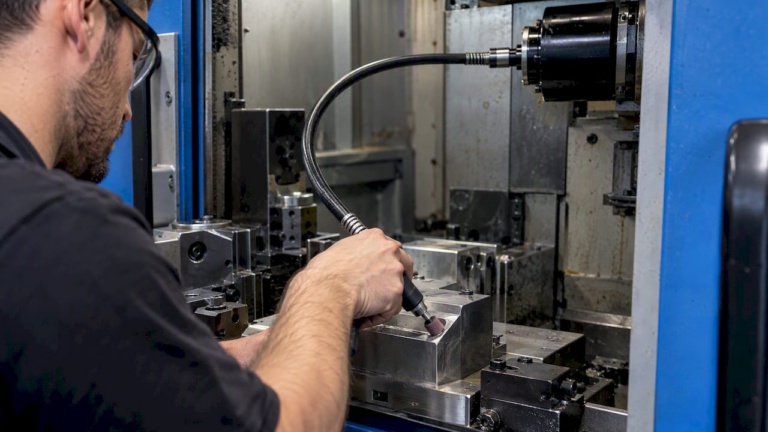
| Deburring and grinding tools | Rotary power delivery to handheld or fixed tools | Automotive, general manufacturing |
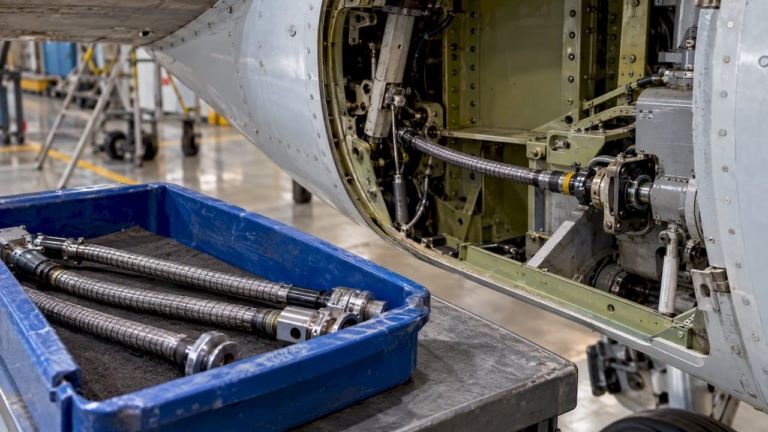
| Valve actuation | Torque transmission to remote or hard-to-reach valves | Process engineering, energy |
| Wind turbine pitch control | Reliable actuation in constrained nacelle spaces | Renewable energy |
| Coolant and cable routing | Internal conduit via hollow shaft cores | Precision machining |
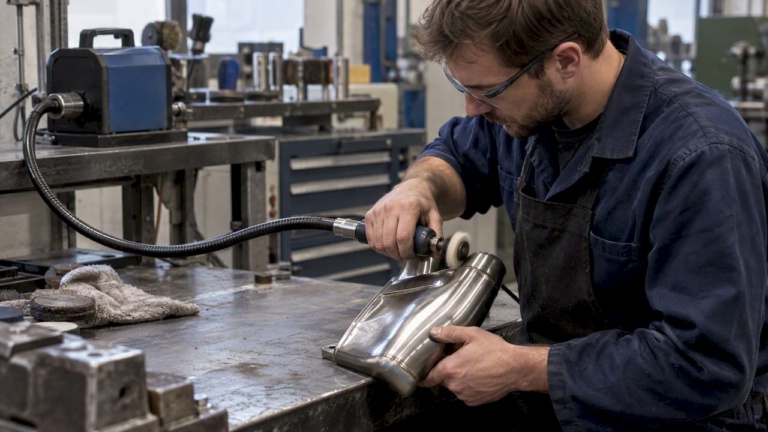
| Polishing and finishing | Vibration-damped rotary drive | Aerospace, medical devices |
Real-world deployment priorities in 2026 follow a clear pattern:
- Compact power transmission: Machine builders are reducing footprints without sacrificing output. Flexible shafts route drive power around structural members that rigid systems cannot navigate.
- Vibration isolation: In precision finishing for aerospace components, vibration transmitted through the drivetrain directly affects surface quality. Flexible shafts reduce this transmission.
- Smart monitoring integration: Sensor-equipped shafts or sheath assemblies allow condition monitoring without stopping production. This aligns directly with Industry 4.0 requirements.
- Sustainable material specification: Engineers are increasingly specifying corrosion-resistant or recyclable shaft materials to meet environmental targets without compromising performance.
Pro Tip: In automotive body-in-white finishing lines, replacing rigid angle drives with flexible shaft assemblies has reduced tooling changeover time by eliminating alignment adjustments between shifts.
BIAX, as an ISO-certified German manufacturer, supports engineers across these sectors with application-specific core configurations and custom protective sheath designs. Exploring industrial shaft applications and understanding maintenance roles in 2026 provides further context for sector-specific decisions.
Selecting and integrating flexible shafts: Decision frameworks for 2026
Having explored applications, the next step is selecting and successfully implementing the right flexible shaft solution for your needs.
Specification accuracy is the foundation of a successful integration. The critical parameters to define before any supplier conversation are:
- Torque requirement: Specify peak torque, not average. Shafts sized only for average load will fatigue prematurely under transient spikes.
- Operating speed: Define both nominal and maximum RPM. High-speed cores require tighter bend radius control.
- Minimum bend radius: Measure the actual routing path in your machine. Do not estimate.
- Operating temperature: Account for ambient heat, friction-generated heat, and any thermal cycling in the process environment.
- Environmental exposure: Identify chemicals, moisture, or particulates the shaft will encounter. This drives sheath and core material selection.
For DACH engineers, ISO-certified, application-specific cores and 2026 trends that prioritize smart integration and sustainable materials define best-practice sourcing. When evaluating suppliers, confirm ISO 9001 certification, ask for documented test data at your operating conditions, and verify that custom configurations are supported, not just catalog items.
Specifying a flexible shaft is not a catalog exercise. The interaction between bend radius, speed, torque, and environment requires engineering input, not just part number selection.
Pro Tip: Request a sample shaft assembly routed through a mockup of your actual machine geometry before committing to a production order. This single step eliminates the majority of integration failures.
Common integration pitfalls include under-specifying the protective sheath, ignoring the effect of shaft rotation direction on wound-wire tightening or loosening, and failing to account for thermal expansion in the sheath length. Each of these is avoidable with proper pre-integration review.
For engineers pursuing engineering custom solutions or aiming for longer shaft life, early supplier engagement during the design phase produces significantly better outcomes than specifying at the procurement stage.
Our take: Why flexible shaft adoption is accelerating and what most miss
Adoption of flexible shafts in precision manufacturing is growing, but not uniformly. The engineers who move fastest are those who recognize that flexible shafts are not a workaround for difficult geometries. They are a primary design tool.
The most common blind spot is treating flexible shafts as a retrofit option rather than a first-choice drivetrain element. This delays their adoption until a rigid system has already created problems, at which point integration is more complex and costly than it needed to be.
Smart manufacturers are embedding condition monitoring into shaft assemblies to detect wear before it causes downtime. This is not a future capability. It is available now and directly supports risk reduction in high-value production lines.
The true cost argument for flexible shafts is rarely made correctly. Most engineers calculate only component cost. The real savings come from improved access during maintenance, reduced machine downtime, and extended service intervals. Reviewing maintenance tools for 2026 reveals that lifecycle cost, not unit price, is the metric that justifies adoption at scale.
Explore next steps for your manufacturing process
If you’re ready to apply these insights or need tailored solutions, here’s where to go next.
BIAX Flexwellen supports machine builders and industrial manufacturers across the DACH region with engineering guidance, standard components, and fully custom shaft configurations. Whether you need a catalog solution or a core designed to your exact torque, speed, and bend radius requirements, the team at Schmid & Wezel GmbH provides direct technical support. Explore advanced industrial applications to see how flexible shafts perform across sectors, review resources on improving design efficiency, or contact the engineering team directly to discuss custom design solutions for your specific process requirements.

Frequently asked questions
What materials are used in manufacturing flexible shafts?
High-tensile steel, advanced alloys, and composites are the primary materials, selected based on the required balance of tensile strength, fatigue resistance, and environmental compatibility.
What is the maximum operating speed of modern flexible shafts?
High-speed cores operate at up to 50,000 RPM, though achievable speed depends on the bend radius in the actual installation and the specific core design selected.
How do flexible shafts contribute to Industry 4.0 manufacturing?
Flexible shafts support smart monitoring through sensor-compatible assemblies and enable compact, reconfigurable machine layouts that align with automated and data-driven production environments.
What certifications should I look for when sourcing flexible shafts?
ISO 9001 certification and documented experience in application-specific core customization are the baseline requirements for any supplier serving precision manufacturing applications.
Recommended
- Flexible shaft applications for industrial manufacturing
- How flexible shafts improve access for precision finishing
- Flexible Shafts for Tight Spaces: Boosting Precision
- Flexible Shafts in Automation: Precision in Tight Spaces – BIAX Flexwellen
Related Topics
Send your spec inquiry
Custom flexible shafts for your application — we quote within 1 working day.