Custom flexible shaft design explained: engineer better solutions
3 April 2026TL;DR:
- Custom flexible shafts are essential for high-precision, space-constrained, or harsh environment applications.
- Proper specification involves selecting the right core type, materials, and parameters like bend radius and duty cycle.
- Collaboration with manufacturers and thorough validation reduce field failures and improve shaft reliability.
Standard flexible shafts work well until they don’t. When your application demands tight routing, precise torque delivery, or operation in a contaminated environment, off-the-shelf solutions frequently fall short. The reality is that flexible shaft design involves a layered set of engineering decisions: core type, material, bend radius, protective sheath, and duty cycle all interact to determine real-world performance. This guide breaks down each decision point clearly, giving design engineers and R&D teams the technical grounding needed to specify custom flexible shafts that perform reliably in compact, high-precision industrial manufacturing environments.
Table of Contents
- What is a flexible shaft and why customize?
- Core types and materials: How to choose the right configuration
- Design parameters: Balancing flexibility, strength, and precision
- Application tips: Specifying and ordering custom shafts for industry
- A smarter path to custom flexible shaft design: What experts get wrong
- Get tailored flexible shaft solutions for your next project
- Frequently asked questions
Key Takeaways
| Point | Details |
|---|---|
| Custom design is critical | Off-the-shelf shafts rarely fit unique space, speed, and environment needs in advanced applications. |
| Core choice impacts performance | Selecting the right core type and material determines torque transmission, speed, and longevity. |
| Balance flexibility and power | The best shaft design meets both compact installation and precision power requirements. |
| Consult early and specify clearly | Supplying duty cycle, environment, and precise specs upfront prevents premature failure. |
What is a flexible shaft and why customize?
A flexible shaft transmits rotary motion and torque along a non-linear path. That simple function enables power delivery in spaces where rigid shafts cannot reach. Understanding the internal structure clarifies why customization is often not optional but necessary.
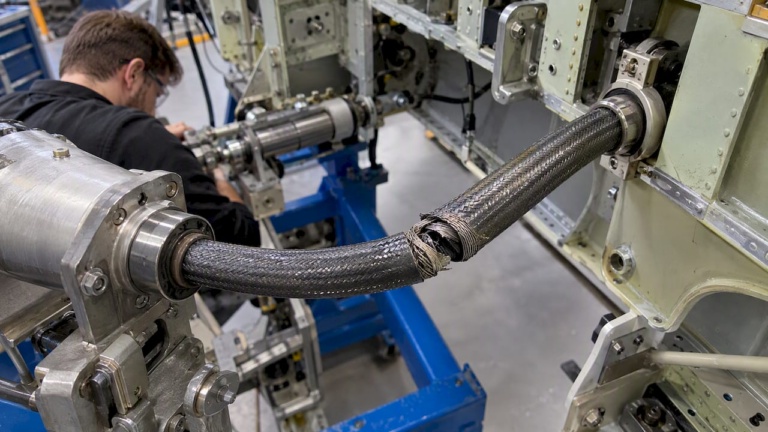
Flexible shafts consist of a coiled wire core wrapped in successive layers that provide torque transmission while allowing controlled bending. The core carries the mechanical load. The layered wrap adds torsional stiffness, directional control, and protection. Around this assembly, a protective sheath or housing resists dust, moisture, and contaminants, which is critical in industrial environments where grinding debris or coolant spray is present.
Off-the-shelf shafts are designed for average conditions. They assume a standard bend radius, a typical RPM range, and a clean operating environment. Most real applications deviate from these assumptions in at least one significant way. Consider the following scenarios where customization becomes essential:
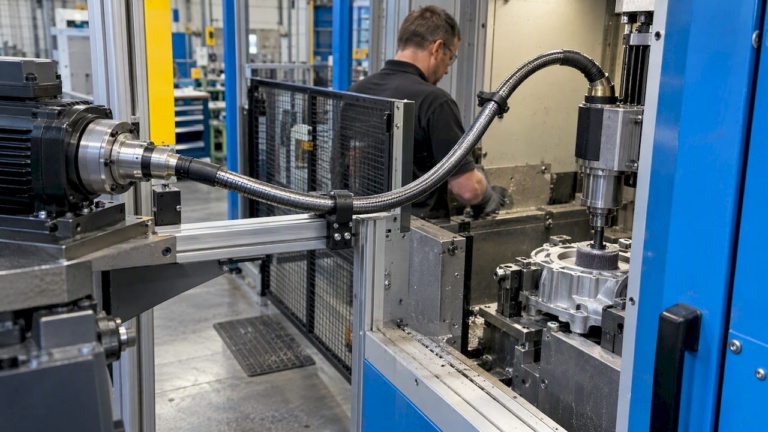
- Space-constrained installations: Robotic end-effectors, medical hand tools, and inline finishing stations often require routing through extremely tight geometries.
- High-precision torque delivery: Grinding and deburring processes in aerospace or automotive component manufacturing require consistent, repeatable torque without slippage or backlash.
- Non-standard RPM profiles: Some applications cycle between idle and full speed repeatedly; others run at sustained high RPM for extended periods.
- Harsh or regulated environments: Food processing, medical device manufacturing, and chemical exposure scenarios demand specific materials and sheath types.
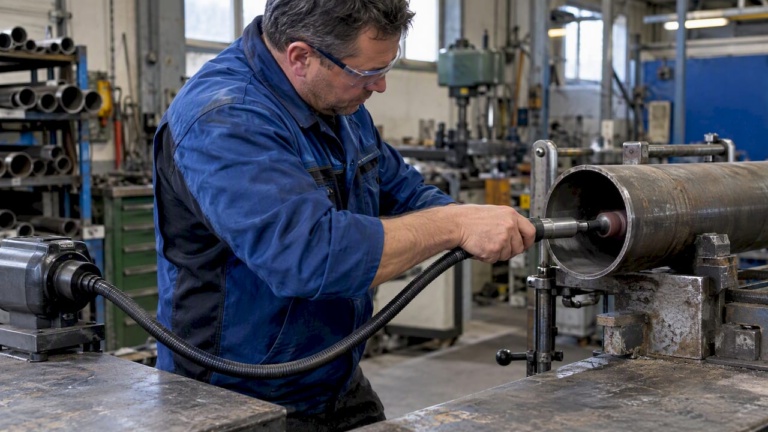
Broad flexible shaft applications in industrial manufacturing span deburring, polishing, grinding, cleaning, and precision machining. Each of these processes places different demands on the shaft. A deburring tool running at 20,000 RPM in a metal dust environment needs a fundamentally different configuration than a low-speed torque-intensive actuator in a sealed assembly cell.
Customization is not about preference. It is about matching shaft performance to the actual mechanical and environmental demands of the application.
When engineers treat flexible shafts as generic components, they accept unnecessary risk. Premature wear, torsional instability, and unexpected failure during production runs are the predictable outcomes of under-specified designs.
Core types and materials: How to choose the right configuration
Selecting the right core type is the most consequential decision in flexible shaft design. Each core architecture makes a specific trade-off between torque capacity, speed capability, and minimum bend radius.
| Core type | Max RPM | Torque capacity | Min bend radius | Typical use case |
|---|---|---|---|---|
| Low torsion | Low | High | Large | Heavy-duty actuation, slow drives |
| Universal | Medium | Medium | Small | General finishing, compact routing |
| High speed | Up to 50,000 RPM | Lower | Very small | Precision grinding, medical tools |
| Stainless | Variable | Variable | Variable | Medical, food, corrosive environments |
| Hollow/helix | Variable | Variable | Variable | Cable or fluid routing through shaft |
Core types include Low Torsion for high torque at low speed, Universal for medium RPM with small bend radii, High Speed cores reaching up to 50,000 RPM, Stainless variants for medical and food applications, and Hollow or Helix cores for routing cables or conduits through the shaft body.
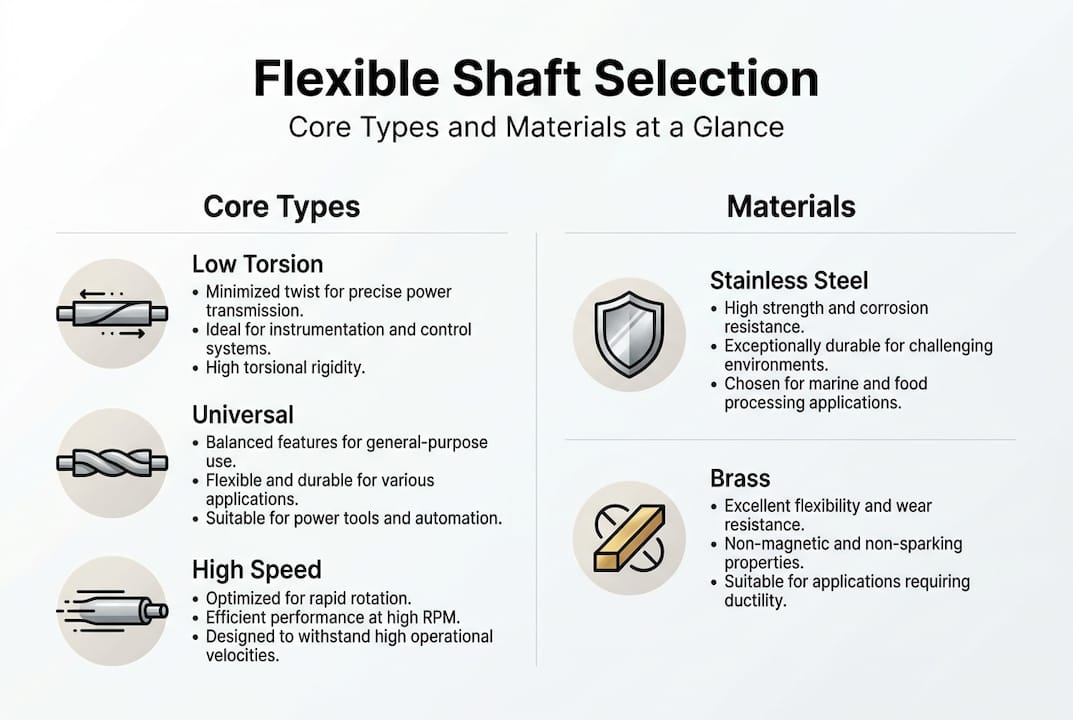
Material selection follows directly from the operating environment. Stainless steel cores resist corrosion and withstand aggressive cleaning agents, making them the correct choice for regulated industries. Standard carbon steel cores offer higher strength-to-cost ratios for dry industrial environments. Hollow cores serve dual purposes: they transmit rotation while allowing a secondary element, such as a wire or fluid line, to pass through the center.

What many engineers miss is the interaction between core type and operational profile. A high-speed core selected for its small bend radius will underperform if the application also demands high torque. Intermittent operation requires duty cycle specification, and harsh environments need stainless cores or protective hoses. Skipping these details during specification leads to cores that overheat, fatigue prematurely, or fail to deliver consistent output.
Key material and configuration considerations:
- Match core type to the primary constraint: bend radius, torque, or speed, not all three simultaneously.
- Specify stainless when cleaning cycles involve water, steam, or chemical agents.
- Use hollow cores only when the secondary routing function is confirmed and the reduced torsional stiffness is acceptable.
- Confirm the flexible shaft configuration guide parameters before finalizing core selection.
For applications in shafts for tight spaces, Universal and High Speed cores are the most frequently specified because they combine small bend radii with acceptable torque for finishing operations.
Pro Tip: Always specify the required duty cycle and environmental hazards in writing before requesting a custom configuration. Vague inputs produce generic outputs that may not survive real operating conditions.
Design parameters: Balancing flexibility, strength, and precision
Engineering a reliable custom flexible shaft requires defining five core parameters before any design work begins. Each parameter interacts with the others, and changing one forces a re-evaluation of the rest.
The five essential parameters:
- Bend radius: The minimum radius the shaft must navigate in the installed configuration. This directly determines which core types are viable.
- Torque load: The maximum and continuous torque the shaft must transmit. Expressed in Newton-meters, this sets the lower bound for core strength.
- RPM range: Both minimum and maximum operating speeds. High-speed cores handle up to 50,000 RPM but sacrifice torque capacity.
- Shaft length: Longer shafts experience greater torsional wind-up under load, which affects precision and response time.
- Sheath type and environment: Determines the protective housing material, sealing requirements, and maintenance interval.
The following comparison illustrates how design priorities shift across application types:
| Application | Priority | Core choice | Sheath requirement |
|---|---|---|---|
| Precision medical tool | Small bend radius, high speed | High speed or Universal | Stainless, cleanable |
| Automotive deburring | High torque, moderate speed | Low torsion or Universal | Standard industrial |
| Aerospace actuator | Reliability, low backlash | Universal | Sealed, dust-resistant |
| Food processing drive | Corrosion resistance | Stainless | Washdown-rated |
For high-precision compact manufacturing, prioritize universal or high-speed cores with small bend radii to balance flexibility and stability in precision power transmission. High speed cores support 50,000 RPM while low torsion cores serve high torque at low speed; use manufacturer calculators for exact capacity values.
A structured specification process reduces errors and revision cycles:
- Define power requirements: torque and RPM at the output.
- Calculate the minimum bend radius from the actual installation geometry.
- Select the core type that satisfies both constraints.
- Choose the sheath material based on the operating environment.
- Detail the duty cycle: continuous, intermittent, or cyclic with specific on/off ratios.
- Validate the full configuration with the manufacturer’s engineering team before ordering.
For guidance on compact drive guide solutions and shaft selection for precision machinery, published technical resources reduce the time needed to reach a validated configuration.
Pro Tip: For precision applications, err toward a smaller bend radius core with higher flex stability rather than maximizing torque capacity. Torsional consistency matters more than peak torque in most finishing and machining processes.
Application tips: Specifying and ordering custom shafts for industry
Even a well-designed shaft fails to deliver if the specification communicated to the manufacturer is incomplete. The quality of the output is directly proportional to the quality of the input.
Minimum specification checklist for custom orders:
- Overall shaft length and routing path geometry
- Minimum bend radius in the installed position
- Required torque at the output end (continuous and peak)
- Operating speed range (minimum, maximum, and typical)
- Duty cycle: continuous, intermittent, or defined on/off ratio
- Operating environment: temperature range, exposure to dust, moisture, or chemicals
- Coupling interface specifications at both ends
- Required service life or maintenance interval
- Any regulatory or industry standards that apply (medical, food, aerospace)
Flexible shafts suit compact high-precision applications including medical devices, tools, aerospace, and automotive, transmitting power around obstacles with low maintenance requirements. This versatility means the same product family can serve radically different applications, but only when specified correctly.
A statistic worth noting: high-speed flexible shaft cores can operate at up to 50,000 RPM, enabling their use in precision grinding and high-frequency finishing tools where conventional drive systems cannot reach.
Common specification mistakes that cause field failures:
- Under-specifying the duty cycle, leading to thermal overload in continuous operation
- Ignoring cleaning and maintenance access requirements, which can force shaft removal during routine servicing
- Failing to account for dynamic load changes during machine startup or process transitions
- Selecting a core based on catalog peak values rather than sustained operating conditions
Describing the actual application context to your supplier matters. A specification that reads “high-speed, continuous operation in a dust-prone medical tool assembly” triggers a fundamentally different design response than “low-speed, intermittent actuation in a clean room.” Precision in language translates directly to precision in design.
For installations where space is the primary constraint, resources on design for tight spaces and improving design efficiency provide application-specific guidance for engineering teams.
A smarter path to custom flexible shaft design: What experts get wrong
Most published guidance on flexible shaft design focuses on the technical parameters: RPM, torque, bend radius, material. That coverage is necessary but not sufficient. The gap between a correct specification and a reliable production shaft lies in the variables that don’t appear on a data sheet.
Real-world performance depends on how the shaft is installed, how the machine cycles over a full shift, and how maintenance teams interact with the assembly. A shaft that performs flawlessly during a 30-minute validation test may degrade within weeks once it encounters the actual duty cycle, vibration harmonics, or cleaning procedures of a live production line.
Experienced engineering teams test prototypes across full duty cycles before committing to production quantities. They also consult maintenance personnel early, because the people who service equipment identify failure modes that designers never anticipate. This cross-disciplinary input consistently produces more durable designs.
The uncomfortable truth is that the most reliable custom shaft solutions are rarely the result of a single, optimized specification. They come from iteration, supplier collaboration, and willingness to revise based on prototype data. Reviewing practical drive solutions from comparable applications shortens this iteration cycle significantly.
Speed to specification is not the same as speed to reliable performance. Teams that invest in the front-end validation process recover that time many times over in reduced field failures and extended service life.
Get tailored flexible shaft solutions for your next project
BIAX Flexwellen (Schmid & Wezel GmbH) supports design engineers and R&D teams with technical expertise, standard components, and fully custom shaft configurations. Whether your application requires a specific torque-to-speed ratio, a non-standard coupling interface, or a sheath rated for washdown environments, the engineering team at BIAX can configure a solution matched to your exact requirements. Access the configuration guide to define your parameters, explore how flexible shafts improve design efficiency in compact machine builds, and review available drive solutions for industrial finishing and machining processes. Submit a technical inquiry to start a direct conversation with BIAX engineers.
Frequently asked questions
What is the minimum bend radius for custom flexible shafts?
The minimum bend radius depends on the core type. Universal and high-speed cores are designed for tight spaces and can achieve very small bend radii, often just a few centimeters, making them suitable for compact routing geometries.
How do I specify environmental requirements for a flexible shaft design?
Document all exposure factors: dust levels, moisture, temperature range, and any cleaning chemicals used. Harsh environments require stainless cores or protective hoses to prevent corrosion and premature wear.
What speed and torque ranges can custom flexible shafts support?
High-speed cores reach up to 50,000 RPM for precision applications, while low torsion cores deliver high torque at low speed. Exact capacity values depend on the specific configuration and should be confirmed with the manufacturer.
Can flexible shafts be used for intermittent versus continuous operation?
Yes, but both modes require different design approaches. Intermittent operation requires duty cycle specification to ensure the correct core and material selection for thermal management and fatigue resistance.
Recommended
- Flexible shaft guide: Engineering compact drive solutions
- Flexible shaft design for tight-space finishing applications
- How flexible shafts improve machine design efficiency
- How to implement flexible shaft drive solutions (2026)
Related Topics
Send your spec inquiry
Custom flexible shafts for your application — we quote within 1 working day.