Flexible Shafts in Automation: Precision in Tight Spaces
23 February 2026Tight machinery layouts in advanced automation often force engineers to make tough choices between performance and space. In industries like aerospace or high-precision manufacturing, getting reliable torque transmission through crowded assemblies in Germany, Austria, or Switzerland means rigid shafts quickly reach their limits. Flexible shafts offer a combination of torsional stiffness and bending capability, solving space constraints without sacrificing precision. This guide explores the fundamental principles, design options, and practical integration tips for flexible shaft solutions that support exacting finishing processes.
Table of Contents
- Defining Flexible Shafts And Core Concepts
- Key Types And Construction Distinctions
- Torque Transmission In Confined Automation Setups
- Flexible Shafts Vs. Rigid Alternatives: Performance Factors
- Common Pitfalls And Integration Best Practices
Key Takeaways
| Point | Details |
|---|---|
| Flexible Shafts Enable Power Transmission | They transmit rotary motion and torque through curved paths, ideal for confined spaces where rigid shafts cannot function. |
| Core Design Considerations | Understanding torque capacity, bend radius, and environmental factors is crucial for selecting the right flexible shaft for your application. |
| Performance Benefits Over Rigid Alternatives | Flexible shafts offer higher efficiency and better vibration dampening, allowing for more compact machinery designs and installation flexibility. |
| Installation and Maintenance Practices | Proper specification of torque and bend radius limits, along with regular lubrication, ensures longevity and reliable performance of flexible shafts. |
Defining Flexible Shafts and Core Concepts
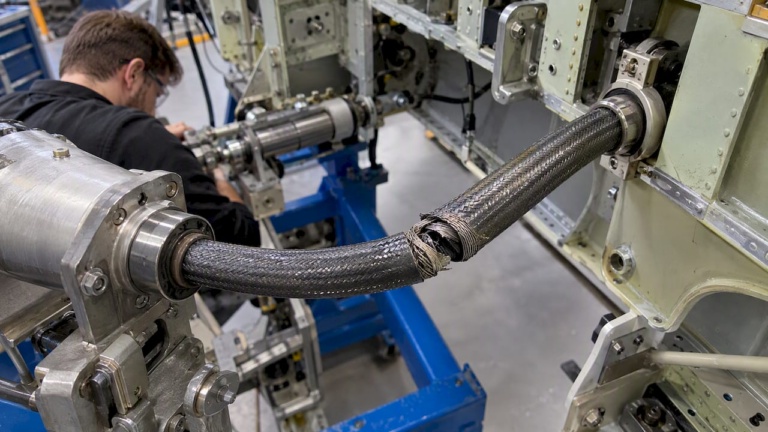
A flexible shaft is a mechanical component designed to transmit rotary motion and torque along curved or adjustable paths where rigid shafts simply cannot fit. Think of tight engine compartments, confined machinery housings, or aerospace installations where every millimeter counts.
These shafts consist of wire layers wound concentrically to create a structure that flexes while maintaining torsional stiffness. The resulting design enables reliable power transmission through bends, angles, and confined spaces without compromising rotational accuracy.
How Flexible Shafts Work
The core principle is straightforward: multiple wire coils wrapped around a central axis create both flexibility and torque-carrying capacity. This dual functionality distinguishes flexible shafts from rigid alternatives.
Key operating characteristics:
- Transmit rotation along curved axes with minimal friction loss
- Accommodate angular misalignment between drive and driven components
- Isolate vibration and dampen shock loads effectively
- Adapt to spatial constraints in confined installation environments
- Maintain consistent torque delivery across the shaft length
A flexible shaft enables power transmission where mechanical space is the limiting factor, not performance requirements.
Core Design Elements
The fundamental structure includes three main components:
- Inner core – steel wire rope or coil forming the main torque path
- Protective sheath – typically a metal or composite outer layer defending against contamination and mechanical damage
- Flexible coupling interfaces – connection points designed to match your motor and driven equipment
This construction allows rotary motion transmission between objects that are not fixed relative to one another, making flexible shafts invaluable for applications requiring articulation or movement.
Aerospace and Industrial Applications
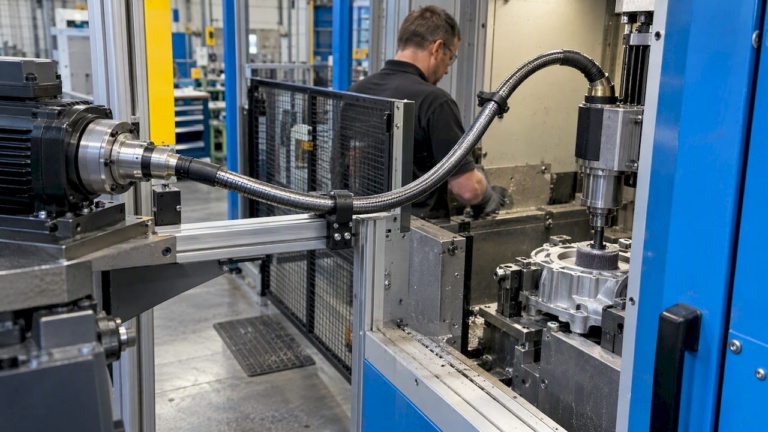
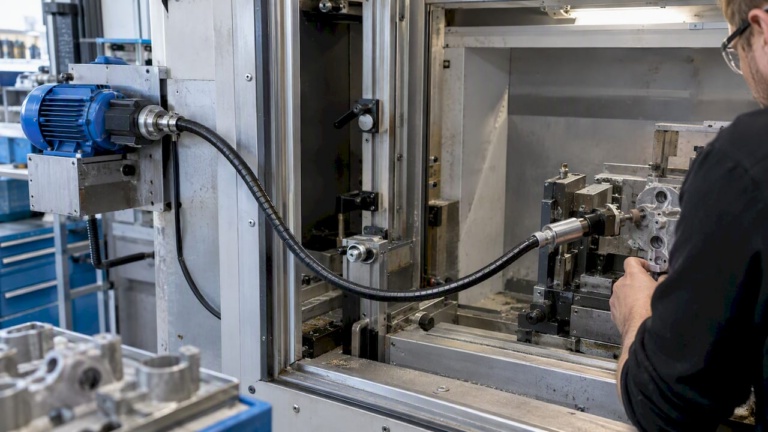
Flexible shafts thrive in demanding aerospace environments. Thrust reverser actuation systems, flap and slat mechanisms, valve override systems, and synchronization shafts all benefit from flexible shaft reliability. In industrial automation, precision finishing processes such as deburring, grinding, and polishing require the torque transmission and compact geometry that flexible shafts provide.
The confined spaces in aircraft fuselages, helicopter transmissions, and integrated fuel systems demand solutions that rigid power transmission cannot deliver. This is where flexible shafts become essential.
Pro tip: When evaluating flexible shafts for your application, verify that the specified torque capacity accounts for your actual operating conditions—continuous duty, intermittent cycles, and shock loads all influence shaft selection and longevity.
Key Types and Construction Distinctions
Flexible shafts come in distinct types, each engineered for specific rotational demands. Understanding these differences helps you select the right solution for your machinery constraints and performance requirements.
The primary distinction centers on rotational capability. Unidirectional shafts rotate in only one direction, while bidirectional shafts handle rotation in both directions. This fundamental difference affects internal wire arrangement and overall mechanical design.
Construction and Wire Configuration
Multiple layers of high-tensile wire wound at opposing angles form the backbone of flexible shaft construction. This criss-cross pattern creates torsional stiffness while preserving the flexibility needed for curved installations.
How the winding pattern works:
- Wire layers wrap at opposing angles around the central core
- This opposing geometry prevents the shaft from twisting excessively under load
- Each layer adds both structural support and rotational resistance
- The cumulative effect creates a shaft that bends smoothly yet transmits torque reliably
Unidirectional shafts use asymmetrical winding optimized for one rotation direction. Bidirectional shafts employ balanced winding patterns that perform equally in both directions.
Here’s a summary of flexible shaft types and their typical applications:
| Shaft Type | Rotational Capability | Typical Application | Key Advantage |
|---|---|---|---|
| Unidirectional | One direction only | Power tools, motor drives | Enhanced torque optimization |
| Bidirectional | Both directions | Aerospace actuators, industrial finishing | Balanced performance and reliability |
| Custom-configured | Variable | High-temp or vibration environments | Tailored for specialty needs |
Material Variations and Protective Options
Construction specifications extend beyond wire arrangement. Modern flexible shafts incorporate specialized materials and protective systems to handle harsh operating environments.
Common variations include:
- Corrosion-resistant materials – stainless steel wire for aerospace and marine applications
- Protective casings – metal or composite sheaths defending against contamination, moisture, and abrasion
- Specialized cores – tailored for high-temperature applications or extreme vibration environments
- Custom coupling interfaces – designed to match your specific motor and driven equipment connections
Shaft selection depends on torque capacity, bend radius, length, speed requirements, and environmental exposure—not just rotational direction.
Performance Specifications
Your application determines critical design parameters. Aerospace thrust reverser systems demand different specifications than industrial finishing equipment. Confined installation environments require careful attention to bend radius limitations.
Key specifications to evaluate:
- Torque capacity (continuous and intermittent ratings)
- Minimum bend radius under operating conditions
- Maximum operating speed and RPM range
- Environmental resistance requirements
- Length and coupling interface compatibility
Design engineers in Germany, Austria, and Switzerland working on precision automation frequently customize flexible shafts to match unique machinery geometries and performance demands.
Pro tip: Specify both the minimum bend radius your installation requires and the torque profile under actual operating conditions—this ensures your flexible shaft won’t fail prematurely or unnecessarily restrict your machinery design.
Torque Transmission in Confined Automation Setups
Space constraints define modern automation. When machinery components pack tightly around each other, traditional rigid power transmission fails. Flexible shafts solve this by delivering consistent torque through three-dimensional paths that rigid systems cannot navigate.

In confined setups, the challenge extends beyond just bending. Your shaft must twist, curve, and flex while maintaining precise rotational control without energy loss or vibration introduction.
How Flexible Shafts Enable Series Elastic Actuation
Flexible shafts function as torsionally compliant components that facilitate series elastic actuation around obstacles. This means they absorb minor torque variations while reliably transmitting motion through complex machinery layouts.
This torsional compliance provides real benefits:
- Absorbs shock loads from sudden acceleration or deceleration
- Reduces vibration transmission to precision equipment nearby
- Allows motor placement distant from driven components
- Enables routing around fixed machinery obstacles
- Maintains rotational accuracy despite spatial routing challenges
The flexible shaft essentially becomes an intelligent connector between your power source and your automation endpoint.
Three-Dimensional Torque Path Control
Confined automation setups rarely follow straight lines. Your shaft might twist 90 degrees, bend vertically, then angle horizontally again. Flexible shafts transmit torque effectively through these complex three-dimensional paths without losing precision.

Consider aerospace flap actuation systems. The actuator motor sits in a confined wing cavity. Power must reach the flap mechanism through a tortuous path that a rigid shaft cannot possibly follow. A flexible shaft makes this routing feasible while maintaining synchronization accuracy.
Industrial finishing equipment faces similar constraints. Grinders and polishers need precise torque delivery in tight machine housings where component density leaves minimal clearance.
Flexible shafts excel precisely where space-saving design meets precision performance requirements.
Practical Performance in Automation
Your machinery gains efficiency advantages when flexible shafts enable optimal component positioning. Motor placement no longer must align with driven component location. This freedom simplifies machine design and reduces overall footprint.
Effective power delivery requires attention to several factors:
- Torque demand during normal operation and peak loads
- Rotational speed consistency needed for your process
- Routing complexity and total bend angles involved
- Environmental conditions surrounding the installation
- Maintenance accessibility for inspection and replacement
Design engineers working on compact automation solutions in the DACH region know that selecting the correct flexible shaft specification prevents costly redesigns later.
Pro tip: Map your actual power routing path in three dimensions, measure total bend angles and minimum radius points, then specify a flexible shaft with a minimum bend radius 20 percent larger than your tightest curve to ensure reliable long-term performance.
Flexible Shafts vs. Rigid Alternatives: Performance Factors
When designing compact automation systems, the power transmission choice fundamentally shapes your machine. Flexible shafts and rigid alternatives each bring distinct advantages and limitations. Understanding these performance differences guides better engineering decisions.
Rigid systems include solid shafts, universal joints, and gear-based transmission. Each handles straight-line power transfer effectively but struggles with spatial constraints and alignment precision.
Efficiency and Power Loss Comparison
Flexible shafts deliver 85 to 95 percent efficiency while maintaining high torsional stiffness with flexibility. Rigid alternatives often suffer greater frictional losses, particularly in universal joints and multi-gear arrangements.
This efficiency difference matters practically:
- 10 percent energy loss in rigid systems becomes waste heat and reduced output
- Flexible shafts minimize vibration transmission compared to universal joints
- Solid shafts require perfect alignment; flexible shafts tolerate minor misalignment
- Gear systems introduce backlash affecting precision finishing processes
- Flexible shafts enable 180-degree offsets without additional couplings
For precision finishing applications like deburring and polishing, this efficiency translates directly to consistent tool pressure and surface quality.
Design Freedom and Installation Complexity
Rigid transmission systems demand precise component alignment. This constraint forces machinery designers into inefficient layouts that waste valuable space. Flexible shafts eliminate this requirement entirely.
Flexible shaft advantages include:
- Motor placement no longer constrained by driven component position
- Routing capability around fixed obstacles and other machinery
- Installation flexibility that reduces machining and assembly time
- Lower overall system weight improving machinery efficiency
- Reduced foundation requirements for vibration isolation
Flexible shafts solve spatial design challenges that rigid alternatives cannot address, unlocking more compact machine configurations.
Weight and System Cost Reduction
Rigid systems require substantial support structures, alignment fixtures, and protective guards. Flexible shafts eliminate much of this infrastructure, reducing material costs and assembly complexity.
Consider aerospace applications. Thrust reverser and flap actuation systems benefit from flexible shaft efficiency and lightweight design. Every kilogram matters in aircraft weight budgets.
Industrial machinery in the DACH region benefits from simplified installation. Engineers reduce development timelines and manufacturing costs by eliminating alignment procedures and complex coupling arrangements.
Performance comparison for confined setups:
Below is a comparison of flexible shafts versus rigid alternatives for confined automation setups:
| Attribute | Flexible Shaft | Rigid Alternative |
|---|---|---|
| Space Efficiency | Fits curved, tight spaces | Requires straight alignment |
| Misalignment Tolerance | High | Low |
| Vibration Dampening | Superior | Minimal |
| Installation Complexity | Simple routing | Complex alignment |
- Torsional stiffness – Flexible shafts maintain precision; rigid joints offer minimal compliance
- Space requirements – Flexible shafts reduce footprint significantly
- Maintenance needs – Fewer components mean lower service costs
- Vibration control – Flexible shafts isolate better than rigid alternatives
- Initial investment – Flexible shafts cost less for complex routing
Pro tip: When comparing transmission options, calculate total system cost including motor positioning flexibility, alignment hardware, and installation labor—flexible shafts frequently prove most economical for non-linear power paths.
Common Pitfalls and Integration Best Practices
Flexible shaft failures rarely happen without warning. Most problems stem from specification mismatches or installation oversights that could have been prevented with proper planning. Understanding common pitfalls protects your machinery and avoids costly downtime.
Premature wear and sudden failure typically trace back to exceeding design limits. Your shaft cannot perform magic—respecting its physical constraints ensures reliability.
Exceeding Torque and Bend Radius Limits
Common integration pitfalls include torque overload and bend radius violations, both leading to accelerated wear or catastrophic failure. Undersizing a shaft to save money creates a false economy that ends in replacement costs and production delays.
These critical specification failures occur when:
- Torque requirements are estimated rather than measured under actual operating conditions
- Peak loads during startup or emergency stops exceed shaft rating
- Bend radius constraints ignored due to routing convenience
- Shaft length selected without accounting for flexibility loss over distance
- Operating speed exceeds manufacturer specifications
You cannot exceed design limits without consequences. Compliance with specifications determines shaft lifespan directly.
Specification Assessment and Environmental Protection
Careful application assessment prevents integration failures before they happen. Document your actual power requirements, routing constraints, and environmental exposure realistically.
Best practice assessment includes:
- Measure continuous torque demand plus peak transient loads
- Verify actual minimum bend radius in your installation path
- Account for environmental exposure—moisture, contamination, temperature extremes
- Specify shaft length with realistic tolerance allowances
- Confirm coupling interfaces match your motor and driven equipment
Harsh industrial environments demand protective casings. Metal or composite sheaths defend against moisture, abrasion, and chemical exposure that would otherwise degrade wire and reduce efficiency.
Proper installation, adequate protection, and regular lubrication form the foundation of flexible shaft durability and reliable performance.
Power Transmission Escalation and Maintenance
Some applications demand torque transmission beyond standard flexible shaft capacity. Gearbox integration steps up power delivery when necessary without oversizing the shaft itself.
This practical approach:
- Maintains compact flexible shaft diameter for tight routing
- Increases available torque through gear reduction
- Allows motor speed optimization for efficiency
- Provides additional rotational flexibility
Lubrication determines shaft longevity significantly. Proper greasing of internal components reduces friction and extends service life substantially. Neglected lubrication accelerates wear exponentially.
Design engineers in Germany, Austria, and Switzerland should establish preventive maintenance schedules that include periodic lubrication and visual inspection for wear signs.
Pro tip: Before finalizing specifications, run a complete load analysis under actual operating conditions—measure torque peaks during startup and transient events, then select a shaft rated for 25 percent above your measured maximum to ensure service life margin and reliability.
Master Torque Transmission in Tight Spaces with BIAX Flexible Shafts
The challenge of transmitting precise torque and rotation through confined and complex paths is clear from the article. Flexible shafts must navigate tight bend radii, absorb shock loads, and maintain consistent performance amid spatial constraints—an essential capability for applications like deburring, polishing, and aerospace actuation. If you are facing issues around bend radius limits, torque capacity matching, or installation complexity, these are common pain points that can lead to premature failure or inefficient operation.
At BIAX Flexwellen, we specialize in engineered flexible shaft solutions tailored precisely to your operational needs. With deep expertise in custom configurations including torque and RPM requirements plus coupling interfaces, our shafts excel where tight spaces and precision cannot be compromised. Benefit from expert guidance and reliable products designed for demanding industrial and automation environments. Explore how our flexible shafts solve your unique challenges by contacting our team today at Contact BIAX Flexwellen. Ensure your automation achieves precision and reliability now without costly delays.
Frequently Asked Questions
What are flexible shafts and how do they work?
Flexible shafts are mechanical components designed to transmit rotary motion and torque along curved paths, allowing reliable power transmission even in confined spaces. They consist of multiple wire layers wound around a central axis, providing both flexibility and torsional stiffness.
What types of applications benefit from flexible shafts?
Flexible shafts are ideal for aerospace applications, such as thrust reverser actuation systems and flap mechanisms, as well as industrial automation processes, including grinding and polishing, where space constraints and precision performance are required.
How do I determine the right flexible shaft for my application?
When selecting a flexible shaft, consider factors such as torque capacity, minimum bend radius, operational speed, environmental exposure, and coupling interface compatibility to ensure optimal performance and longevity.
What are the advantages of flexible shafts over rigid alternatives?
Flexible shafts provide several advantages, including the ability to fit into tight spaces, accommodate misalignment, deliver consistent torque, minimize vibration transmission, and reduce overall system weight and complexity compared to rigid alternatives.
Recommended
- Die 7 besten flexiblen Wellen 2026 für industrielle Anwendungen – BIAX Flexwellen
- 7 Vorteile flexibler Antriebswellen für beengte Räume – BIAX Flexwellen
- Step by Step Shaft Design for Precision Applications
- Flexible Shaft Maintenance Process for Peak Performance
Related Topics
Send your spec inquiry
Custom flexible shafts for your application — we quote within 1 working day.