Flexible shaft applications for industrial manufacturing
25 March 2026Flexible shafts are transforming industrial manufacturing with a forecasted 10.8% CAGR through 2033, yet many engineers still view them as simple power transmission tools rather than precision components capable of solving complex machining challenges. Design engineers face mounting pressure to optimize dynamic performance, control vibrations, and access tight spaces in niche finishing applications. This guide cuts through outdated assumptions to deliver advanced theory, practical design considerations, and proven application insights that position flexible shafts as critical enablers for 2026 manufacturing innovation.
Table of Contents
- Key takeaways
- The growing role of flexible shafts in industrial manufacturing
- Advanced flexible shaft dynamics: applying higher-order shear deformation theory (HOSDT)
- Design considerations for conical and hollow flexible shafts in precision rotating machinery
- Practical applications and performance advantages of flexible shafts in niche machining and finishing
- Explore BIAX Flexwellen’s flexible shaft solutions
- Frequently asked questions about flexible shaft applications
Key Takeaways
| Point | Details |
|---|---|
| Market growth drivers | The flexible shaft market is expanding rapidly with a 10.8 percent CAGR through 2033, driven by demand for precision solutions that enable access to tight geometries in aerospace, medical devices, and precision tooling. |
| HOSDT improves vibration modeling | Advanced higher order shear deformation theory accounts for shear effects, delivering more accurate vibration predictions than classical beam theories and reducing resonance risk in high speed rotating shafts. |
| Stiffness and flexibility balance | Design optimization must balance stiffness and flexibility to meet higher speeds, lower vibration, and longer service life in machining applications. |
| Access and precision gains | Flexible shafts enable compact tool designs that reach confined spaces while maintaining power transmission, improving surface finish and reducing vibration in finishing operations. |
The growing role of flexible shafts in industrial manufacturing
The flexible shaft market is experiencing remarkable expansion, with the grinder segment growing at 10.8% annually as manufacturers demand precision solutions for increasingly complex machining tasks. This growth stems from fundamental shifts in industrial requirements. Traditional rigid shaft systems cannot navigate the tight geometries and access constraints that modern manufacturing processes demand, particularly in aerospace component finishing, medical device production, and precision tooling applications.
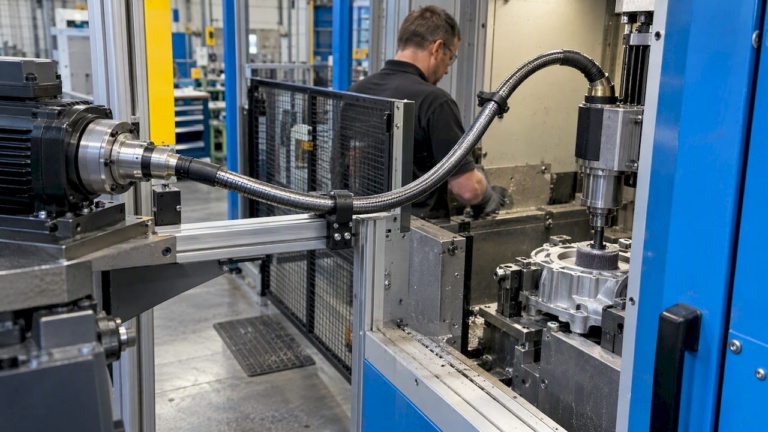
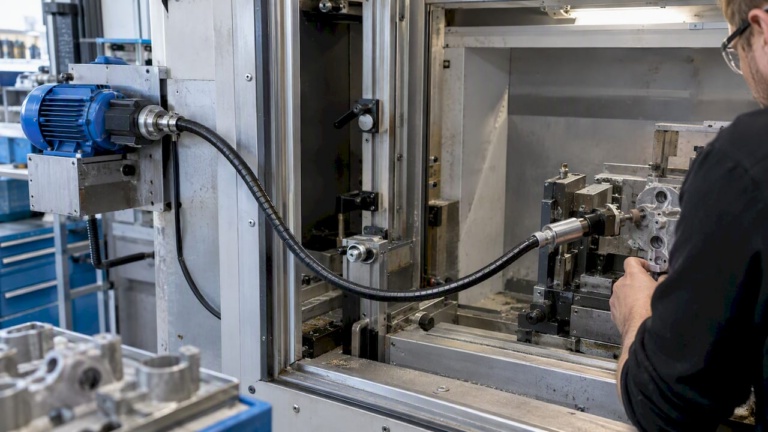
Flexible shafts solve critical access problems by transmitting torque and rotation through curved paths while maintaining power delivery efficiency. Where rigid shafts require straight-line access and bulky motor positioning, flexible shafts enable compact tool designs that reach confined spaces without compromising performance. This capability proves essential for manufacturing efficiency improvements in applications ranging from turbine blade finishing to intricate mold polishing.
Current industrial applications demonstrate the versatility driving market growth:
- High-speed grinding operations requiring precise surface finishes in aerospace components
- Rotor system assembly where vibration control directly impacts operational reliability
- Turbine component finishing demanding both access flexibility and consistent power transmission
- Medical device manufacturing requiring sterile, compact tooling configurations
- Automotive finishing processes in tight engine compartment geometries
The rising complexity of manufactured components creates corresponding demands for advanced flexible shaft solutions. Engineers must now address simultaneous requirements for higher rotational speeds, lower vibration transmission, improved dynamic stability, and extended service life. These competing demands push traditional design approaches to their limits, requiring sophisticated analytical methods and optimized geometries to achieve performance targets. The market responds by developing specialized shaft configurations tailored to specific application profiles, from ultra-high-speed finishing tools to low-vibration power transmission systems.

Manufacturers investing in flexible shaft technology report measurable improvements in production efficiency, surface finish quality, and tooling accessibility. These benefits translate directly to competitive advantages in industries where precision and process flexibility determine market position. As manufacturing continues evolving toward smaller tolerances and more complex geometries, flexible shafts transition from specialty components to essential enabling technologies.
Advanced flexible shaft dynamics: applying higher-order shear deformation theory (HOSDT)
Accurate vibration prediction separates successful flexible shaft implementations from costly failures, yet classical beam theories consistently underestimate dynamic behavior in hollow shaft configurations. HOSDT provides superior accuracy by accounting for shear deformation effects that classical Euler-Bernoulli and Timoshenko theories neglect or oversimplify. This theoretical advancement matters because vibration prediction errors compound in high-speed rotating applications, leading to resonance problems, premature wear, and catastrophic failures.
The practical advantage of HOSDT lies in its computational efficiency relative to three-dimensional finite element analysis while maintaining prediction accuracy within acceptable engineering tolerances. Classical theories assume constant shear stress distribution across shaft cross-sections, an assumption that breaks down in thin-walled hollow geometries common in modern flexible shaft designs. HOSDT incorporates higher-order polynomial representations of displacement fields, capturing the actual stress distributions that influence dynamic response.
For R&D teams developing new flexible shaft configurations, HOSDT enables rapid design iteration without the computational overhead of full 3D FEA models. Engineers can evaluate multiple geometric variations, material combinations, and operating speed ranges in the time previously required for a single detailed analysis. This acceleration proves critical when optimizing machine design efficiency under tight development schedules.
| Analysis method | Accuracy vs. 3D FEA | Computation time | Best use case |
|---|---|---|---|
| Euler-Bernoulli | 65-75% correlation | Seconds | Preliminary sizing only |
| Timoshenko | 78-85% correlation | Seconds to minutes | Initial design concepts |
| HOSDT | 92-97% correlation | Minutes | Design optimization |
| 3D FEA | Reference standard | Hours | Final validation |
The comparison reveals HOSDT’s sweet spot: near-FEA accuracy at a fraction of the computational cost. This balance matters most during the iterative design phase when engineers evaluate dozens of configuration options to identify optimal solutions. Classical theories lack the fidelity needed for confident design decisions, while full FEA creates bottlenecks that slow development cycles.
Pro Tip: Integrate HOSDT analysis into your early prototype simulation workflow to identify potential resonance issues before committing to physical testing. This approach catches design flaws when corrections cost hours of engineering time rather than weeks of tooling modifications and test iterations.
The mathematical framework underlying HOSDT incorporates transverse shear strain energy terms neglected in simpler theories, producing more accurate natural frequency predictions across all vibration modes. For flexible shafts operating near critical speeds, this improved accuracy directly translates to safer operating envelopes and more confident performance specifications. Engineers gain the ability to push design boundaries while maintaining adequate safety margins, extracting maximum performance from each shaft configuration.
Design considerations for conical and hollow flexible shafts in precision rotating machinery
Conical shaft geometries introduce design variables that dramatically influence stiffness characteristics and critical speed thresholds, yet many engineers overlook these relationships when specifying flexible shafts for precision applications. The cone angle parameter serves as a powerful optimization tool, enabling designers to tune lateral stiffness, angular stiffness, and cross-stiffness independently to achieve target dynamic performance. Research demonstrates that increasing lateral and angular stiffness while simultaneously reducing cross-stiffness raises the pitching mode critical speed, expanding safe operating ranges for high-speed machinery.
The physics underlying these relationships stems from how cone angles distribute material and modify shaft geometry along the length. Larger cone angles concentrate stiffness toward one end, creating asymmetric dynamic behavior that can either enhance or degrade performance depending on application requirements. Aero-engine applications particularly benefit from optimized conical designs because they must transmit substantial torque through flexible connections while maintaining precise alignment under varying thermal and mechanical loads.
| Cone angle | Lateral stiffness | Angular stiffness | Cross-stiffness | Pitching critical speed |
|---|---|---|---|---|
| 0° (cylindrical) | Baseline | Baseline | Baseline | Baseline |
| 2° | +8% | +12% | +3% | +6% |
| 4° | +18% | +28% | +8% | +14% |
| 6° | +31% | +48% | +15% | +24% |
| 8° | +47% | +73% | +24% | +35% |
The data reveals non-linear relationships between cone angle adjustments and resulting stiffness parameters. Small angle changes produce modest improvements, while larger angles create dramatic effects that must be balanced against other design constraints such as manufacturing complexity and coupling interface requirements.
Design optimization for conical flexible shafts requires systematic consideration of multiple factors:
- Match cone angle to dominant loading conditions, prioritizing lateral support for cantilevered tools or angular stiffness for precision alignment applications
- Evaluate material distribution to concentrate stiffness where dynamic loads peak during operation
- Consider thermal expansion effects that alter effective cone angles under operating temperatures
- Analyze coupling interfaces to ensure cone geometry accommodates connection hardware without stress concentrations
- Validate critical speed margins across the full operating range, including transient conditions during startup and shutdown
These considerations become especially critical in aero-engine and precision machining contexts where operating speeds approach or exceed first-mode critical speeds. Engineers must balance competing requirements: sufficient flexibility to accommodate misalignment and thermal growth while maintaining adequate stiffness to prevent destructive resonances. Conical geometries provide additional design freedom to navigate these tradeoffs, but only when properly optimized for specific application profiles.
The relationship between stiffness parameters and critical speeds follows predictable patterns that enable targeted design adjustments. Increasing lateral stiffness raises the first bending mode critical speed, while angular stiffness improvements elevate pitching mode thresholds. Cross-stiffness couples these modes, potentially creating complex dynamic interactions that require careful analysis. Compact drive solutions leverage these principles to achieve high performance in constrained installation envelopes.
Practical implementation requires iterative analysis cycling between geometry adjustments and dynamic simulation until performance targets are met. Modern computational tools enable rapid evaluation of candidate designs, but engineering judgment remains essential for identifying promising optimization directions and validating final configurations against real-world operating conditions.
Practical applications and performance advantages of flexible shafts in niche machining and finishing
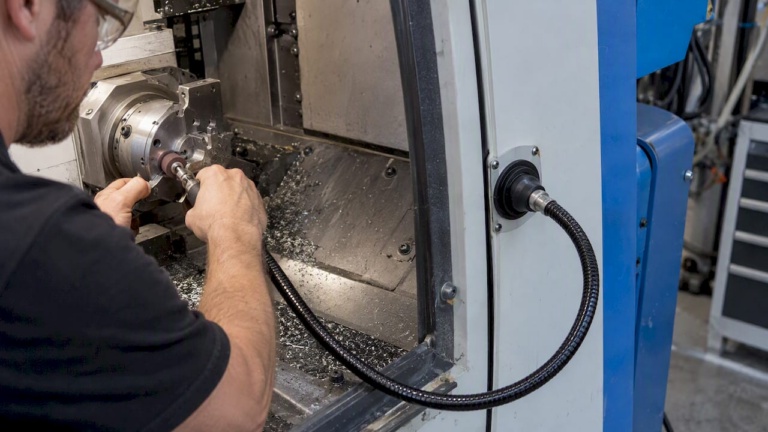
Flexible shafts deliver measurable performance advantages in applications where rigid shaft systems fail completely, transforming previously impossible machining operations into routine production processes. The fundamental capability enabling these advantages is simple: flexible shafts transmit rotational power through curved paths while maintaining torque delivery and speed consistency. This seemingly basic function unlocks access to workpiece geometries that rigid tooling cannot reach, dramatically expanding manufacturing capabilities in aerospace, medical device, and precision component production.

High-RPM finishing operations particularly benefit from flexible shaft technology because these applications demand both speed and access. Grinding and polishing tools operating at 20,000 to 60,000 RPM must reach complex surface geometries while maintaining consistent surface speeds and minimal vibration. Flexible shafts achieve this combination by decoupling motor positioning from tool location, allowing engineers to place drive units in convenient locations while routing power to optimal tool positions. The result: improved surface finishes, reduced tool wear, and faster cycle times compared to rigid shaft alternatives.
Vibration control separates high-performance flexible shafts from basic power transmission cables. Engineering analysis reveals that while grinder applications prioritize high RPM capability and accessory compatibility, rotor dynamics applications emphasize stiffness optimization to minimize vibration transmission. This distinction guides shaft selection and configuration decisions. Finishing tools benefit from lightweight, highly flexible designs that maximize maneuverability, while power transmission applications require stiffer constructions that maintain alignment and reduce dynamic deflections.
Five practical application scenarios demonstrate flexible shaft advantages:
- Turbine blade finishing where tools must follow complex airfoil contours while maintaining consistent material removal rates
- Medical implant polishing requiring sterile, compact tooling that accesses intricate surface geometries without contamination risk
- Mold cavity finishing in injection molding tools where rigid shaft access is geometrically impossible
- Automotive engine component deburring in assembled configurations where disassembly for machining access is cost prohibitive
- Aerospace structural component grinding where lightweight portable tools enable in-situ finishing without part removal
These scenarios share common requirements: access constraints that eliminate rigid shaft options, precision finishing demands requiring vibration control, and production efficiency targets that justify flexible shaft investments. Engineers selecting flexible shafts for these applications report cycle time reductions of 30 to 50 percent compared to alternative approaches, primarily from eliminating part handling and setup operations.
Pro Tip: Match flexible shaft stiffness and length to your specific tooling speeds and environmental conditions rather than selecting generic configurations. A shaft optimized for 40,000 RPM grinding performs poorly in 8,000 RPM power transmission, and vice versa. Consult manufacturers early in tool development to specify appropriate configurations.
The performance advantages extend beyond simple access improvements. Flexible shafts enable ergonomic tool designs that reduce operator fatigue in manual finishing operations, a benefit that compounds over production shifts. Reduced vibration transmission protects precision spindle bearings in motorized tools, extending service intervals and reducing maintenance costs. The ability to position motors remotely from cutting points enables better cooling, chip evacuation, and operator visibility compared to integrated motor-tool designs.
Tool life improvements represent another measurable advantage. Flexible shafts absorb shock loads and dampen vibrations that would otherwise transmit directly to cutting edges, reducing tool wear rates and extending replacement intervals. In high-volume production, these improvements translate to substantial cost savings and reduced downtime for tool changes. Surface finish quality benefits similarly, as reduced vibration produces more consistent material removal and finer surface textures.
Precision finishing applications leverage these advantages to achieve surface specifications previously requiring secondary operations or specialized fixtures. By combining access flexibility with vibration control and consistent power delivery, flexible shafts enable single-setup finishing that meets final specifications directly from machining operations. This capability eliminates process steps, reduces work-in-process inventory, and accelerates throughput in high-value component manufacturing.
Explore BIAX Flexwellen’s flexible shaft solutions
Translating flexible shaft theory into production-ready tooling requires specialized engineering knowledge and proven component designs that deliver reliable performance across demanding industrial applications. BIAX Flexwellen combines decades of flexible shaft development experience with comprehensive product lines engineered specifically for niche machining challenges facing design engineers and R&D teams. Our solutions address the complete spectrum of requirements from machine design efficiency optimization to precision finishing access improvements, supported by technical consultation that accelerates development cycles and reduces implementation risks.
Our engineering team helps you navigate the complex tradeoffs between flexibility, stiffness, speed capability, and torque transmission to identify optimal configurations for your specific applications. Whether you need standard components for proven designs or custom prototypes for innovative tooling concepts, we provide the technical support and manufacturing capabilities to realize your performance targets. Flexible shaft drive solutions from BIAX Flexwellen deliver the reliability and precision your manufacturing processes demand.
Pro Tip: Contact BIAX Flexwellen during early development phases rather than after finalizing tool designs. Our engineers identify optimization opportunities and potential issues when design changes cost hours instead of weeks, ensuring your flexible shaft implementations achieve performance targets on schedule and within budget.
Frequently asked questions about flexible shaft applications
What industries benefit most from flexible shaft technology in 2026?
Aerospace component finishing, medical device manufacturing, precision mold production, and automotive assembly operations gain the greatest advantages from flexible shaft technology. These industries face stringent surface finish requirements combined with complex geometries that rigid tooling cannot efficiently access, making flexible shafts essential enabling technologies rather than optional accessories.
How does HOSDT improve flexible shaft vibration predictions?
HOSDT incorporates higher-order polynomial displacement field representations that capture shear deformation effects neglected by classical beam theories, producing vibration predictions within 92 to 97 percent of full 3D finite element analysis accuracy. This improvement enables confident design optimization without the computational overhead that slows development cycles, particularly valuable for hollow shaft configurations where classical theories significantly underestimate dynamic response.
What factors affect flexible shaft critical speeds in rotating machinery?
Critical speeds depend on shaft geometry including length, diameter, wall thickness, and cone angle, material properties such as elastic modulus and density, boundary conditions at coupling interfaces, and operating conditions including temperature and preload. Conical geometries provide additional design variables for tuning lateral stiffness, angular stiffness, and cross-stiffness to optimize critical speed margins for specific applications.
Are flexible shafts suitable for extremely high-speed machining?
Flexible shafts routinely operate at 20,000 to 60,000 RPM in grinding and finishing applications, with specialized designs reaching even higher speeds. Success at extreme speeds requires careful matching of shaft construction, length, and stiffness to operating conditions, plus proper balancing and coupling alignment. Consult manufacturers to verify speed capability for your specific configuration and loading conditions.
How can engineers optimize flexible shafts for limited space applications?
Optimization for confined spaces focuses on minimizing bend radius requirements while maintaining adequate stiffness for vibration control, selecting compact coupling interfaces that reduce overall installation length, and positioning drive motors remotely to maximize tool access. Conical shaft geometries concentrate stiffness strategically, enabling tighter bends without sacrificing dynamic performance, while hollow constructions reduce weight for improved handling in manual operations.
Recommended
- Industrial shaft applications: 40% longer shaft life
- Flexible Shaft Drive Solutions: Unlocking Compact Efficiency
- Flexible Shafts for Tight Spaces: Boosting Precision
- How flexible shafts improve machine design efficiency
Related Topics
Send your spec inquiry
Custom flexible shafts for your application — we quote within 1 working day.