Flexible Shaft Spares: Custom Lead Times Raise Stock Risk in Aerospace
16 October 2026Manage flexible-shaft spares with an item-level, risk-based policy: ABC/XYZ classification sets the stocking rule, and lifecycle cost (LCC) justifies the buffer for critical items, while low-criticality parts are procured on demand. Custom end fittings and variable lead times make blanket stocking inefficient. Our team at BIAX is available to support the technical inputs.
TL;DR:
- Classify each shaft by failure impact and demand predictability; when failure records are sparse, prioritize installed count and outage consequences, then revise its class.
- Bespoke end fittings can add machining, heat treatment, finishing, and coupling queues, so cover long lead times with capacity agreements or targeted buffers.
- Use statistical safety stock for measurable demand, but set a fixed minimum for high consequence, sparse demand items, then weigh carrying cost against avoided downtime.
- Reliable rules require exact part numbers, drawing revisions, installed counts, failure history, lead times, and repair capability; missing bills of materials make stock decisions guesses.
Table of Contents
- How do you classify flexible-shaft parts by criticality and demand?
- What lead-time constraints shape the stocking policy?
- How do you size reorder points and buffers for flexible-shaft spares?
- Which processes and data make stocking rules reliable?
- Which supplier and design tactics reduce on-site stock?
- How do you roll out the strategy step by step?
- What should aerospace and confined installations add to the plan?
- Where can you get engineering support for custom spares?
- FAQ
- Sources
How do you classify flexible-shaft parts by criticality and demand?
Start with a criticality rating (A, B, C) and overlay demand predictability (X, Y, Z). aVince recommends combining a criticality assessment with ABC/XYZ analysis, and the A-X combination, high impact with predictable demand, gets the tightest control.
For flexible shafts, rate the failure impact against these criteria:
- Single-point drive: the shaft is the only torque path, with no redundant drive.
- Safety consequence: failure affects an override, actuation or protective function.
- Repair versus replace: the shaft can be re-terminated or reworked, or must be exchanged complete.
- Access: replacement requires disassembly of a confined installation.
- Downtime cost per hour: how quickly an outage becomes expensive.
The minimum data set for the classification is the failure history, the number of installed units, supplier lead time, repair time and the uptime consequence. Where failure history is thin, treat the installed count and consequence as the dominant inputs and revisit the class after sufficient recorded events.
What lead-time constraints shape the stocking policy?
Standard meterware cores can be cut and finished. Bespoke end-finished shafts behave differently: they add machining, heat treatment, surface finishing and coupling fit-up, each a possible queue.
The usual lead-time drivers are:
- Custom coupling interfaces that exist only for one customer or program.
- Small-batch runs, where setup time dominates the schedule.
- External finishing shops with their own capacity cycles.
Three tactics reduce the exposure. A framework agreement fixes capacity and response times in advance. A minimum strategic safety stock covers A-class items whose lead time exceeds the tolerable outage. Consignment or vendor-managed inventory moves part of the stock to the supplier’s side without losing access. Fraunhofer IML cautions that holding maximum stock for maximum availability is economically unsustainable, which is why lead time should be weighed per item rather than applied as a blanket buffer.
How do you size reorder points and buffers for flexible-shaft spares?
Every item has a stock level at which the sum of carrying cost and expected downtime cost is lowest. Too little stock raises outage risk; too much ties up capital. Fraunhofer’s practitioner guide frames the optimal stock as the one that minimizes total cost, using capital tied in inventory, lead time, failure counts and expected scrap as inputs.
A workable sequence:
- Assign the ABC/XYZ class to each shaft type.
- Record mean lead time and its variability, not only the quoted figure.
- For items with measurable demand (X, Y), compute a statistical safety stock from demand variance and lead-time variance at a service level matched to the criticality class.
- For sparse-demand items (Z) with high consequence, set a fixed minimum buffer based on the installed group and its risk.
- Compare the carrying cost of that buffer with the downtime cost it avoids, and adjust.
Fraunhofer IML describes ERBORAS software as a tool that estimates the optimal stock per item from failure frequency, failure consequences, lead time and cost factors. Where the data exists, this per-item optimization is the advanced step beyond class-based rules. Where it does not, the class-based policy above is a sound starting point.
Which processes and data make stocking rules reliable?
Stocking rules fail more often for process reasons than for mathematical ones. Fraunhofer IML identifies missing documentation, unclear part ownership and a lack of integrated IT between maintenance and procurement as the largest obstacles. Typical symptoms in flexible-shaft programs include:
- Missing or outdated bills of materials, so installed counts are guesses.
- No named owner for a part number, so nobody triggers the reorder.
- Inconsistent master data, with one shaft stored under several part numbers.
Each shaft record should carry the exact part number, the drawing revision, the number of installed units, the failure history, supplier lead time and available repair capability. On the IT side, add ERP fields for lead time and replacement policy, record issues by barcode or RFID so consumption is captured at the point of use, and link condition-monitoring signals to reorder triggers where such monitoring exists. Our guidance on the flexible shaft maintenance process covers how to capture the underlying condition data.
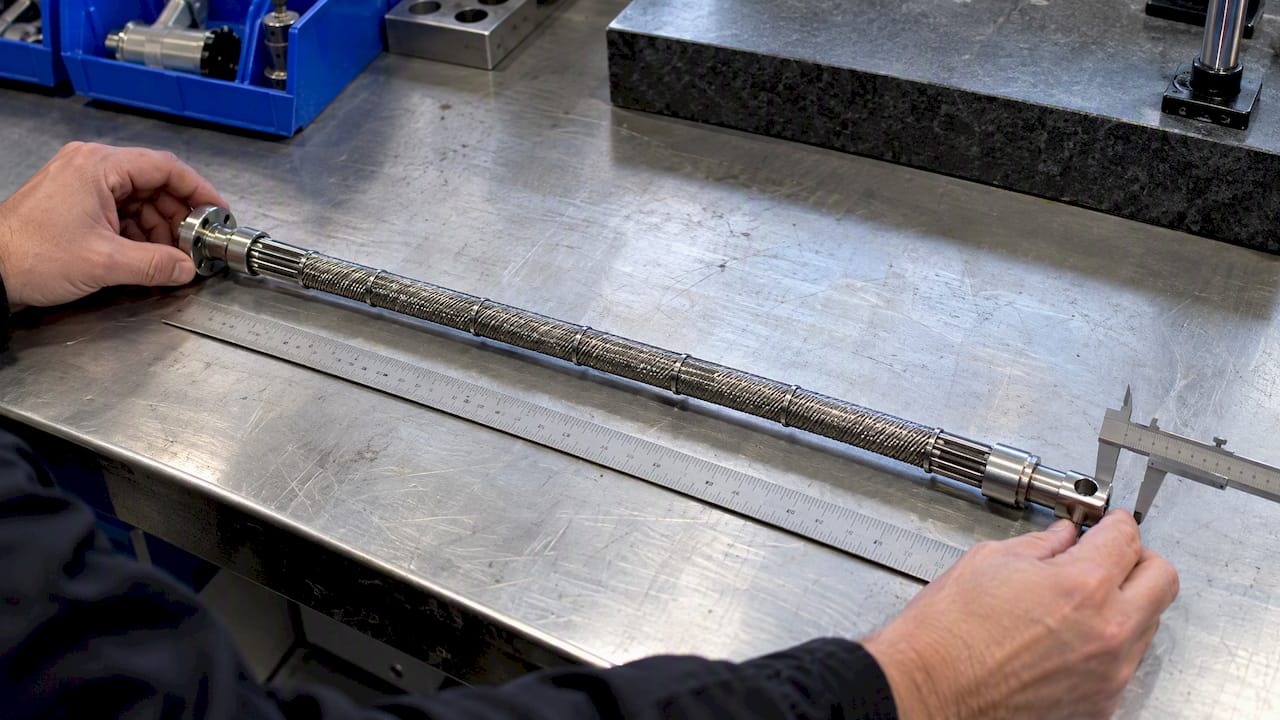
Pro Tip: Store the shaft length, end-fitting type and drawing revision in one structured field. A spare that matches the part number but not the revision is not a spare.
Which supplier and design tactics reduce on-site stock?
Qualify a second supplier or repair partner when a shaft type is A-class, single-point and long-lead. aVince lists dual sourcing, consignment and guaranteed rapid-service agreements as options for critical, high-impact items. Weigh qualification effort against exposure: a second source only pays off if drawings and test criteria are transferable.
- Dual sourcing or repair partner: qualify against the same drawing, torque and speed envelope.
- Consignment and lead-time clauses: contract a guaranteed response time and keep stock at the supplier’s site.
- Small-batch prototyping: a short pilot run can shorten effective lead time for an unplanned spare.
- Modular coupling interfaces: a standardized interface lets one spare serve several installations.
- Repair-friendly finishes: choose terminations that allow re-fitting rather than full replacement.
Our guide to custom shaft design for engineers explains which configuration choices keep a design serviceable.
How do you roll out the strategy step by step?
Follow this sequence and treat each step as a milestone:
- Collect BOMs and installed counts for every flexible-shaft application.
- Run the ABC/XYZ classification and record the lifecycle-cost basis. VDMA guidance holds that components should be judged on lifecycle cost, not purchase price alone.
- Compute initial safety stocks for A and X items.
- Pilot a framework agreement or consignment arrangement for one critical type.
- Integrate ERP fields and barcode or RFID issue recording.
- Measure the KPIs below, then iterate.
Track key KPIs: fill rate for critical parts, mean downtime per failure, inventory turnover and capital tied up in spares. Compare capital cost against avoided downtime, as lifecycle-cost modeling does for machine tools, to keep the stocking case grounded in cost.
Pro Tip: Pilot on one machine group or one confined aerospace subsystem, where installed counts and failure consequences are already well documented.
What should aerospace and confined installations add to the plan?
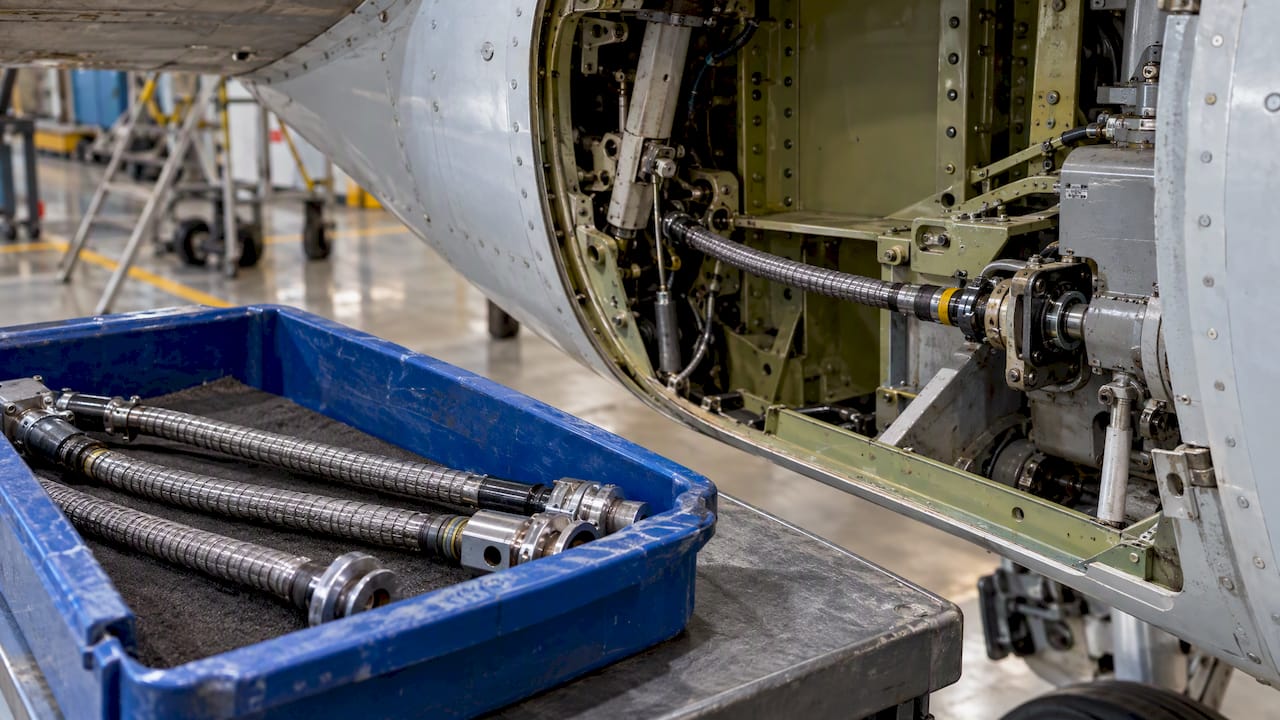
In thrust reverser systems, flap and slat actuation, valve override mechanisms and synchronization shafts, the shaft is often the sole mechanical link, and access is restricted. That makes lifecycle thinking more than a cost exercise: the replacement path must be planned before the first failure. In practice, specify coupling interfaces that can be swapped without removing adjacent assemblies, and define the modular swap unit early. Inventory choices must always stay within the safety and regulatory constraints of the platform.
— Uli
Where can you get engineering support for custom spares?
We supply standard and custom flexible shafts. They can be configured for pilot spare programs and critical applications. If your spare strategy needs a defined interface, a short-run spare or a design review, our custom solutions and prototypes page describes what we build. For a quotation or a technical inquiry, use our contact page.
FAQ
What is an A-X spare part?
An A-X part combines high criticality (A) with predictable demand (X). It receives the tightest stocking control, because both the consequence of a shortage and the ability to forecast consumption are high.
Should every flexible shaft be stocked as a spare?
No. Stock only items where the downtime or safety consequence outweighs the carrying cost. Low-criticality parts can be procured on demand or held by the supplier.
How much safety stock does a critical flexible shaft need?
It depends on lead time variability, demand pattern and downtime cost. With measurable demand, use a statistical safety stock; with sparse demand and high consequence, hold a fixed minimum buffer and review it against total cost.
What data is needed before setting stocking rules?
You need the exact part number, drawing revision, installed count, failure history, supplier lead time and repair capability. Without a reliable BOM, installed counts and classification remain guesses.
Sources
Recommended
- Custom Shaft Configuration Advantages for Engineers
- Flexible Shaft Failure Causes: 4 Triggers, Aerospace RCFA Clues
- Custom flexible shaft benefits: boost precision and reliability
- Custom flexible shaft design explained: engineer better solutions
Related Topics
Send your spec inquiry
Custom flexible shafts for your application — we quote within 1 working day.