Key benefits of flexible shaft technology for manufacturing
6 April 2026TL;DR:
- Flexible shafts enable power transmission around obstacles and in tight spaces.
- They offer longer service life and reduce maintenance through vibration dampening.
- Ideal for applications needing misalignment tolerance, quick tool changes, and compact routing.
Achieving precision and reliability in compact, demanding manufacturing environments is rarely straightforward. Engineers and machine builders frequently encounter a hidden bottleneck: power transmission. When drive components must navigate tight spaces, angular offsets, or vibration-prone assemblies, rigid solutions fall short. Flexible shaft technology addresses this directly, offering a proven path to transmitting torque and rotation where conventional designs cannot reach. This article examines the selection criteria, core advantages, and real-world applications of flexible shafts, giving engineers and decision-makers a structured basis for evaluating this technology in their own systems.
Table of Contents
- Key criteria for evaluating shaft technologies
- Top benefits of flexible shaft technology
- Comparison: Flexible shafts vs. rigid shafts
- Application highlights: Where flexible shafts outperform
- A new perspective: Why flexible shafts are reshaping machine design
- Explore flexible shaft solutions for your operations
- Frequently asked questions
Key Takeaways
| Point | Details |
|---|---|
| Longer service life | Flexible shaft solutions can increase shaft lifespan by up to 40% in demanding industrial settings. |
| Greater design freedom | They allow for compact, adaptable transmission layouts conventional systems can’t match. |
| Lower maintenance costs | Flexible shafts absorb misalignment and reduce wear, minimizing unplanned downtime. |
| Ideal for tight spaces | Flexible shafts excel in intricate machinery or finishing environments with limited access. |
Key criteria for evaluating shaft technologies
Before examining the specific benefits, understand the selection criteria for power transmission solutions. Choosing the right shaft system is not simply a matter of matching torque ratings. It requires a structured evaluation across several performance dimensions that directly affect machine reliability and total cost of ownership.
- Load capacity and torque requirements. Every shaft selection starts with torque. Engineers must account for peak loads, duty cycles, and the direction of rotation. Undersizing a shaft leads to premature failure; oversizing adds unnecessary mass and cost.
- Precision and minimal backlash. In finishing and machining processes, backlash translates directly into surface defects. The shaft system must maintain consistent angular transmission without play, especially during directional changes or variable-speed operation.
- Compact design for tight integration. Modern machine layouts leave little room for bulky drive trains. A shaft system that can route through confined spaces without requiring large housings or complex linkages reduces overall machine footprint and simplifies assembly.
- Energy efficiency and reduced downtime. Mechanical losses in the drivetrain accumulate over time. Systems that minimize friction, absorb vibration, and resist wear contribute to lower operating costs and fewer unplanned stoppages.
- Adaptability across configurations. Machine builders working across multiple product lines benefit from shaft systems that can be configured for different torque, RPM, and coupling requirements without a complete redesign.
Flexible shafts score well across all five criteria. Higher durability and reduced maintenance are well-documented advantages in industrial environments, making them a strong candidate for demanding applications. When evaluating design efficiency criteria, flexible shafts consistently enable more compact, serviceable machine architectures than their rigid counterparts.
Pro Tip: When specifying a shaft system early in the design phase, prioritize adaptability. A flexible shaft that can accommodate minor misalignment and routing changes during integration saves significant re-engineering time downstream.
Top benefits of flexible shaft technology
With a clear rubric established, explore the actual advantages of flexible shaft systems. These benefits are not theoretical. They reflect performance outcomes observed across industrial finishing, assembly, and automation environments.
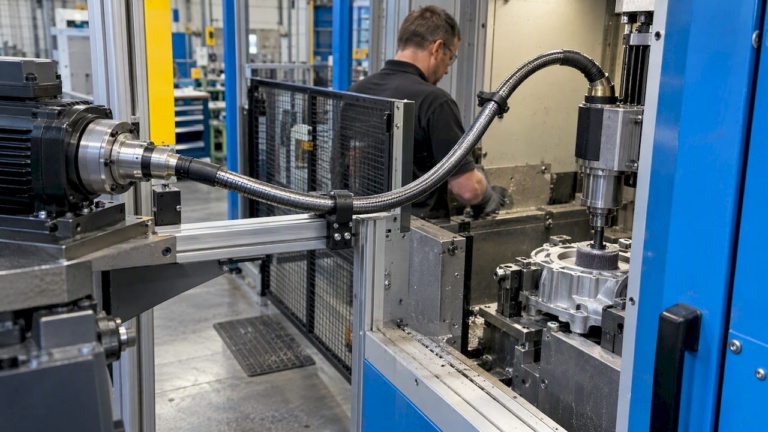
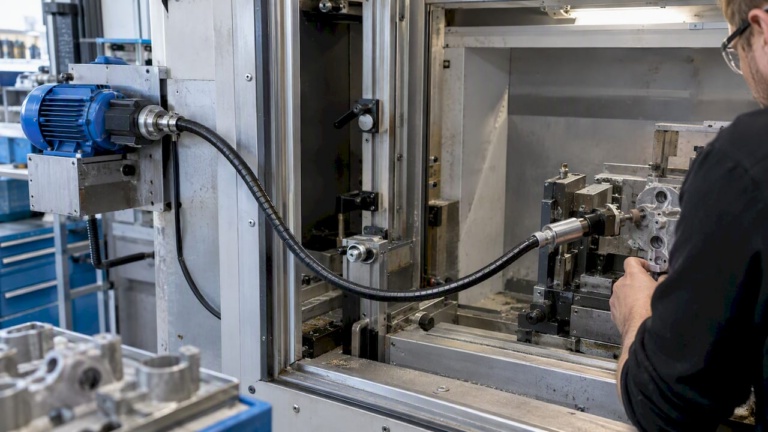
- Power transmission around obstacles. Flexible shafts route torque through curves, bends, and angular offsets that would require complex gearboxes or universal joints in a rigid system. This enables tool placement in locations that are otherwise inaccessible.
- Extended service life. Shaft life increases of up to 40% have been observed in suitable industrial applications. This is a measurable, significant gain that directly affects maintenance schedules and spare parts inventory.
- Minimal vibration transmission. The inherent compliance of a flexible shaft absorbs and dampens vibration before it reaches the tool or workpiece. In grinding and polishing operations, this translates to improved surface finish and reduced operator fatigue.
- Reduced downtime and maintenance intervals. Because flexible shafts tolerate misalignment without generating excessive wear, they require less frequent inspection and replacement compared to rigid drive components operating under similar conditions.
- Compatibility with variable-speed drives. Flexible shafts work effectively across a wide RPM range, making them suitable for processes that require speed adjustment during operation, such as deburring complex geometries.
“Flexible shafts enable solutions rigid designs cannot deliver.” This is not a marketing claim. It reflects the engineering reality that certain machine layouts, tool access requirements, and process demands simply cannot be met with conventional rigid drive trains.
For engineers working on precision in tight spaces, the combination of vibration dampening and flexible routing is particularly valuable. It allows consistent tool engagement even when the drive path must navigate around structural elements or other components.
Comparison: Flexible shafts vs. rigid shafts
Knowing the unique benefits, see how flexible shafts stack up against the main alternative. Rigid shafts remain the standard choice in many applications, and for good reason. Understanding where each technology excels is essential for making informed specification decisions.
| Criterion | Flexible shaft | Rigid shaft |
|---|---|---|
| Torque capacity | Moderate to high | High |
| Misalignment tolerance | Excellent | Poor |
| Vibration dampening | Effective | Minimal |
| Design flexibility | High | Low |
| Maintenance frequency | Low | Moderate to high |
| Service life (typical) | Extended | Standard |
| Routing complexity | Low | High |
Rigid shafts perform best in straight-line, high-torque applications where alignment is fixed and vibration is not a concern. They are appropriate for heavy-duty gearbox outputs and direct-drive spindles in stable, well-aligned setups.
Flexible shafts are preferred when:
- The drive path must change direction or navigate around components
- Misalignment between motor and tool is unavoidable or variable
- Vibration isolation is required to protect the workpiece or the operator
- The machine layout demands compact, reconfigurable drive routing
- Rapid tooling changes require a drive system that accommodates positional variation
Flexible shafts are superior in handling misalignment and reducing wear compared to rigid shafts, particularly in dynamic assemblies where positional tolerances cannot be fully controlled. For a detailed rigid vs flexible comparison or to explore compact drive insights for specific machine layouts, these resources provide additional engineering guidance.
The practical implication is clear: rigid shafts are not universally superior, and defaulting to them in complex machine layouts often creates alignment and maintenance problems that flexible shafts would avoid entirely.
Application highlights: Where flexible shafts outperform
Follow the comparison by zooming in on the environments where flexible shaft systems deliver the highest impact. Across industries, certain application types consistently benefit from the routing freedom and vibration tolerance that flexible shafts provide.
| Application | Key benefit | Typical process |
|---|---|---|
| Precision finishing | Consistent tool engagement | Grinding, polishing, deburring |
| Assembly automation | Compact drive routing | Fastening, torque delivery |
| Robotics integration | Flexible path transmission | End-of-arm tooling |
| Maintenance and repair | Access in confined spaces | In-situ machining |
Productivity and access gains in finishing, robotics, and automated operations are well-established outcomes when flexible shafts are correctly specified. The following scenarios illustrate where this technology delivers the clearest advantage:
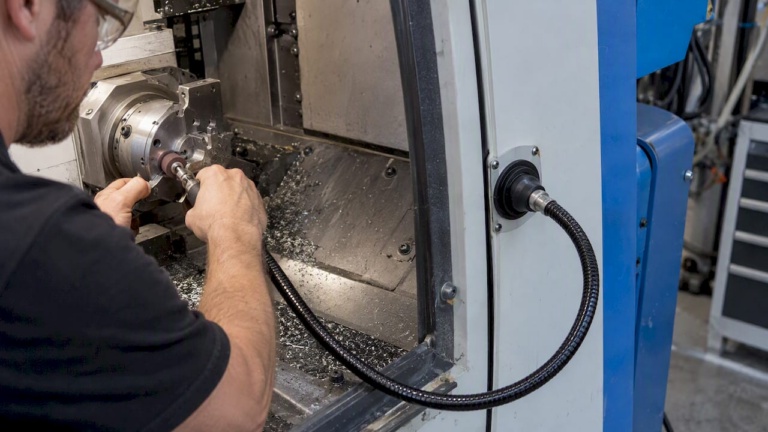
- Hard-to-reach areas. In aerospace component finishing or automotive body work, the tool must reach recessed surfaces, internal cavities, or undercuts. Flexible shafts make this possible without repositioning the entire drive unit.
- Rapid tooling changes. In production environments where operators switch between grinding, polishing, and cleaning attachments, a flexible shaft drive accommodates positional variation between tool types without recalibration.
- Variable-speed tasks. Processes such as edge deburring on cast components require speed adjustment as the tool transitions between different material sections. Flexible shafts transmit power consistently across this range.
- Robotics end-of-arm tooling. When a robot arm carries a finishing tool, the drive path must flex with the arm’s movement. Flexible shafts integrated into robotics application examples eliminate the need for complex articulated drive joints.
For precision finishing use cases involving tight tolerances and difficult geometries, flexible shaft systems consistently outperform rigid alternatives in both access and surface quality outcomes.
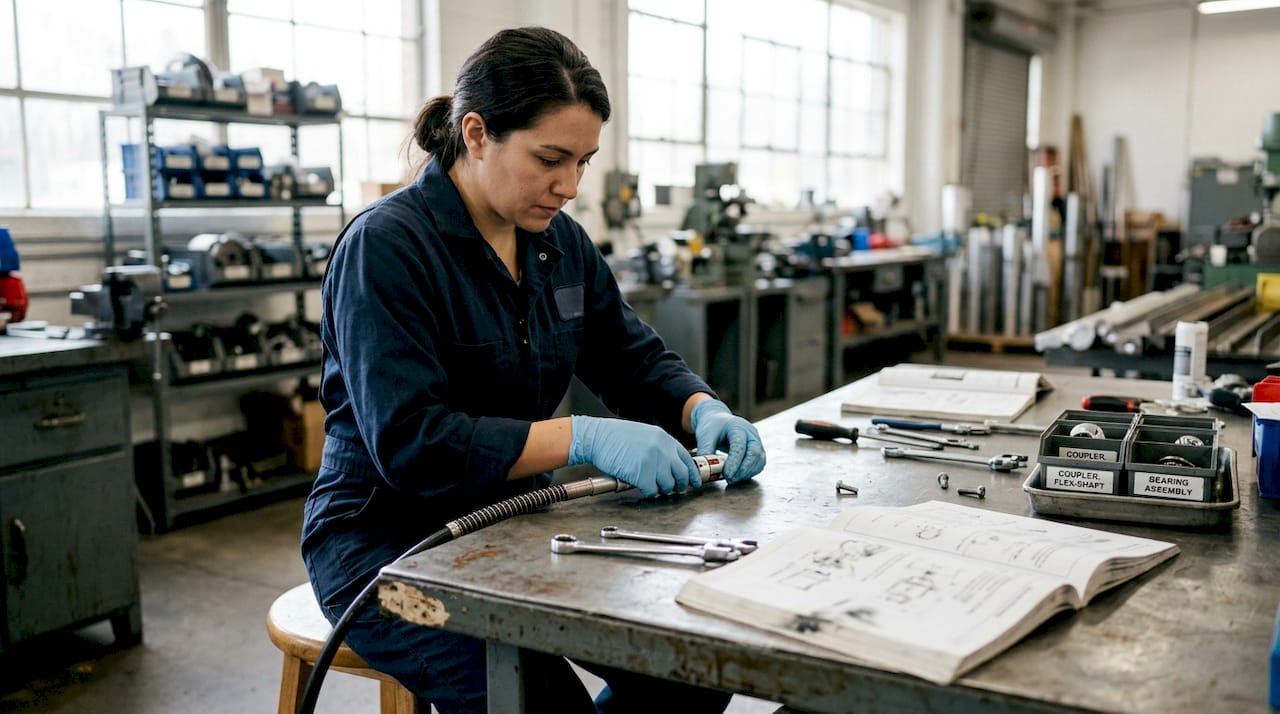
Pro Tip: Custom shaft configurations, including specific core diameters, protective sheath materials, and coupling interfaces, maximize performance in niche applications. Standard catalog components cover most use cases, but tailored designs unlock additional value in specialized processes.
A new perspective: Why flexible shafts are reshaping machine design
With operational contexts in hand, it is valuable to step back and reconsider some industry assumptions. The conventional approach to machine design treats the drive train as a fixed architecture, built around a motor and a rigid output shaft. Flexible shafts challenge this assumption at a fundamental level.
The real value of flexible shaft technology is not just in solving access problems. It is in enabling modular, scalable machine layouts that can be reconfigured without a complete mechanical redesign. This is increasingly important as manufacturers face shorter product cycles and more varied workpiece geometries.
Automation and robotics projects that initially specified rigid drive solutions frequently encounter alignment and maintenance issues that were not anticipated at the design stage. When these projects pivot to flexible shaft systems, the results are not just incremental improvements. They often involve a fundamental simplification of the drive architecture, reducing part count and improving serviceability. Practical engineering case studies from these transitions show consistent gains in uptime and assembly efficiency.
The underappreciated insight is this: flexible shafts do not just solve a routing problem. They change what is possible in machine layout, and that has long-term value that rigid-centric design thinking consistently underestimates.
Explore flexible shaft solutions for your operations
Having explored the value, practical applications, and perspective on flexible shafts, the next step is applying these insights to your specific requirements. BIAX Flexwellen offers engineering guidance, standard components, and custom configurations for torque, RPM, coupling interfaces, and shaft design.
For engineers evaluating how to improve machine efficiency through better drive architecture, the solution pages provide detailed technical specifications and application examples. Explore the full range of flexible shaft applications across finishing, assembly, and robotics, or review available shaft drive solutions to find the right fit for your process. Direct technical inquiries are welcome for tailored application support.

Frequently asked questions
What are the main maintenance advantages of flexible shaft technology?
Flexible shafts tolerate misalignment and absorb vibration, which reduces wear on drive components and lowers the frequency of maintenance interventions. This results in measurable reductions in unplanned downtime across industrial manufacturing environments.
How do flexible shafts improve precision finishing operations?
They transmit power smoothly around obstacles and through angular offsets, ensuring consistent tool engagement and improved surface finish. Precision finishing in tight spaces that rigid drives cannot access is a well-documented application advantage.
In which applications do flexible shafts outperform rigid shafts?
Flexible shafts excel in robotics integration, assembly automation, and finishing processes that require complex drive routing or vibration isolation. Productivity gains in finishing and robotics are consistently observed when flexible shafts replace rigid alternatives in these environments.
What measurable life extension can flexible shaft solutions provide?
A correctly specified flexible shaft can deliver up to 40% longer service life compared to rigid shaft alternatives in suitable industrial applications, directly reducing spare parts consumption and maintenance costs.
Recommended
- How flexible shafts improve machine design efficiency
- How flexible shafts improve access for precision finishing
- Flexible shaft applications for industrial manufacturing
- Benefits of flexible drive systems for manufacturing efficiency
Related Topics
Send your spec inquiry
Custom flexible shafts for your application — we quote within 1 working day.