Flexible vs rigid shafts: How to choose the right drive
27 March 2026Rigid shafts are often treated as the default in drive system design, but that assumption carries real risk. A shaft that cannot tolerate even minor misalignment can cause accelerated bearing wear, coupling failure, and unplanned downtime within months of commissioning. The decision between a flexible and rigid shaft is not just a mechanical detail. It shapes your system’s reliability, maintenance burden, and long-term operating cost. Selection factors include torque, speed, misalignment tolerance, and environment, and getting them wrong is expensive. This article gives you a clear, engineer-focused framework to make the right call.
Table of Contents
- What are flexible and rigid shafts?
- Flexible shafts vs rigid shafts: Key differences at a glance
- When to choose flexible shafts
- When rigid shafts are the better solution
- Selecting the right shaft: A systematic approach
- Common pitfalls in shaft selection and how to avoid them
- Flexible and rigid shaft solutions for your next project
- Frequently asked questions
Key Takeaways
| Point | Details |
|---|---|
| Flexible vs rigid roles | Flexible shafts are ideal for offset, vibration, or space-limited systems, while rigid shafts fit precise, high-load applications. |
| Risk of misalignment | Rigid shafts can cause failures if misaligned, making application analysis critical. |
| Selection factors | Always consider torque, speed, misalignment, and environment when choosing a shaft type. |
| System efficiency | Flexible shafts can enhance efficiency in complex or changing layouts. |
| Avoiding pitfalls | Use systematic evaluation and expert advice to prevent costly errors in shaft choice. |
What are flexible and rigid shafts?
A rigid shaft is a solid, inflexible mechanical element that transmits torque and rotation along a fixed axis. It requires near-perfect alignment between the driving and driven components. Any angular or parallel offset introduces bending stress, which shortens component life rapidly.
A flexible shaft, by contrast, is a multi-layer wound wire construction that transmits torque around bends and through curves without requiring a straight-line path between driver and load. It accommodates angular, parallel, and axial misalignment by design. This makes it fundamentally different in both construction and application logic.
Here is where each type is commonly found:
- Rigid shafts: Gearboxes, electric motors with close-coupled pumps, precision machine tools, and short direct-drive systems with controlled alignment
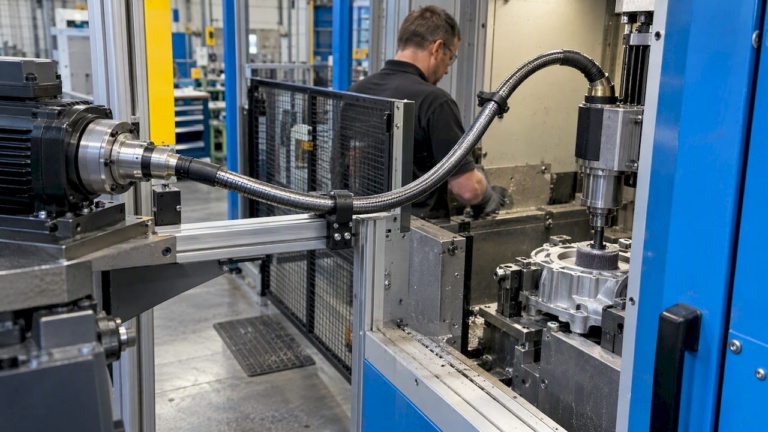
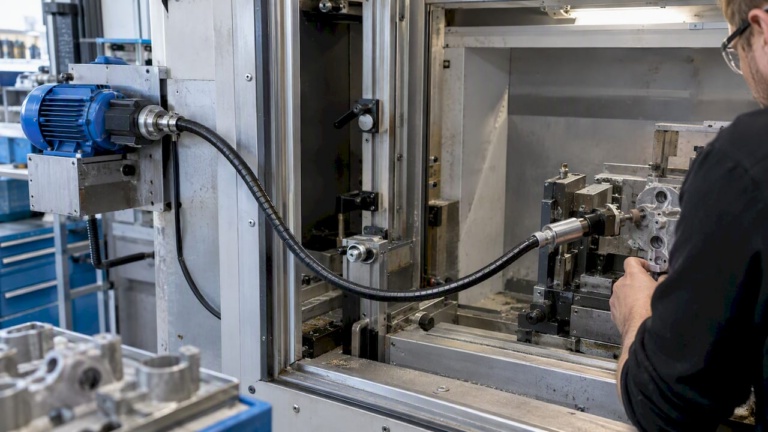
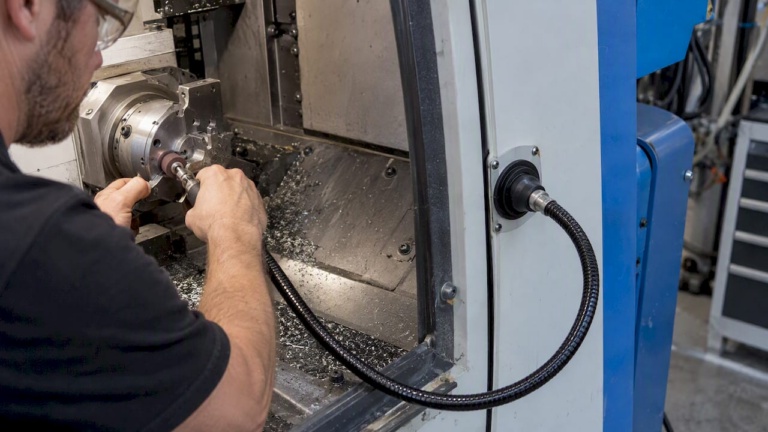
- Flexible shafts: Deburring and grinding tools, robotic end-effectors, medical devices, agricultural equipment, and any application where the drive path must change direction or where alignment cannot be guaranteed
- Flexible shaft couplings (hybrid): Used between two rigid shafts to absorb minor misalignment and vibration without replacing the shaft itself
Understanding which category your application falls into is the first filter in your selection process. Explore use cases for flexible shafts to see how these principles apply across real industrial environments.
Flexible shafts vs rigid shafts: Key differences at a glance
With definitions in place, it is essential to see how flexible and rigid shafts stack up side by side. The table below covers the attributes that matter most to machine builders and system integrators.
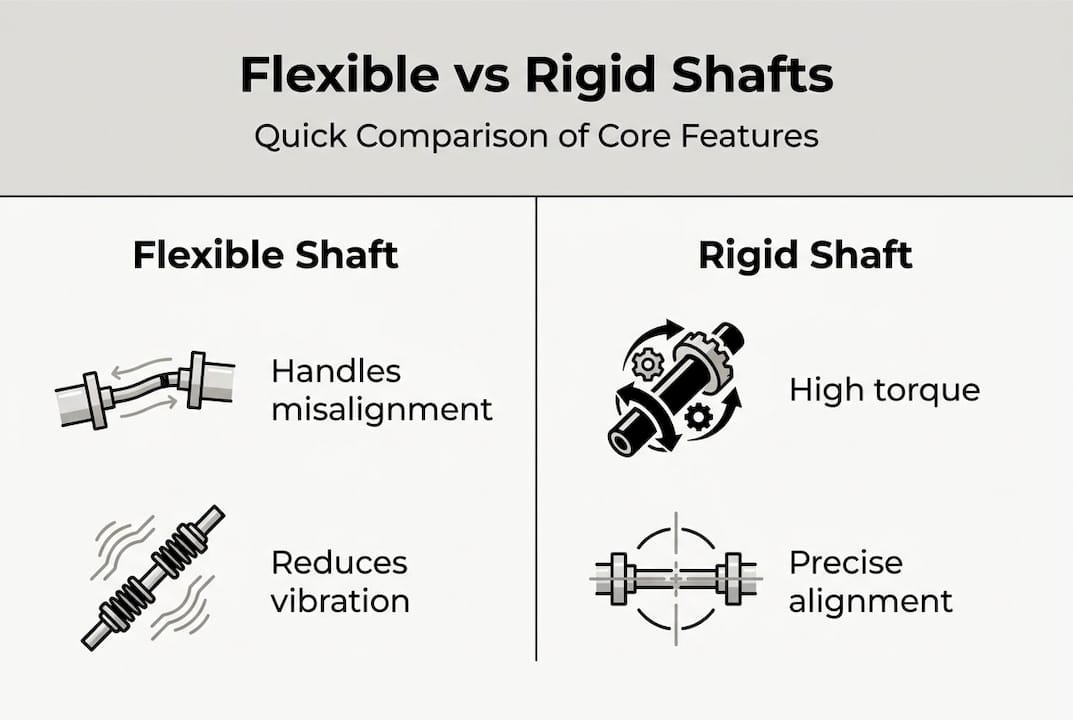
| Attribute | Flexible shaft | Rigid shaft |
|---|---|---|
| Alignment requirement | Tolerates misalignment | Requires precise alignment |
| Vibration absorption | Yes, inherent | No, transmits vibration |
| Torque capacity | Moderate (diameter-dependent) | High |
| Installation complexity | Lower in constrained layouts | Higher if alignment is difficult |
| Initial cost | Moderate to higher | Lower |
| Maintenance risk | Lower in misaligned systems | Higher if alignment drifts |
| Path flexibility | Curves and bends possible | Straight line only |
| Typical applications | Finishing, robotics, tight spaces | Motors, pumps, precision drives |
Rigid shafts are less costly upfront but can cause catastrophic failure under misalignment, while flexible shafts tolerate offsets and dampen vibration by design. That cost difference disappears quickly when you factor in one unplanned shutdown.
Statistic callout: Studies in industrial drive systems show that misalignment is responsible for up to 50% of rotating equipment failures. Choosing the wrong shaft type is not a minor oversight. It is a reliability risk.
For a deeper look at how shaft choice affects overall system architecture, see how machine design efficiency changes when flexible drives are introduced.
When to choose flexible shafts
Flexible shafts are not a compromise. In the right application, they are the superior engineering choice. Here is when they outperform rigid alternatives.
Misalignment is unavoidable or likely to change. In many real-world installations, thermal expansion, structural settling, or frequent repositioning means alignment shifts over time. A flexible shaft handles this without transferring damaging loads to bearings or housings.

The drive path cannot be straight. Flexible shafts absorb vibration and safely transmit rotary motion around obstacles, through panels, and into confined cavities. This is physically impossible with a rigid shaft.
Key scenarios where flexible shafts are the right call:
- Deburring, grinding, and polishing tools where the operator or machine head moves relative to the drive motor
- Robotic arms and end-effectors where joint articulation changes the drive geometry continuously
- Agricultural and construction equipment where vibration and terrain-induced misalignment are constant
- Medical and dental devices where compact, curved drive paths are required
- Any system where efficiency in tight spaces is a design constraint
Flexible shafts also reduce installation time in complex layouts. You do not need to precision-align a motor and a driven tool when the shaft itself accommodates the offset. This is a real labor saving in production environments.
Pro Tip: If your application involves any form of manual tool positioning or the drive motor is mounted remotely from the work point, a flexible shaft almost always reduces total system cost when you include alignment labor and maintenance over a three-year horizon. See how they address precision finishing challenges in practice.
When rigid shafts are the better solution
But there are clear circumstances where traditional rigid shafts make more sense. Rigid is not wrong. It is just context-dependent.
Rigid shafts excel in low-misalignment, short-length, cost-sensitive applications where the mechanical layout is fixed and controlled. If you can guarantee alignment and the drive path is straight, a rigid shaft delivers maximum torque capacity at minimum cost.
Choose a rigid shaft when:
- The drive is short and direct. A motor directly coupled to a pump or gearbox in a fixed frame is a classic rigid shaft application. The geometry does not change.
- Torque demands are very high. Rigid shafts of a given diameter transmit more torque than flexible shafts of the same size. For heavy-duty drives, this matters.
- Precision positioning is critical. CNC machine tool spindles and servo-driven axes require torsional stiffness. A flexible shaft introduces compliance that is unacceptable in these systems.
- Cost is the primary driver and alignment is controlled. In simple, well-engineered layouts, rigid shafts are cheaper to source and install.
- Speed is very high. At extreme RPM, flexible shafts have practical limits. Rigid shafts handle high-speed applications more predictably.
Pro Tip: Before committing to a rigid shaft, run a realistic alignment audit. Account for thermal growth, foundation movement, and maintenance reassembly tolerances. If total misalignment could exceed 0.05 mm under any operating condition, factor in a flexible element or review shaft selection for precision machinery before finalizing your design.
Selecting the right shaft: A systematic approach
To make the choice in real-world projects, follow this engineer-friendly decision pathway. Gut feel is not a selection method. Structured evaluation is.
Step-by-step selection process:
- Define your torque and speed requirements. Calculate peak and continuous values, not just nominal.
- Map the drive path geometry. Is it straight? Does it need to curve or pass through a confined space?
- Assess alignment conditions. What is the maximum expected misalignment under all operating conditions, including thermal and dynamic loads?
- Identify vibration and shock loads. Will the system generate or receive impulse loads that need damping?
- Evaluate the environment. Temperature, contamination, moisture, and chemical exposure all affect material and construction choices.
- Consider maintenance access. Will the shaft need to be removed or replaced frequently? How easy is alignment verification in service?
Engineers must factor in torque, speed, alignment, and environment to optimize performance. Skipping any of these inputs produces a selection that looks right on paper but fails in the field.
Use this decision matrix to organize your evaluation:
| Parameter | Favors flexible shaft | Favors rigid shaft |
|---|---|---|
| Misalignment | Greater than 0.1 mm | Less than 0.05 mm |
| Drive path | Curved or obstructed | Straight and fixed |
| Vibration | Present or variable | Minimal and controlled |
| Torque level | Moderate | High |
| Maintenance access | Limited | Good |
| Layout changes expected | Yes | No |
| Installation labor | Constrained | Adequate |
For applications in robotics or automated systems, the geometry changes dynamically, which almost always points to flexible. Read more about flexible shafts in robotics and how they handle articulated drive paths. For maintenance tool applications, see how maintenance with flexible shafts reduces service complexity in the field.
Common pitfalls in shaft selection and how to avoid them
Finally, let’s ensure the right choice delivers true reliability by avoiding common engineering pitfalls. The selection framework above works, but only if you apply it honestly.
The most frequent mistakes in shaft selection:
- Underestimating misalignment in rigid shaft systems. Engineers often assume alignment will be maintained after installation. It rarely is. Thermal cycling, foundation movement, and reassembly after maintenance all introduce offset.
- Ignoring future layout changes. A rigid shaft system that works perfectly today may become a maintenance problem after a machine relocation or process modification.
- Overlooking dynamic loads. Static torque calculations are not enough. Impulse loads during startup, braking, or tool contact can exceed rated values by a factor of two or more.
- Applying flexible shafts beyond their rated bend radius. Flexible shafts have minimum bend radius specifications. Violating them causes rapid fatigue failure. Always verify the installation geometry against the manufacturer’s data.
- Skipping prototype validation. Especially in custom or unusual layouts, a physical prototype run under real operating conditions reveals problems that simulation misses.
“Improper shaft selection can lead to unplanned downtime and significant repair costs.” The fix is not more expensive components. It is a more rigorous selection process applied earlier in the design cycle.
For applications involving confined or complex geometries, review the principles behind designing for tight spaces before finalizing your shaft configuration. Early-stage geometry analysis prevents late-stage redesign.
Flexible and rigid shaft solutions for your next project
At BIAX Flexwellen, we work with machine builders and industrial manufacturers across the DACH region who face exactly the selection challenges described in this article. Whether your application involves deburring in a confined cell, a robotic finishing process, or a custom drive path that no standard component fits, we provide engineering guidance alongside our product range. Explore industrial manufacturing applications to see how our flexible shafts perform across real use cases. Browse our flexible shaft drive solutions for standard configurations, or use our custom flexible shaft configuration guide to define torque, RPM, bend radius, and coupling interface for your specific system. Contact us directly for a technical consultation.
Frequently asked questions
Can flexible shafts handle the same torque as rigid shafts?
Flexible shafts cannot transfer as much torque as rigid shafts of the same diameter due to their wound wire construction. For high-torque applications, rigid shafts or larger-diameter flexible shafts are required.
How do you know if your system needs a flexible shaft?
If your application involves misalignment, vibration, or a drive path that cannot be straight, a flexible shaft is usually the better choice. Flexible shafts transmit rotary motion safely around obstacles and absorb vibration that would otherwise damage rigid drive components.
What happens if a rigid shaft is misaligned?
Misalignment in a rigid shaft system causes accelerated bearing wear, coupling fatigue, and eventual system failure. Rigid shafts carry higher failure risk when alignment is not perfectly maintained throughout the operating life of the machine.
Are flexible shafts more expensive to maintain?
Not necessarily. In applications where alignment is difficult to maintain, flexible shafts reduce maintenance frequency and cost by eliminating the root cause of many drive failures. Flexible shafts reduce alignment difficulties, which directly lowers maintenance burden in complex or dynamic layouts.
Recommended
- Flexible Shaft Drive Solutions: Unlocking Compact Efficiency
- How to Select Flexible Shafts for Precision Machinery
- How to implement flexible shaft drive solutions (2026)
- Flexible Shafts in Automation: Precision in Tight Spaces – BIAX Flexwellen
Related Topics
Send your spec inquiry
Custom flexible shafts for your application — we quote within 1 working day.