Flexible Shaft Drive Solutions: Unlocking Compact Efficiency
25 February 2026Space constraints and complex mounting layouts often challenge design engineers and R&D teams in German, Austrian, and Swiss manufacturing facilities. Flexible shaft drive solutions transform these challenges into opportunities by delivering power transmission in confined environments where rigid shafts cannot fit. With a compact geometry and the ability to tolerate torsion, bending, and even buckling, these shafts enable efficient machining processes that adapt to tight production spaces. This article provides practical insights into selecting and integrating flexible shaft systems that meet demanding operational specifications.
Table of Contents
- Defining Flexible Shaft Drive Solutions
- Types And Construction Methods Compared
- How Flexible Shafts Transmit Torque Efficiently
- Industrial Applications In Compact Machining Environments
- Comparisons With Rigid Shafts And Common Pitfalls
Key Takeaways
| Point | Details |
|---|---|
| Flexible Shaft Design | Flexible shafts accommodate 3D movement, making them ideal for tight spaces where rigid shafts fail. |
| Operational Efficiency | They maintain 85-95% efficiency, reducing heat generation and extending component life. |
| Material Selection | Choosing the correct core material and protective sheath optimizes performance and lifespan for specific environments. |
| Application Versatility | Flexible shafts are essential for various applications, including deburring, grinding, and automation in constrained environments. |
Defining flexible shaft drive solutions
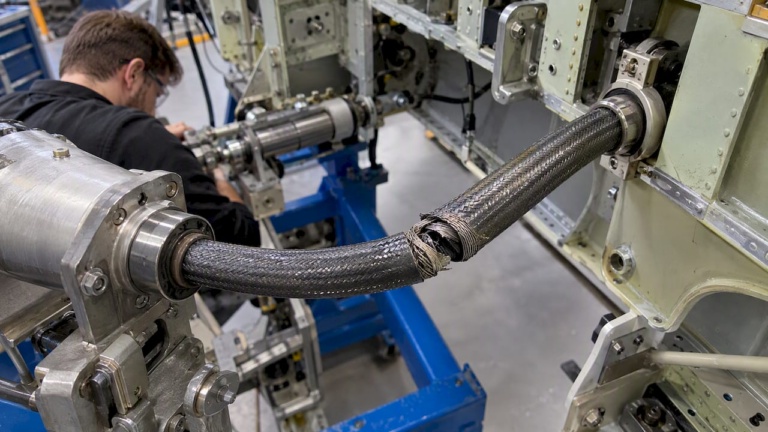
A flexible shaft drive solution is a specialized power transmission system designed to transmit torque and rotation between locations where space constraints, misalignment, or mechanical complexity prevent direct shaft connection. Unlike rigid shafts, flexible shafts accommodate three-dimensional movement while maintaining power transfer efficiency.
Flexible shafts consist of multiple layers of wound wires that enable torsional compliance and elastic behavior. This construction allows the shaft to bend, twist, and absorb shock without losing rotational power, making them ideal for confined industrial environments.
Core Characteristics
These drive solutions deliver several defining functional properties:
- Compact geometry allows installation in spaces too tight for conventional rigid shafts
- Torsional flexibility permits remote motor placement away from the work area
- High rotational speed capability supports speeds from low-torque applications to high-RPM finishing operations
- Shock absorption reduces vibration transmission and extends component life
- Series elastic actuation enables precise load matching in automation systems
How They Operate
Flexible shafts transmit power by combining bending and elastic properties. The wound wire construction tolerates deformations including torsion, bending, and controlled buckling without structural failure. This allows the shaft to route around obstacles, through confined spaces, and adapt to non-coaxial motor-to-load arrangements.
Flexible shafts transform space constraints from design obstacles into manageable variables by decoupling motor location from load location.
Real-World Applications in Industrial Manufacturing
Design engineers in the DACH region use flexible shaft solutions across multiple finishing processes:
- Deburring and grinding operations in constrained production layouts
- Polishing and surface finishing where tool access is limited
- Pipe cleaning and confined-space applications
- Valve actuation and override systems requiring compact packaging
- Thrust reverser actuation in aerospace platforms
These applications share a common requirement: efficient power transmission where conventional rigid shafts cannot physically fit or operate.
Why This Matters for Your Design Challenges
When traditional shaft arrangements fail due to spatial limitations, flexible shaft drives offer a practical alternative. They eliminate redesign requirements that would otherwise demand repositioning motors, restructuring mounting arrangements, or compromising system efficiency.
Understanding how practical shaft drive solutions function in real machining processes helps engineers anticipate how flexible systems integrate with existing equipment constraints.
Pro tip: When evaluating flexible shaft solutions for your application, specify exact torque and RPM requirements alongside space envelope dimensions; this enables suppliers to recommend the appropriate core construction and protective sheath configuration for your specific operational conditions.
Types and construction methods compared
Flexible shaft designs fall into two primary categories based on rotational capability and intended duty cycle. Your choice between them directly impacts performance, lifespan, and suitability for specific machining applications.
Unidirectional vs. Bidirectional Shafts
Unidirectional and bidirectional shafts represent the fundamental shaft classification in flexible drive systems. Understanding the distinction helps determine which design fits your operational requirements.
Unidirectional shafts rotate continuously in a single direction. These are optimized for heavy-duty industrial applications where the load consistently runs in one rotational sense. They deliver maximum torque capacity and efficiency in single-direction service.
Bidirectional shafts accommodate both clockwise and counterclockwise rotation. These suit cyclic applications requiring repeated directional changes, such as reciprocating finishing tools or reversible automation sequences. The design trades some peak torque capacity for rotational flexibility.
Construction Layer and Wire Configuration
The internal structure determines mechanical performance and load-handling capability. Multiple layers of steel wires wound at opposing pitch angles create the shaft’s torsional strength and flexibility balance.
- Wire winding pattern uses alternating pitch angles to distribute loads and prevent wire slippage during torque transmission
- Layer count increases from single-layer designs for light applications to multi-layer construction for heavy-duty industrial use
- Pitch angle selection varies based on required torque, RPM range, and flexibility requirements
- Wire diameter affects both strength and bending radius capabilities
The opposing pitch angle construction is what enables flexible shafts to transmit torque while accommodating three-dimensional movement without mechanical failure.
Material Selection for Operational Environments
Core material composition depends on operating conditions and environmental exposure in your production facility.
- Carbon steel provides standard performance for general industrial machining in dry, temperature-stable environments
- Stainless steel resists corrosion in wet machining processes, food processing facilities, or outdoor equipment
- Protective casing options shield the wire core from coolant, chips, and abrasive particles depending on application severity
Design engineers in the DACH region frequently encounter applications requiring corrosion-resistant construction due to coolant exposure during grinding and deburring operations.
To assist with material and sheath selection for flexible shafts, here is a quick reference:
| Environment | Core Material | Protective Sheath Option |
|---|---|---|
| Dry, stable interiors | Carbon steel | Minimal or no casing needed |
| Wet, corrosive areas | Stainless steel | Comprehensive jacketing recommended |
| High abrasion zones | Carbon/stainless | Heavy-duty abrasion-resistant sheath |
| Food processing lines | Stainless steel | Sanitary, sealed casing required |
Use this table as a starting point when specifying shaft materials and coverings based on operational conditions.
Protective Sheaths and Covering Systems
The outer casing protects internal wire construction and extends service life significantly. Options range from minimal covering for clean environments to comprehensive jacketing for severe duty applications.
Pro tip: Select your shaft type based on actual operating duty cycle, not theoretical maximum capacity; unidirectional shafts deliver superior torque-to-size efficiency for continuous-duty applications, while bidirectional designs provide broader flexibility for automated systems requiring reversible operation.
How flexible shafts transmit torque efficiently
Torque transmission through flexible shafts works differently than rigid shaft systems. The mechanism relies on the interaction between multiple wire layers that expand and contract dynamically as rotational force passes through the core.

The Wire Layer Mechanism
Multiple layers of wound wires create torsional stiffness far exceeding what individual wires could deliver independently. When torque loads the shaft, the wire layers deform elastically, with inner and outer layers moving relative to each other to distribute force throughout the core.
This mechanical interaction generates torsional stiffness approximately 100 times higher than any single wire layer alone. The interference between layers prevents slippage while allowing the minute flexing necessary for three-dimensional movement.
Efficiency Performance Under Load
Flexible shafts maintain transmission efficiency between 85% and 95%, a performance range that beats conventional alternatives in constrained installations. This efficiency advantage comes from the elimination of sliding friction losses inherent in gear systems, universal joints, and belt drives.
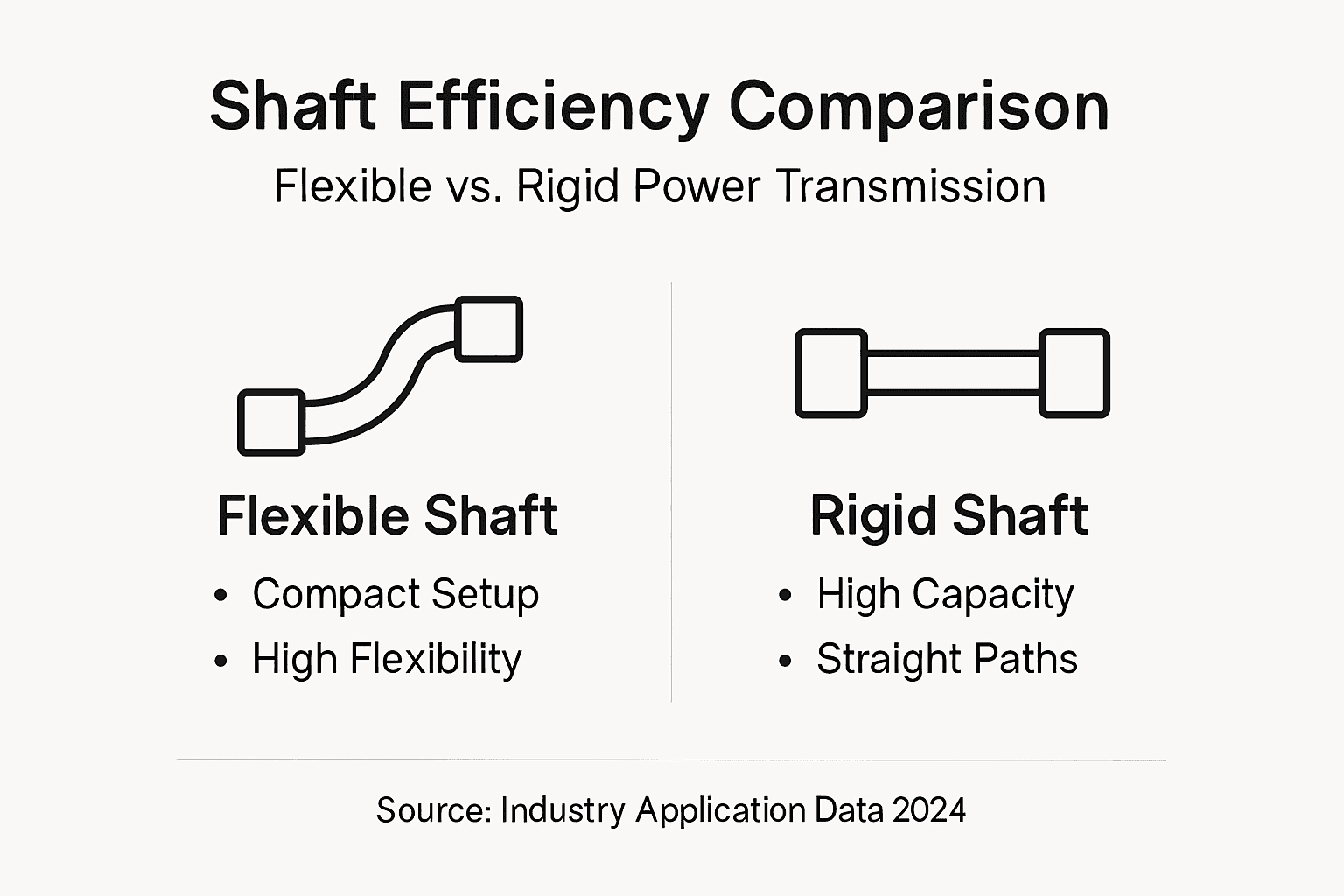
The key advantage: flexible shafts transmit power with minimal heat generation, reducing cooling requirements and extending component life in production environments where space prevents traditional power transmission solutions.
How Elastic Deformation Enables Torque Transmission
Torque transmission in flexible shafts depends on careful control of tensile and compressive forces within wire layers. Design optimization balances stiffness against flexibility, ensuring the shaft can bend and twist while maintaining rotational power delivery.
- Tensile deformation occurs in wires positioned on the shaft’s outer edge during bending
- Compressive deformation affects inner-layer wires as the shaft flexes
- Torsional resistance increases proportionally with wire diameter and layer count
- Load distribution spreads transmitted force across multiple wire paths, preventing stress concentration
The elastic deformation in flexible shaft cores is what allows them to transmit torque reliably while navigating confined spaces that would jam or stall rigid shafts.
Comparison with Alternative Power Transmission Methods
When designing compact machining systems, understanding efficiency differences shapes your power transmission choice:
- Flexible shafts: 85-95% efficiency, compact routing, minimal vibration
- Gear systems: 75-85% efficiency, significant frictional losses, space-intensive
- Belt drives: 70-90% efficiency, slip potential under load, require tensioning
- Universal joints: 60-80% efficiency, limited angle accommodation, vibration-prone
For deburring, grinding, and polishing operations in tight production layouts, flexible shaft efficiency directly reduces motor sizing requirements and operational heat generation.
Designers working on flexible shafts for tight spaces benefit from understanding this torque transmission principle when evaluating core diameter, layer count, and material selections for their specific duty cycle.
Pro tip: Monitor torque transmission efficiency during commissioning by measuring motor current draw under steady-state operation; efficiency loss manifests as unexpected current increases, indicating potential wire layer wear or internal deformation requiring shaft replacement before catastrophic failure occurs.
Industrial applications in compact machining environments
Flexible shaft solutions enable precision machining operations in production environments where traditional rigid shaft systems cannot physically fit or function effectively. The compact nature of flexible shafts transforms spatial limitations into design advantages across multiple manufacturing processes.
Finishing Operations in Confined Spaces
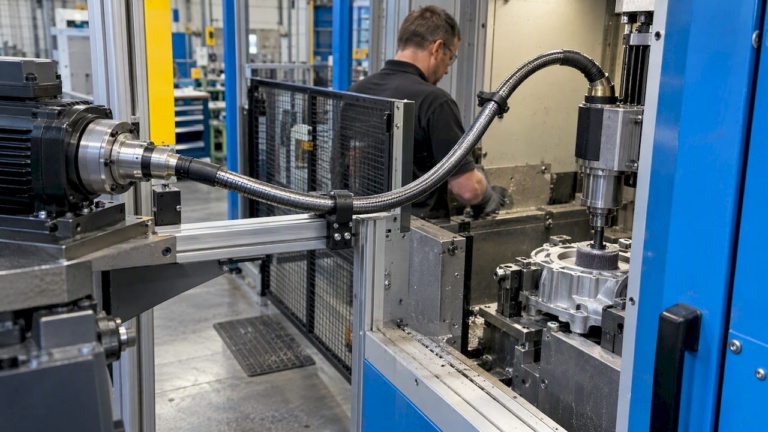
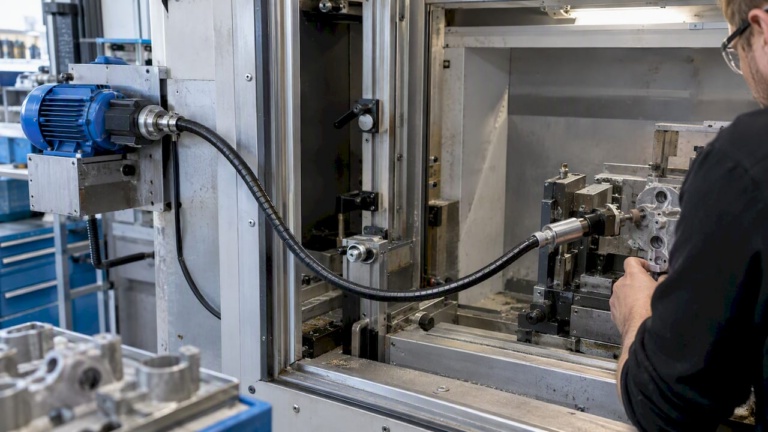
Flexible shafts in industrial environments support critical finishing operations requiring remote motor placement and precision tool control. Deburring, grinding, and polishing applications in tight production layouts benefit from the ability to route drive shafts around obstacles and through narrow access points.
Design engineers specify flexible shafts when conventional equipment layouts would require costly machinery repositioning or facility restructuring. The lightweight construction reduces inertia loads on motors, enabling smaller drive units and faster acceleration profiles.
Specific Applications in European Manufacturing
Production facilities across the DACH region commonly deploy flexible shaft solutions for:
- Deburring stations where tool access requires routing shafts through machine frames
- Grinding operations on precision components in confined workspaces
- Polishing and surface finishing on complex geometries requiring flexible tool positioning
- Valve actuation systems in aerospace thrust reverser mechanisms requiring compact installation
- Synchronization shafts for coordinating multiple tool movements in automated assembly
These applications demand reliable torque transmission combined with spatial flexibility that rigid systems simply cannot deliver.
Concrete Vibrators and Industrial Power Tools
Flexible shafts enable concrete vibrator systems to transmit rotational force through flexible tubes, eliminating rigid connection requirements that would complicate equipment design. This same principle applies to industrial power tools requiring remote actuation in confined work areas.
Flexible shafts reduce operational complexity by separating motor placement from load location, enabling engineers to optimize both aspects independently.
Safety and Inertia Advantages
The lightweight, flexible design delivers measurable operational benefits beyond spatial considerations:
- Reduced inertia enables faster tool acceleration and smoother speed transitions
- Enhanced safety through isolation of rotating motor components from operator proximity
- Lower vibration transmission reduces fatigue loads on mounting structures
- Simplified maintenance access since motors can be positioned remotely for convenient servicing
When designing compact machining environments, these secondary benefits often justify flexible shaft implementation even when space constraints alone would not necessitate them.
Integration with Automation Systems
Flexible shafts in automation platforms support synchronized multi-tool operations where precise timing and coordinated rotation require flexible drive architecture. Manufacturing cells producing high-precision components benefit from the ability to integrate drive systems into compact footprints without sacrificing performance.
Pro tip: When evaluating flexible shaft integration into existing production lines, specify exact mounting constraints, torque requirements, and RPM ranges; this enables suppliers to recommend optimal core diameter and protective casing configurations that prevent performance degradation from coolant exposure or thermal cycling during extended production runs.
Comparisons with rigid shafts and common pitfalls
Choosing between flexible and rigid shaft systems requires understanding fundamental performance trade-offs. Neither solution excels universally; success depends on matching shaft type to application requirements with precision.
Rigid Shafts: Strengths and Constraints
Rigid shafts deliver maximum torque capacity with minimal deformation. They excel in high-power applications where direct motor-to-load alignment is feasible. However, they demand precise alignment, cannot accommodate misalignment, and fail entirely when spatial constraints prevent coaxial positioning.
Rigid shafts remain the standard in conventional production environments where equipment layout permits conventional mounting. They offer proven reliability, minimal maintenance, and predictable performance characteristics across decades of industrial use.
Flexible Shafts: Trade-offs and Advantages
Flexible shafts tolerate misalignment and accommodate complex routing that rigid systems cannot match. They enable remote motor placement and adapt to non-coaxial arrangements that would otherwise require facility redesign.
The trade-off is real: flexible shafts typically exhibit lower maximum torque capacity than equivalent rigid designs. This limitation does not eliminate flexibility from consideration; rather, it requires proper selection based on actual duty cycle demands rather than theoretical maximum capacity.
Common Selection Pitfalls
Design engineers frequently encounter these mistakes when evaluating flexible shaft solutions:
- Undersizing torsional stiffness by failing to account for actual torque requirements during peak operational loads
- Ignoring environmental protection allowing coolant and chip exposure to degrade wire construction prematurely
- Exceeding bend radius limits by routing shafts through curves tighter than design specifications permit
- Insufficient shaft length planning that creates tension and accelerated wear on internal wires
- Inadequate coupling interface selection causing slippage and torque loss during operation
Premature flexible shaft failure typically stems not from design limitations but from improper environmental protection or installation that violates minimum bend radius constraints.
Wire Fatigue and Lifespan Considerations
Cable fatigue and torsional backlash emerge when shafts experience cyclic stress beyond design parameters or operate without protective casing in harsh environments. Wire friction accelerates wear when coolant or abrasive particles contaminate the core.
Proper material selection and protective jacketing extend flexible shaft lifespan significantly. Stainless steel construction resists corrosion in wet machining environments, while comprehensive casing shields internal wires from chip exposure.
When to Specify Flexible vs. Rigid Solutions
Flexible shafts solve problems rigid systems cannot address. Specify flexible shafts when:
- Space constraints prevent direct motor-to-load alignment
- Misalignment or angular offset exceeds rigid shaft tolerance
- Complex routing through machine frames is necessary
- Remote actuation improves safety or operational efficiency
Specify rigid shafts when maximum torque capacity, minimal backlash, or lowest cost justifies the layout constraints they impose.
Here’s a concise comparison of flexible and rigid shaft systems for industrial applications:
| Criteria | Flexible Shafts | Rigid Shafts |
|---|---|---|
| Spatial Adaptability | Fits complex and tight layouts | Requires direct alignment |
| Torque Capacity | Moderate; depends on wire design | High; suitable for heavy loads |
| Installation Flexibility | Allows remote motor positioning | Motor and load must be coaxial |
| Maintenance Needs | Needs protection and periodic checks | Minimal; very predictable lifespan |
| Vibration Handling | Absorbs and reduces vibrations | Transmits vibrations directly |
| Typical Applications | Compact machining, automation | Standard production, heavy-duty |
This table summarizes system traits to help engineers select the best shaft type for specific design requirements.
Evaluating practical shaft drive examples for similar applications helps inform your selection criteria and avoids repeating common mistakes.
Pro tip: Calculate realistic duty cycle torque requirements and specify flexible shaft core diameter with 20-30% capacity margin above actual peak loads; this reserves strength for thermal cycling and operational uncertainties while preventing undersizing errors that lead to premature wire fatigue and unexpected downtime.
Discover Tailored Flexible Shaft Solutions for Your Compact Design Needs
Facing the challenge of transmitting torque and rotation in tight or complex spaces is common in many industrial applications. If you are struggling with space limitations, misalignment, or the need for remote motor placement, flexible shaft drives provide a reliable and efficient alternative to rigid shaft systems. Our expertise at BIAX Flexwellen lies in understanding these pain points and delivering custom-engineered flexible shafts that match your exact torque, RPM, and environmental requirements.
Whether your project involves deburring, polishing, grinding, or any precision finishing process, our solutions are designed to maximize operational efficiency while reducing downtime caused by misfit or improper shaft design. Explore how our Uncategorized Archive – BIAX Flexwellen offers insights into practical shaft drive applications and design tips. Ready to unlock compact efficiency and boost your machining performance? Contact our engineering team today for tailored advice and proven flexible shaft configurations. Visit BIAX Flexwellen Contact to discuss your project and ensure you select the optimal drive solution that transforms your space constraints into operational success.
Frequently Asked Questions
What is a flexible shaft drive solution?
A flexible shaft drive solution is a power transmission system that transmits torque and rotation between locations with spatial constraints or misalignment, allowing for three-dimensional movement while maintaining efficiency.
How do flexible shafts transmit torque effectively?
Flexible shafts transmit torque through multiple layers of wound wires that deform elastically, allowing for torsional compliance and flexibility without structural failure, achieving 85% to 95% efficiency in power transmission.
What are the main advantages of using flexible shafts in manufacturing?
Flexible shafts offer several advantages, including compact geometry for tight spaces, torsional flexibility for remote motor placement, high rotational speed capability, shock absorption, and suitability for automation systems.
In which applications are flexible shafts most commonly used?
Flexible shafts are commonly used in applications such as deburring, grinding, polishing, valve actuation, and tasks requiring remote motor placement in confined workspaces.
Recommended
- Flexible Shafts for Tight Spaces: Boosting Precision
- 7 Practical Examples of Shaft Drive Solutions for Engineers
- Flexible Shafts in Automation: Precision in Tight Spaces – BIAX Flexwellen
- Custom Flexible Shaft Configuration Guide for Engineers
- Continuing Education: Driving Success for Manufacturers
Related Topics
Send your spec inquiry
Custom flexible shafts for your application — we quote within 1 working day.