Flexible shafts in robotics: benefits and applications
20 March 2026Engineers designing industrial robots face a persistent challenge: how do you transmit torque efficiently when motors can’t sit directly at the point of action? Misalignment, vibration, and cramped spaces create mechanical nightmares that rigid drive systems simply can’t solve. Flexible shafts transmit torque and rotary motion between misaligned or remotely located components in robotics, accommodating non-linear paths, misalignment, vibration, and limited access areas. This article explores how flexible shafts unlock new possibilities in robotic design, from exoskeletons to precision manufacturing systems, delivering practical insights for mechanical engineers seeking innovative drive solutions.
Table of Contents
- How Flexible Shafts Transmit Torque In Complex Robotic Systems
- Flexible Shafts Enabling Remote Actuation In Robotic Exoskeletons And Joints
- Comparing Flexible Shafts To Traditional Rigid Shafts And Other Drive Mechanisms In Robotics
- Practical Tips For Integrating Flexible Shafts Into Industrial Robotic Designs
- Explore Flexible Shaft Solutions For Your Robotic Applications
- Frequently Asked Questions
Key takeaways
| Point | Details |
|---|---|
| Misalignment tolerance | Flexible shafts accommodate angular and parallel offsets that would cause rigid shaft failure in robotic systems. |
| Remote actuation capability | Motors can be positioned away from joints, reducing weight and inertia at critical movement points. |
| Vibration damping | Built-in flexibility absorbs vibrations that degrade precision and accelerate component wear in automation. |
| Space efficiency | Complex routing through tight spaces enables compact robot designs impossible with straight shaft runs. |
| Manufacturing precision | Consistent torque transmission maintains accuracy in finishing operations like deburring and polishing. |
How flexible shafts transmit torque in complex robotic systems
Robotic systems demand drive solutions that can navigate around obstacles, bend through tight corners, and maintain torque transmission despite constant motion. Traditional rigid shafts fail when faced with these requirements, forcing designers into compromises that limit robot capabilities or increase system complexity.
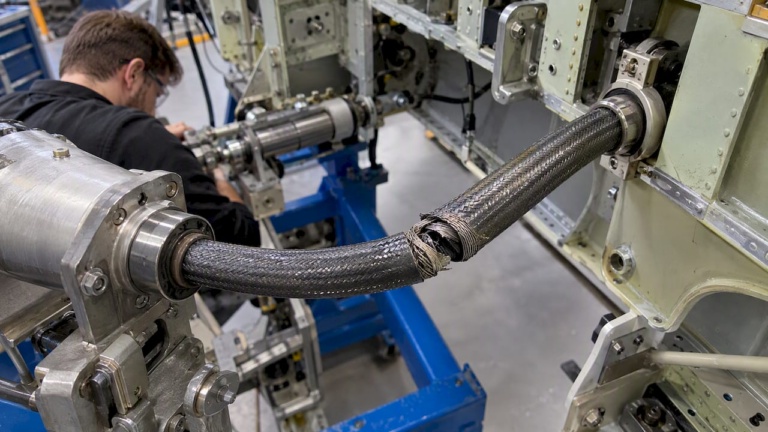
Flexible shafts solve this fundamental problem through their unique construction. A helically wound wire core allows the shaft to bend while maintaining torsional rigidity, transmitting rotational force through curves and offsets that would snap a rigid shaft. This capability transforms how engineers approach machine design efficiency with flexible shafts, particularly in applications where space constraints or dynamic motion paths make conventional drive systems impractical.
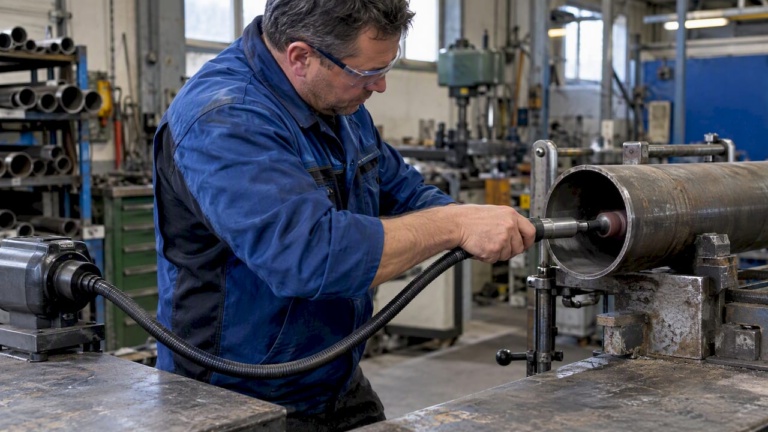
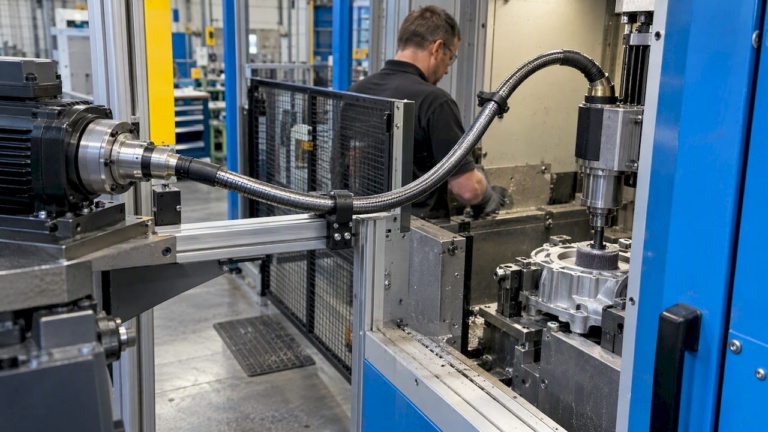
The mechanical advantages extend beyond simple flexibility. Efficient flexible shafts in tight spaces maintain 85 to 95 percent power transmission efficiency even when routed through complex paths. This performance makes them ideal for robotic end effectors that perform finishing operations, where motors must be mounted remotely to reduce tool weight while delivering precise rotational force to grinding or polishing attachments.
Common robotic applications include:
- Deburring tools on collaborative robot arms where motor weight at the end effector would compromise payload capacity
- Polishing systems in automotive manufacturing requiring flexible routing around body panels
- Inspection devices with cameras and sensors that need rotation in confined spaces
- Assembly tools that must reach into tight cavities while maintaining torque for fastening operations
- Cleaning equipment on mobile robots navigating variable terrain and obstacles
The engineering challenges flexible shafts address go beyond simple mechanical routing. Vibration isolation becomes critical in precision robotics, where oscillations from motors or external sources can degrade accuracy. The helical construction naturally damps these vibrations, protecting sensitive components and improving overall system performance. Parallel offset capabilities allow motors to be positioned where weight distribution is optimal rather than being constrained by direct alignment requirements.
Pro Tip: Calculate the minimum bend radius based on your torque requirements before finalizing robot geometry. Tighter curves reduce shaft lifespan exponentially, so design paths with the largest practical radius to maximize durability and maintain consistent performance over millions of cycles.
Flexible shafts enabling remote actuation in robotic exoskeletons and joints
Exoskeletons represent one of the most demanding applications for flexible drive technology. These wearable robots must assist human movement without adding excessive weight or restricting natural motion patterns. Placing heavy motors directly at shoulder or elbow joints would create unacceptable inertia, making the device more burden than aid.
In robotic exoskeletons, flexible shafts enable remote actuation by positioning heavy motors near the wearer’s center of mass while transmitting torque to shoulder joints, maintaining kinematic compatibility with human motion. This approach concentrates mass at the torso where it has minimal impact on natural movement, then routes rotational force through flexible shafts to joints that require assistance. The result is a system that feels responsive and natural rather than fighting against the wearer’s intended movements.

Quantitative performance data demonstrates the viability of this approach:
| Parameter | Specification | Impact on Design |
|---|---|---|
| Maximum torque | 5 Nm | Sufficient for shoulder assistance during lifting tasks |
| Gearbox ratio | 3.5:1 backdrivable | Allows natural motion when assistance is not needed |
| Shaft diameter | 4 mm | Minimal profile for routing along limbs without bulk |
| Efficiency | 88 to 92 percent | Acceptable power loss for battery-operated systems |
The backdrivability specification deserves special attention. In human-robot interaction, the system must not resist natural movement when the wearer moves without assistance. A backdrivable gearbox combined with a flexible shaft allows the joint to move freely, with the motor following rather than fighting. This characteristic is essential for safety and user acceptance in assistive robotics.
Key advantages of remote actuation through flexible shafts include:
- Reduced rotational inertia at joints improves response time and reduces energy consumption during rapid movements
- Lower distal mass decreases metabolic cost for the wearer compared to joint-mounted motors
- Flexible routing accommodates the complex motion paths of human joints without binding or restricting range of motion
- Vibration isolation prevents motor oscillations from being transmitted directly to the wearer’s body
- Simplified maintenance with motors accessible at the torso rather than embedded in joint mechanisms
The kinematic compatibility issue is more subtle but equally important. Human shoulder joints move through complex three-dimensional paths that would bind rigid shafts. Flexible shafts accommodate these motion patterns without introducing unwanted forces that would alter natural biomechanics. This capability is critical not just for comfort but for preventing injury from repetitive unnatural loading patterns.
Pro Tip: When designing exoskeletons or other human-interactive robots, prioritize low-inertia flexible shaft configurations and test backdriveability under realistic load conditions. A system that feels sluggish or resistant will be rejected by users regardless of its assistance capabilities, so tune the entire drive train for transparency during passive movement.
Comparing flexible shafts to traditional rigid shafts and other drive mechanisms in robotics
Engineers face multiple options when selecting drive mechanisms for robotic systems. Understanding the tradeoffs between flexible shafts, rigid shafts, and alternative technologies is essential for making informed design decisions that balance performance, cost, and reliability.
Rigid shafts excel in applications with perfect alignment and ample space for straight runs. Their simple construction and high efficiency make them attractive when conditions allow. However, robotics rarely provides ideal conditions. Misalignment from manufacturing tolerances, thermal expansion, or dynamic motion quickly leads to bearing wear, vibration, and premature failure in rigid shaft systems.
The comparison becomes clearer when examining specific performance characteristics:
| Feature | Flexible Shaft | Rigid Shaft | Belt Drive | Cable Drive |
|---|---|---|---|---|
| Alignment tolerance | ±15 degrees angular, significant parallel offset | Requires precise alignment within 0.1 mm | Moderate, requires tensioning | High, but efficiency suffers |
| Space efficiency | Routes through complex paths | Requires straight line of sight | Needs pulley clearance | Compact but limited torque |
| Vibration damping | Excellent natural damping | Transmits all vibration | Moderate damping | Poor damping |
| Maintenance frequency | Low, primarily lubrication | Moderate, bearing replacement | High, belt tensioning and replacement | High, cable stretch and wear |
| Torque transmission | Consistent across bending | Highest when aligned | Variable with tension | Limited by cable strength |
| Installation complexity | Simple, flexible routing | Requires precise machining | Moderate, alignment critical | Simple but requires tensioning |

Belt and cable drives offer flexibility but introduce compliance that can compromise precision. In robotic finishing operations where tool position must be maintained within micrometers, the elasticity of belts or cables creates positioning errors that flexible shafts avoid through their torsionally rigid construction.
The maintenance advantage of flexible shafts becomes significant in industrial environments. Flexible shafts offer advantages over rigid shafts by allowing misalignment, wider installation options, and vibration damping while maintaining high torque transmission efficiency. Reduced bearing loads from vibration isolation and misalignment tolerance translate directly to longer service intervals and lower total cost of ownership.
Considerations for selecting the appropriate shaft solution:
- Evaluate the actual installation path, including obstacles, required bends, and available clearances
- Calculate cumulative misalignment from all sources including manufacturing tolerances, thermal effects, and dynamic motion
- Assess vibration sources and their impact on precision requirements and component lifespan
- Consider maintenance access and the cost of downtime for your specific application
- Analyze duty cycle and torque requirements to ensure adequate safety margin in shaft selection
The decision often comes down to whether your application can guarantee the perfect conditions rigid shafts require or whether real-world constraints demand the adaptability of flexible shafts. For most robotic applications, particularly those involving flexible shafts in automation, the ability to accommodate imperfect conditions outweighs the slight efficiency advantage of rigid systems.
Practical tips for integrating flexible shafts into industrial robotic designs
Successful integration of flexible shafts requires attention to selection criteria, installation practices, and ongoing maintenance. Following a systematic approach ensures optimal performance and maximizes shaft lifespan in demanding robotic applications.
Step-by-step selection process:
- Calculate maximum torque requirements including safety factor for shock loads and startup transients that can exceed steady-state values by 200 to 300 percent.
- Map the complete shaft path including all bends, measuring the radius of each curve to verify it exceeds manufacturer minimum specifications.
- Determine rotational speed requirements and verify the shaft’s critical speed is at least 50 percent above maximum operating RPM to avoid resonance.
- Assess environmental factors including temperature extremes, exposure to coolants or chemicals, and potential contamination from debris.
- Select appropriate end fittings that match your motor and driven component interfaces, considering whether quick-disconnect capability is needed for maintenance.
- Specify shaft length with adequate slack for dynamic motion if the robot path changes during operation, but avoid excess length that introduces unnecessary compliance.
Installation best practices prevent the premature wear that undermines flexible shaft advantages. Support the shaft at regular intervals to prevent sagging that increases bending stress. Avoid sharp transitions where the shaft enters or exits casings, using gradual curves or guide bushings to distribute bending loads. Ensure end fittings are properly tightened to specification, as loose connections cause fretting wear that quickly degrades performance.
The path geometry deserves careful attention during installation. While flexible shafts accommodate bends, each curve reduces efficiency and increases wear. Design the shortest practical path that maintains bend radii above minimum specifications. When multiple bends are unavoidable, orient them in different planes rather than compound curves in the same plane, which concentrate stress.
Maintenance extends shaft life significantly when performed consistently:
- Inspect shaft condition monthly in high-duty applications, looking for kinks, fraying of the outer casing, or unusual noise during operation
- Lubricate according to manufacturer specifications, typically every 500 to 1000 operating hours depending on speed and load
- Monitor operating temperature, as excessive heat indicates inadequate lubrication or overloading that will cause rapid degradation
- Check end fitting tightness quarterly, as vibration can loosen connections over time
- Replace shafts at the first sign of degradation rather than waiting for complete failure that could damage connected components
Overcome vibration, misalignment, and blocked paths using flexible shafts to extend shaft life and maintain efficiency in robotics. Proper selection and maintenance can achieve service life exceeding 10,000 hours in industrial robotic applications.
The precision in flexible shaft manufacture directly impacts performance. Quality shafts use carefully controlled wire winding patterns that balance flexibility with torsional rigidity. Inferior products may appear similar but fail prematurely under load or exhibit excessive backlash that compromises positioning accuracy. Specify shafts from manufacturers with documented quality systems and application engineering support.
Configuration options allow optimization for specific applications. Variable-pitch winding adjusts flexibility along the shaft length, placing tighter winds in high-stress areas. Specialized coatings protect against corrosive environments. Custom end fittings eliminate adapters that add length and potential failure points. Engineers should select flexible shafts for precision machinery with attention to these details that separate adequate performance from optimal results.
Pro Tip: Engage with flexible shaft manufacturers during the design phase rather than treating shaft selection as an afterthought. Application engineers can recommend configurations optimized for your specific requirements and identify potential issues before you commit to a robot geometry that creates unnecessary constraints or performance compromises.
Explore flexible shaft solutions for your robotic applications
BIAX Flexwellen specializes in flexible shaft drive solutions engineered for demanding industrial robotics and automation systems. Our product range includes standard components for common applications and custom configurations tailored to your specific torque, speed, and geometric requirements.
Our custom flexible shaft configuration guide walks you through the selection process, helping you specify the optimal shaft design for your application. We provide engineering support to analyze your installation path, calculate performance parameters, and recommend end fittings that integrate seamlessly with your existing components.
The compact design and high efficiency of BIAX flexible shafts enable robot configurations that would be impractical with rigid drive systems. Our focus on precision manufacturing ensures consistent performance and industrial shaft applications and shaft life that reduces maintenance costs and downtime.
Contact our engineering team to discuss your robotic drive requirements and discover how flexible shafts can solve your toughest torque transmission challenges.
Frequently asked questions
What is a flexible shaft and how does it differ from a rigid shaft?
A flexible shaft transmits torque through a helically wound wire core that bends while maintaining torsional rigidity, allowing power transmission through curved paths. Rigid shafts require straight, precisely aligned installation and fail when subjected to angular or parallel misalignment. Flexible shafts accommodate complex routing around obstacles and through confined spaces where rigid shafts cannot function.
How do flexible shafts improve robot joint performance?
Flexible shafts enable remote actuation, allowing heavy motors to be positioned away from joints to reduce weight and rotational inertia at movement points. They absorb vibration that would otherwise degrade precision and accelerate bearing wear in robotic systems. The result is more compact, ergonomically compatible robot designs with improved dynamic response and lower energy consumption.
What factors should engineers consider when selecting flexible shafts?
Prioritize torque capacity with adequate safety factor for shock loads, verify bend radius specifications match your installation path, and assess environmental conditions including temperature and chemical exposure. Evaluate compatibility with your duty cycle and rotational speed requirements to avoid resonance issues. Work directly with manufacturers on custom configurations when standard products don’t meet your specific interface or performance needs.
Can flexible shafts maintain efficiency in tight, vibration-prone spaces?
Flexible shafts maintain 85 to 95 percent transmission efficiency even when routed through complex paths in confined spaces. The helical construction naturally damps vibration while accommodating the misalignment common in compact robotic systems. This combination makes flexible shafts ideal for automation applications where space constraints and vibration would cause premature failure of rigid drive mechanisms.
Recommended
- Flexible Shafts Maintain 85-95% Efficiency in Tight Spaces
- How flexible shafts improve machine design efficiency
- Flexible Shafts for Tight Spaces: Boosting Precision
- Flexible Shafts in Automation: Precision in Tight Spaces – BIAX Flexwellen
Related Topics
Send your spec inquiry
Custom flexible shafts for your application — we quote within 1 working day.