Precision engineering terminology explained for manufacturing
15 May 2026TL;DR:
- Misinterpreting technical terms on drawings can cause costly rework, scrap, and inspection failures in precision engineering. Understanding the differences between accuracy, precision, tolerance types, and GD&T controls is essential for reliable manufacturing and inspection processes. Mastery of terminology enhances communication, reduces rework, and improves overall production ROI in high-precision environments.
Misinterpreting a single term on a technical drawing can trigger a cascade of costly consequences: scrapped batches, failed inspections, and rework cycles that erode margins on high-value components. Even experienced mechanical design engineers sometimes conflate accuracy with precision, or apply the wrong tolerance type, with results that surface only after machining is complete. Precision engineering involves the accurate definition, control, and verification of dimensions, geometry, and surface characteristics in machined components where tight tolerances ensure functional reliability. This guide builds a clear, process-linked vocabulary to reduce that risk.
Table of Contents
- Core precision engineering terms and definitions
- Demystifying GD&T: From symbols to shop floor
- Tolerance, grinding, polishing, and deburring: Process impacts clarified
- Process capability and advanced considerations
- Why mastering terminology means fewer rejected parts (and higher ROI)
- Boost your precision engineering outcomes
- Frequently asked questions
Key Takeaways
| Point | Details |
|---|---|
| Clear terms drive quality | Using precise language ensures reliable manufacturing and reduces costly errors. |
| GD&T standardizes precision | Mastering GD&T links design intent with actual inspection and production accuracy. |
| Finishing process impacts matter | Grinding, polishing, and deburring each achieve different tolerances and finishes, directly affecting performance. |
| Capability metrics prevent defects | Metrics like Cp and Cpk help you validate if processes will consistently meet tight specs. |
| Application beats memorization | True expertise is connecting terminology with real-world decisions and process improvements. |
Core precision engineering terms and definitions
With the need for clarity established, defining the most critical terms and their impact on engineering project outcomes is the logical starting point.
Accuracy describes how close a measured value is to the true or nominal value. Precision, often called repeatability, describes how consistently a process produces the same result regardless of whether that result is correct. These two concepts are frequently confused, and the distinction has direct production consequences. A machine tool can be highly precise but inaccurate, producing consistent parts that are consistently wrong.
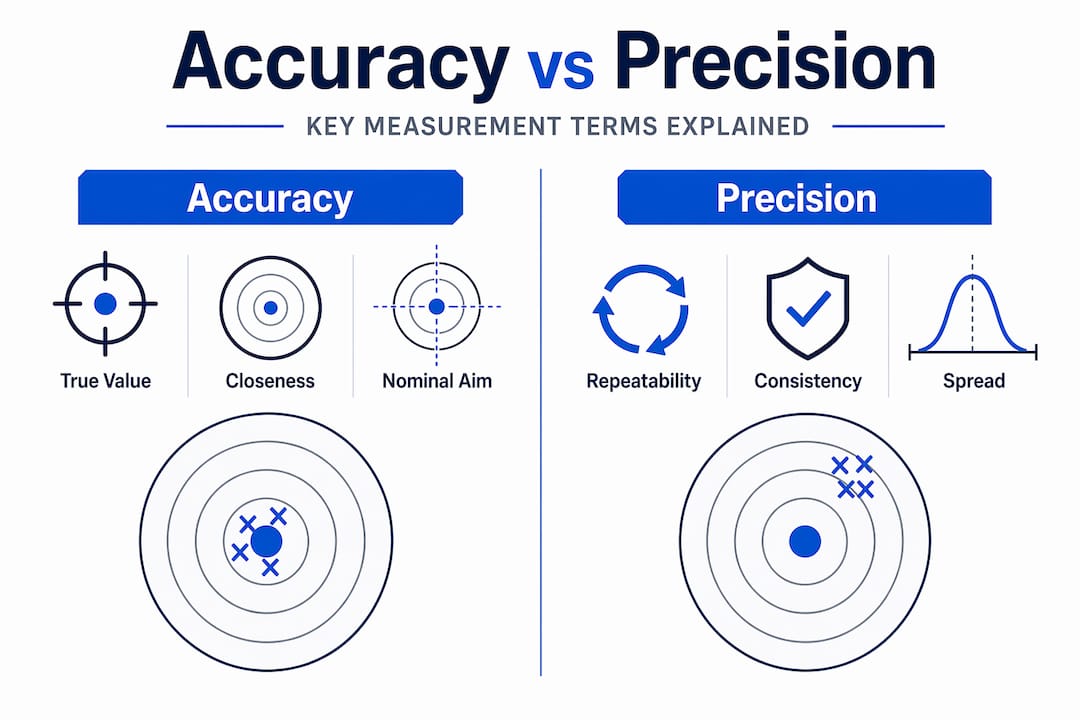
Key terms in CNC quality include accuracy (closeness to true value), precision/repeatability (consistency of measurements), bilateral tolerance (variation permitted on both sides of nominal), CMM (Coordinate Measuring Machine for 3D measurements), and MMC (Maximum Material Condition, which permits bonus tolerance when a feature departs from its maximum material size).
Tolerance defines the permissible deviation from a nominal dimension. Two primary types appear in engineering drawings:
- Unilateral tolerance: Variation is permitted in only one direction from nominal (e.g., +0.00 / -0.02 mm). Common for shafts fitting into fixed bores.
- Bilateral tolerance: Variation is permitted in both directions (e.g., ±0.01 mm). Typical for general dimensional control.
Geometric features add a further layer of precision control. Circularity (also called roundness) defines how closely a cross section of a cylinder conforms to a perfect circle. Flatness defines the deviation of a surface from a perfect plane. Both are measured independently of size tolerances and require specific inspection methods, often a CMM.
| Term | Definition | Common confusion |
|---|---|---|
| Accuracy | Closeness to true/nominal value | Often used interchangeably with precision |
| Precision | Repeatability across multiple measurements | Does not imply correctness |
| Unilateral tolerance | Variation in one direction only | Confused with bilateral in drawing interpretation |
| Bilateral tolerance | Variation in both directions from nominal | Not always symmetric |
| CMM | Coordinate Measuring Machine for 3D inspection | Seen as optional, not mandatory |
| MMC | Maximum Material Condition for bonus tolerance | Overlooked during tolerance stack-up analysis |
Confusing accuracy with precision in a tolerance stack-up analysis is one of the most common causes of systematic part rejection. Both concepts must be addressed independently in process planning.
Understanding metal fabrication terms alongside precision engineering vocabulary helps engineers communicate requirements consistently across machining, fabrication, and finishing teams. For considerations tied directly to component geometry, shaft design for precision applications adds another dimension to how these terms translate into physical product decisions.
Demystifying GD&T: From symbols to shop floor
Once the core vocabulary is in place, the next layer of precision language is Geometric Dimensioning and Tolerancing (GD&T), which formalizes geometric control beyond basic dimensions.
GD&T is a symbolic language per ASME Y14.5 that defines allowable geometric variation beyond basic dimensions, controlling form, orientation, location, profile, and runout. It replaces ambiguous coordinate tolerancing with standardized controls that apply consistently across design, machining, and inspection functions.
GD&T is organized into five categories, each controlling a distinct geometric characteristic:
| Category | Example symbols | Shop-floor meaning |
|---|---|---|
| Form | Straightness, flatness, circularity, cylindricity | Controls shape of a single feature, no datum needed |
| Orientation | Perpendicularity, angularity, parallelism | Relates feature angle to a datum reference |
| Location | True position, concentricity, symmetry | Controls position of a feature relative to a datum |
| Profile | Profile of a line, profile of a surface | Controls complex curves and surfaces |
| Runout | Circular runout, total runout | Controls surface variation around an axis of rotation |
The 3-2-1 rule defines how a datum reference frame is established: three points constrain a primary datum plane, two points constrain a secondary datum, and one point constrains a tertiary datum. This framework ensures that inspection is repeatable and that parts are evaluated in the same orientation used during machining. Inconsistency in datum setup is a primary cause of “good parts failing inspection,” where components are geometrically compliant but fail because they were measured from a different reference than specified.
Steps for interpreting GD&T on engineering drawings:
- Identify the datum reference frame. Note which surfaces are designated A, B, and C.
- Read the feature control frame from left to right: characteristic symbol, tolerance value, and datum references.
- Determine whether a material condition modifier (MMC or LMC) applies. This affects the tolerance zone size.
- Cross-reference the tolerance type with the measurement equipment available. Some GD&T controls require CMM; others can use standard gauges.
- Verify that machining setups use the same datum surfaces specified in the drawing. Mismatched datums between operations are a leading cause of inspection failures.
Pro Tip: Before machining, confirm that the inspection team’s datum setup matches the machining fixture. A part clamped differently on the CMM than during milling will generate inspection failures that reflect fixturing errors, not dimensional errors. This is one of the most avoidable sources of scrap in precision work.
Considering how automation is changing sheet metal fabrication also signals how GD&T interpretation must keep pace with automated inspection systems. For engineers working with flexible shafts in automation environments, GD&T controls on coupling interfaces and shaft interfaces are equally critical for reliable power transmission.
Tolerance, grinding, polishing, and deburring: Process impacts clarified
With GD&T establishing the language, the next step is connecting those terms to the physical capabilities of actual finishing processes.
Each manufacturing process has a defined envelope of achievable tolerances and surface finishes. Selecting a process without understanding this envelope leads directly to either unreachable specifications or unnecessary cost. Precision grinding achieves tolerances of ±0.001 to ±0.005 mm and surface finishes of Ra 0.2 to 0.8 µm, compared to CNC machining tolerances of ±0.01 to ±0.02 mm with Ra 0.8 to 3.2 µm. Grinding is specifically suited for hardened materials above HRC 50, bearing fits, and sealing surfaces where CNC alone cannot meet functional requirements.
Surface finish benchmarks by process span a wide range: polishing and lapping achieve Ra 0.01 to 0.1 µm (N1 to N3 scale), precision grinding achieves Ra 0.2 to 0.8 µm (N4 to N6), and standard CNC machining produces Ra 1.6 to 3.2 µm (N7 to N8). Ra (average roughness) alone can be misleading; Rz (peak-to-valley height) is more informative for applications such as orthopedic implants or hydraulic seals where surface peak geometry affects function.
Deburring involves the post-machining removal of burrs and debris. Vibratory or tumble deburring typically achieves Ra 0.4 to 1.6 µm, while electropolishing delivers Ra 0.1 to 0.4 µm and is preferred for medical-grade components. Deburring is not a surface finishing process in the dimensional sense, but improper deburring can damage functional surfaces and compromise tolerances already achieved by grinding.
| Process | Typical tolerance | Surface finish (Ra) | Key application |
|---|---|---|---|
| CNC machining | ±0.01 to ±0.02 mm | 0.8 to 3.2 µm | General precision parts |
| Precision grinding | ±0.001 to ±0.005 mm | 0.2 to 0.8 µm | Hardened parts, bearing fits |
| Polishing / lapping | ±0.001 mm or better | 0.01 to 0.1 µm | Optical, medical, sealing |
| Vibratory deburring | Not a sizing process | 0.4 to 1.6 µm | Edge finishing, batch parts |
| Electropolishing | Not a sizing process | 0.1 to 0.4 µm | Medical, corrosion resistance |
Grinding achieves 2 to 10 times tighter tolerances than standard CNC machining and reduces scrap rates to below 2% in well-controlled operations. That statistic carries direct cost implications: on high-value aerospace or medical components, a 2% scrap rate versus a 15% scrap rate from incorrect process selection represents significant per-unit cost differences.
Common production risks from misunderstood terminology:
- Specifying Ra when Rz is the functionally relevant parameter, leading to surface defects in sealing applications
- Applying bilateral tolerance where unilateral is required, causing interference fits to fail assembly
- Requesting grinding-class tolerances on a CNC-only line, making parts impossible to produce within specification
- Treating deburring as a finishing step capable of correcting dimensional errors from prior machining
- Overlooking the effect of heat-treat distortion on tolerances, requiring post-heat-treat grinding to restore geometry
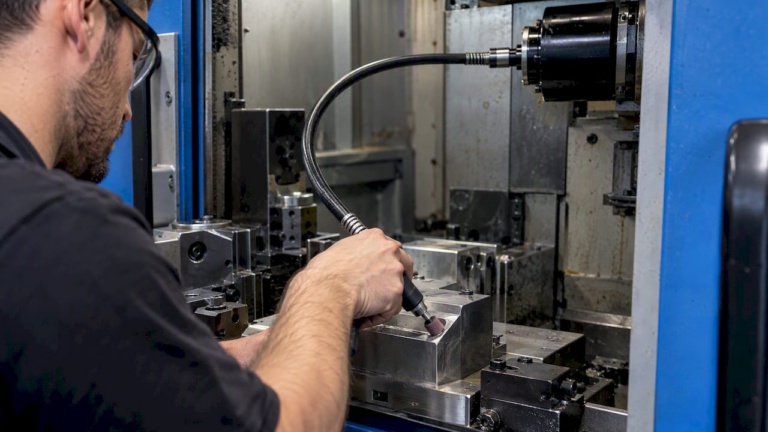
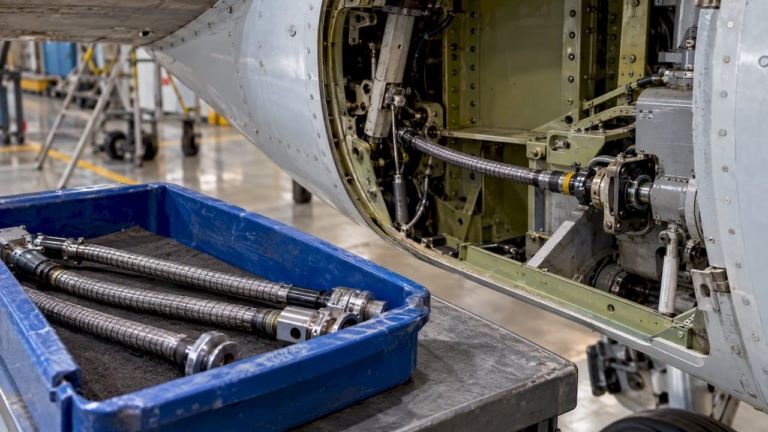
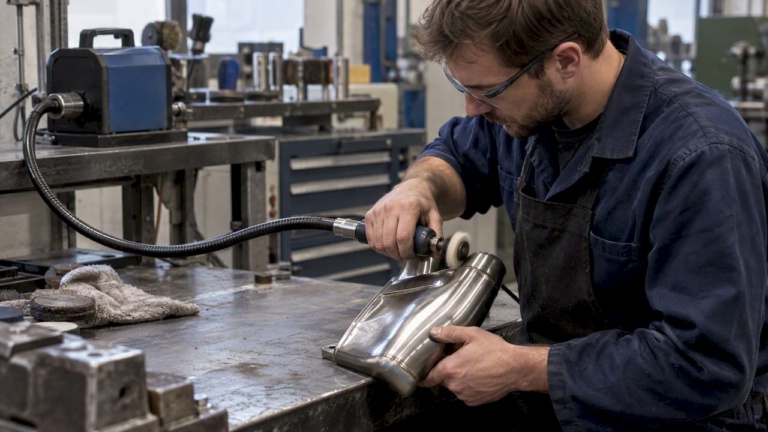
For finishing operations in tight or complex geometries, flexible shafts for tight spaces provide access to surfaces that conventional rigid tooling cannot reach, maintaining the surface finish requirements of the design. Additional application context is available for engineers focused on improving access for finishing in complex assemblies. Supporting services such as laser cutting and stamping also intersect with these tolerance and surface considerations in fabricated components.
Process capability and advanced considerations
Correct terminology and the right process selection still require verification. That is where process capability metrics become essential tools for production engineers.

Cp (process capability) measures how well a process fits within its specification limits assuming it is perfectly centered. Cpk (process capability index) accounts for process centering, measuring the distance from the process mean to the nearest specification limit. Cpk correlates directly to PPM defect rates; a Cpk of 1.33 yields approximately 64 PPM defects, while a Cpk of 1.67 drops to about 0.6 PPM. For high-volume precision manufacturing, the difference between these two values is commercially significant.
Steps to align process capability with terminology requirements:
- Convert all drawing tolerances into measurable acceptance criteria with explicit upper and lower limits.
- Run an initial capability study (minimum 30 samples) to calculate Cp and Cpk before committing to full production.
- If Cpk falls below 1.33, identify whether the issue is process centering (adjust offsets) or process spread (review tooling, fixturing, or thermal compensation).
- Document the measurement system uncertainty. A CMM with 1 µm uncertainty measuring a ±0.005 mm tolerance consumes 20% of the tolerance budget on measurement alone.
- Establish a control plan that links each critical characteristic to its measurement frequency and response protocol.
Pro Tip: For thin-wall components below 0.3 mm in titanium or similar materials, CNC machining struggles with deflection and thermal effects at tight tolerances. Grinding minimizes cutting forces and reduces thermal input, making it the reliable choice for these geometries. Thin walls require a fundamentally different process strategy, not just tighter machine settings.
Hard turning is a viable alternative to grinding for materials above 45 HRC, offering faster cycle times and single-setup flexibility. However, grinding remains preferred for post-heat-treat operations where dimensional stability is critical and tolerances are in the ±0.001 to ±0.003 mm range. The decision between hard turning and grinding should be based on the tolerance range, surface finish requirement, and required Cpk, not on machine availability alone.
For engineers focused on optimizing shaft design in high-load or high-precision configurations, capability metrics must be factored into the design tolerances assigned to critical features such as coupling interfaces and bearing seats. Selecting a metal fabricator with demonstrated Cpk data is equally critical; resources on selecting a metal fabricator for precision projects offer a useful framework for supplier qualification.
Why mastering terminology means fewer rejected parts (and higher ROI)
There is a perspective that terminology is a secondary concern compared to machine capability or tooling selection. That view is incorrect and costly.
Errors in terminology propagate through the entire product lifecycle. A drawing that specifies bilateral tolerance where unilateral is required will generate interference fits that fail assembly. A surface finish specified in Ra instead of Rz will pass inspection but fail in service on a hydraulic sealing surface. These are not machinist errors. They are communication failures rooted in imprecise language.
The real value of mastering this vocabulary lies in what it enables: clean translation of functional requirements from design intent through supplier negotiation, manufacturing execution, and final inspection. Every stakeholder in that chain reads the same drawing and interprets the same symbols. When terminology is applied consistently and correctly, rework rates fall, supplier relationships improve, and inspection becomes a confirmation step rather than a discovery step.
There is also an alignment function that is often underestimated. When a production engineer and a quality engineer use the same definition of Cpk, the conversation about process improvement is shorter and more productive. When a design engineer and a machinist agree on what bilateral tolerance means in context, the first article is more likely to be correct. These are direct contributions to ROI.
Reviewing precision insights for 2026 highlights how the industry is moving toward tighter integration of design data, inspection data, and process data. In that environment, terminology precision is not a soft skill. It is an engineering requirement.
Boost your precision engineering outcomes
Applying this terminology correctly in production requires both the right knowledge and the right tooling. BIAX Flexwellen supports mechanical design and production engineers with specialized flexible shaft solutions designed for deburring, grinding, polishing, and other precision finishing processes in tight or complex geometries. Explore the full range of flexible shaft applications to identify the right configuration for your process requirements. For engineers designing precision components with demanding coupling or interface specifications, the precision shaft design guide provides step-by-step support. Contact the BIAX Flexwellen engineering team directly for custom configurations matched to your torque, RPM, and access requirements.
Frequently asked questions
What is the difference between accuracy and precision in engineering?
Accuracy refers to closeness to the true value, while precision refers to the repeatability of measurements regardless of their correctness. Both must be controlled independently in any reliable measurement or production system.
What does Ra surface finish mean, and what is considered a fine finish?
Ra is the arithmetic average of surface profile deviations from the mean line. Values below 0.4 µm, achieved by grinding or lapping, are generally considered fine finishes and are required for bearing fits, sealing surfaces, and medical components.
Why do parts pass machining but fail inspection for GD&T?
A mismatch between machining and inspection datums means that a part measured from a different reference than specified can appear non-compliant even when the geometry itself is correct. Datum alignment must be consistent across all operations.
How does process capability (Cpk) relate to quality?
Cpk directly correlates to PPM defect rates, so a Cpk of 1.33 yields approximately 64 PPM defects. Higher Cpk values reduce defect rates exponentially and are a standard requirement in automotive and medical manufacturing contracts.
What finishing process achieves the highest dimensional accuracy?
Polishing and lapping achieve Ra 0.01 to 0.1 µm and represent the highest achievable surface accuracy, with precision grinding as a reliable second option for hardened parts requiring Ra 0.2 to 0.8 µm.
Recommended
- Step by Step Shaft Design for Precision Applications
- Streamline your industrial drive solution workflow for precision
- Flexible Shafts for Tight Spaces: Boosting Precision
Related Topics
Send your spec inquiry
Custom flexible shafts for your application — we quote within 1 working day.