Step by Step Shaft Design for Precision Applications
20 February 2026Designing shafts for precision deburring and grinding often feels like a balancing act between strength, cost, and reliability. For engineers creating custom solutions in Germany, the smallest mistake in sizing or material choice can cascade into costly failures or lost accuracy. Starting with accurate torque and RPM requirements lays a strong foundation, while smart material selection and geometry maximize shaft performance. This guide walks you through each decision point that shapes a dependable, high-precision shaft design.
Table of Contents
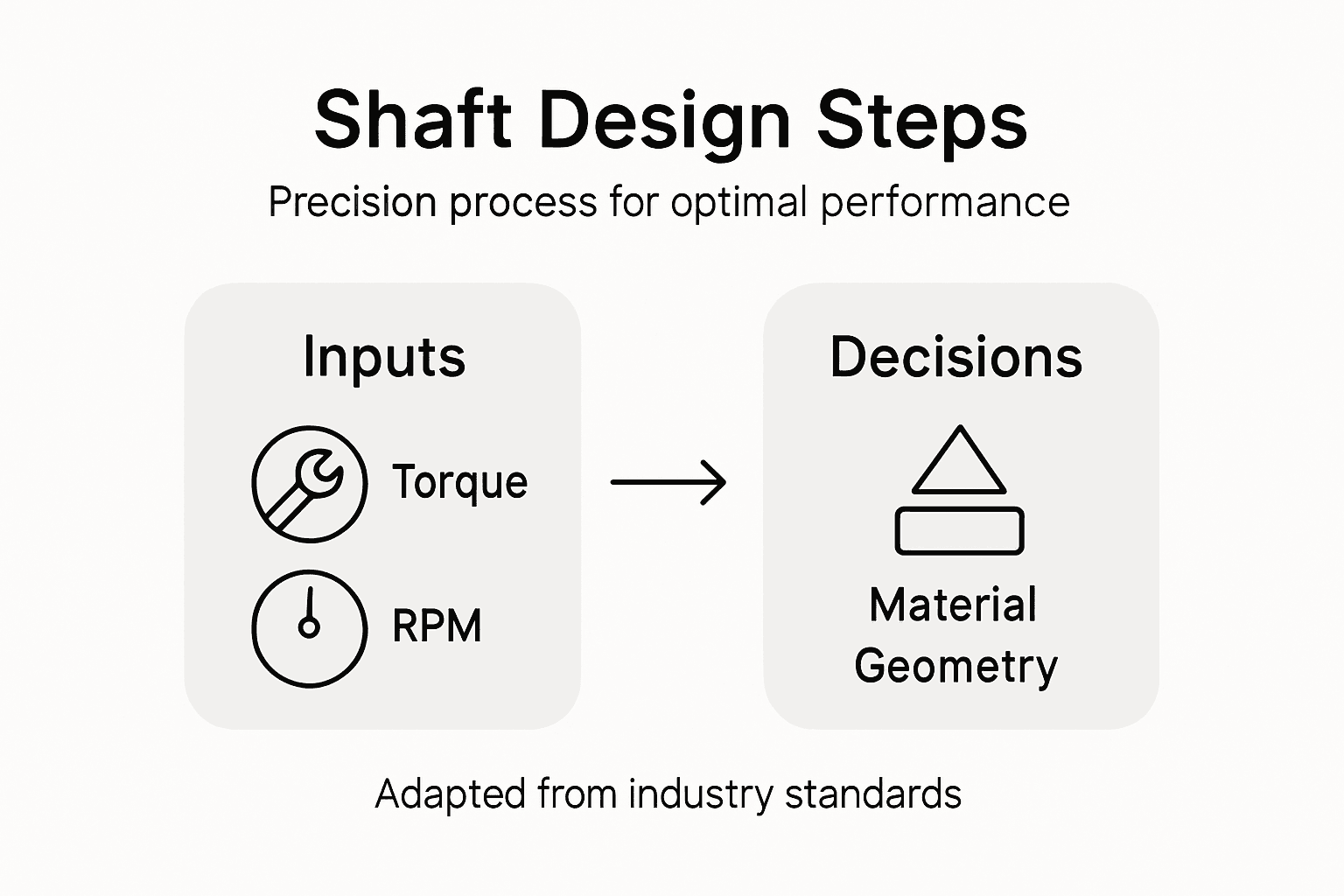
- Step 1: Assess Torque And RPM Requirements
- Step 2: Select Suitable Materials And Geometry
- Step 3: Define Coupling And Interface Specifications
- Step 4: Calculate Shaft Dimensions And Tolerances
- Step 5: Verify Performance And Quality Standards
Quick Summary
| Key Point | Explanation |
|---|---|
| 1. Document Torque and RPM Requirements | Accurate torque and RPM calculations prevent oversizing or undersizing shafts, avoiding material waste and possible failures. |
| 2. Choose Appropriate Materials | Selecting the right material enhances strength and fatigue resistance, ensuring reliability in demanding applications. |
| 3. Define Coupling and Interface Specifications | Proper coupling design maintains alignment and repeatability, crucial for the precision of grinding or deburring tasks. |
| 4. Calculate Shaft Dimensions and Tolerances | Correct diameter and tolerances ensure easy assembly and reliable performance, preventing defects and failures. |
| 5. Verify Performance and Quality Standards | Rigorous verification processes confirm that shafts meet specified requirements, essential for operational reliability and safety. |
Step 1: Assess torque and RPM requirements
Getting torque and RPM right is the foundation of everything that follows. Without accurate values, you’ll either oversize your shaft (wasting material and money) or undersize it (risking catastrophic failure). This step involves determining the actual power transmission needs and rotational speed your application demands, then using those figures to identify the stresses your shaft will face.
Start by documenting your power requirements. How much power does your deburring or grinding process consume? This might come from motor specifications, machinery datasheets, or actual measurements from existing equipment. Convert this power value into torque using the relationship between power, torque, and RPM. The basic formula is straightforward: Torque (in Nm) = Power (in watts) ÷ RPM ÷ 9.549. This gives you your baseline torque at normal operating conditions.
But normal operation is only part of the picture. Your shaft experiences peak stresses during startup, when inertial forces are at their maximum. Design standards require you to account for startup torque multipliers, which can range from 1.5 to 3 times the running torque depending on your load characteristics. If your process involves grinding wheels or deburring heads with significant rotational mass, those multipliers matter. Additionally, consider whether your application experiences cyclic loading—repeated bursts of torque—or steady-state rotation. Cyclic patterns create fatigue stresses that differ substantially from continuous rotation.
Documenting torque and rotational speed requirements helps you identify the bending moments and torsional stresses your design must accommodate. Your RPM value is equally critical because it determines whether your shaft will operate near or at critical speeds. Shafts have natural vibration frequencies, and rotating at or near these critical speeds causes whirling, which amplifies bending loads and can lead to rapid failure.
Gather these specific values before proceeding:
- Continuous operating torque (in Newton-meters)
- Maximum startup or shock torque
- Operating RPM range (minimum and maximum)
- Estimated bearing loads based on shaft geometry and load distribution
- Duty cycle (continuous, intermittent, or cyclic)
- Any external forces (radial or axial loads from coupled components)
If you’re working with existing machinery, measure actual values under representative loading. If you’re designing something new, consult motor ratings, load analysis, and similar reference machines. Many precision deburring systems operate in the 3,000 to 10,000 RPM range with torques ranging from 5 to 50 Nm, depending on the workpiece material and cutting tool size. These benchmarks can help validate your initial estimates.
Inaccurate torque or RPM assumptions are among the most common causes of shaft failure in custom precision applications. Spend time validating these numbers before sizing the shaft diameter.
Pro tip: If your application has variable torque throughout the cycle—like deburring that encounters resistance changes—calculate the torque at the highest load point, not the average load. Shaft design must accommodate peak conditions, not mean values.
Step 2: Select suitable materials and geometry
Material and geometry choices directly determine whether your shaft will perform reliably or fail prematurely. This step involves selecting a material that provides adequate strength and fatigue resistance for your specific application, then designing the shaft geometry to optimize stiffness and stress distribution. The right combination balances performance, cost, and manufacturability.
Start with material selection. For precision deburring and grinding applications, you’re typically choosing between low-carbon steels and alloy steels. Low-carbon steels like AISI 1020 through AISI 1050 offer good machinability and reasonable strength at moderate cost, making them suitable for lower-torque applications or less demanding duty cycles. They’re easier to machine and readily available, which matters when you need custom dimensions. For higher-stress applications, alloy steels such as AISI 4140 and 4340 provide superior fatigue resistance and strength. These materials respond well to heat treatment, allowing you to achieve specific hardness levels that match your load requirements. The tradeoff is increased cost and slightly more demanding machining.

Your material choice depends on several factors working together. Fatigue resistance matters most in precision applications because your shaft experiences cyclic loading from startup, shutdown, and varying cutting forces. Corrosion resistance becomes critical if your deburring or grinding process involves coolants or humid environments. Heat treatment capability determines whether you can optimize the material’s properties for your specific torque and speed requirements. If your application demands exceptional strength in a confined installation, alloy steels with proper heat treatment provide the best performance. If you’re working with simpler equipment or lower torques, carbon steels deliver adequate results at lower cost.
Here is a comparison of common shaft materials for precision deburring and grinding applications:
| Material Type | Typical Strength | Fatigue Resistance | Cost Impact |
|---|---|---|---|
| Low-Carbon Steel | Moderate | Fair for non-cyclic loads | Low |
| Alloy Steel 4140 | High | Superior for cyclic stress | Medium |
| Alloy Steel 4340 | Very High | Excellent, even in fatigue | Higher |
Geometry follows directly from your material choice and torque requirements. Shafts are designed as stepped cylindrical sections, where different sections have different diameters to optimize strength while minimizing weight and deflection. This stepped approach concentrates material where stresses are highest and reduces it where loads are lighter. Your shaft’s diameter at each step depends on the bending and torsional stresses calculated from your torque and RPM values. Larger diameter sections resist bending better, while length and diameter together determine overall stiffness.
Consider these geometry factors carefully:
- Diameter at the power input (where the motor or drive couples) must accommodate your maximum torque
- Diameter at working tool interfaces must support radial and axial loads from cutting forces
- Length and step transitions affect deflection and critical speed; minimize unsupported length where possible
- Fillet radii at diameter transitions reduce stress concentration at the most vulnerable points
- Surface finish quality impacts fatigue strength, especially for alloy steels
Shaft layout determines appropriate diameters and shapes that balance rigidity against strength requirements. A shaft that deflects too much under load introduces angular misalignment in coupling interfaces, reducing grinding or deburring precision and accelerating wear. A shaft designed for maximum rigidity might be oversized and unnecessarily expensive. Your goal is finding the balance point where deflection stays within acceptable limits (typically 0.5 to 1.0 millimeters for precision equipment) while stress levels remain safely below yield values.
For confined installation environments common in aerospace applications like thrust reverser systems or valve override mechanisms, geometry constraints are tighter. You may need a shaft that fits within a specific envelope while still transmitting required torque. This demands creative stepped designs that pack strength into minimal diameter. Consult with your shaft manufacturer early if you have tight spatial constraints, because custom geometry solutions exist but require planning during the initial design phase.
Material and geometry work as partners. Choosing a premium alloy without proper stepped geometry wastes the material’s potential, while designing excellent geometry with inadequate material leads to fatigue failure.
Pro tip: Request material certifications and hardness test results from your shaft supplier. Verifying that your alloy steel achieved the specified hardness after heat treatment (typically 38 to 42 HRC for 4140) ensures the material properties match your design assumptions and prevents failures caused by incomplete heat treatment.
Step 3: Define coupling and interface specifications
How your shaft connects to motors, gearboxes, and working tools fundamentally affects system performance and reliability. This step involves specifying the coupling type and interface geometry that will transmit torque reliably while maintaining repeatability and stiffness. Poor interface design leads to angular misalignment, lost precision, and accelerated wear even if your shaft itself is perfectly designed.
Begin by understanding the two primary interface challenges you’re solving. First, you need mechanical repeatability, meaning the coupling can be connected and disconnected repeatedly without introducing positional drift. Second, you need stiffness at the interface, so torque transmission doesn’t create unwanted angular deflection. These requirements conflict with simplicity, which is why interface design demands careful thought. A basic slip-fit keyed coupling offers simplicity but poor repeatability. A precision kinematic coupling delivers exceptional repeatability and stiffness but demands higher manufacturing precision and cost.
Kinematic couplings with pin, groove, and ball contacts provide rigid, repeatable interfaces by constraining exactly six degrees of freedom without over-constraint. Think of this as the contact geometry being precisely designed so the shaft always seats in the same position relative to the mating surface. A pin rests in a V-groove, a ball sits in a spherical dimple, and these point and line contacts create highly repeatable positioning. The engineering here is sophisticated, but the payoff in precision applications is substantial. For aerospace applications involving thrust reverser systems, flap actuation, or synchronization shafts, kinematic couplings eliminate the hysteresis that would otherwise cause positioning errors. Hysteresis is the lag or lag variation that occurs when components are repeatedly engaged and disengaged. Standard couplings might exhibit 5 to 10 micrometers of hysteresis. Well-designed kinematic couplings reduce this to less than 0.1 micrometer, which is the difference between acceptable and exceptional precision.
Your coupling specification must address several interrelated parameters. Contact type determines load capacity and manufacturing complexity. Surface contacts (like a spline) distribute loads broadly and can handle higher torques, but manufacturing costs climb with precision requirements. Line contacts (grooves) offer moderate load capacity with better precision characteristics. Point contacts (balls in dimples) deliver exceptional precision and repeatability but require careful preload management and higher material hardness. For deburring and grinding applications in confined installations, line or point contacts often provide the best balance.
Consider these coupling design factors:
- Preload strategy (spring preload, mechanical preload, or gravity-based) ensures contacts remain seated under all operating conditions
- Material hardness at contact points determines load capacity; cemented carbide or hardened steel at contact areas extends service life
- Tolerance stack between coupling components directly impacts repeatability; tighter tolerances improve performance but increase cost
- Axial and radial load capacity must exceed the forces your deburring or grinding process generates
- Angular misalignment tolerance determines how much shaft deflection the coupling can accommodate without binding
For confined installation environments common in aerospace, your coupling must fit specific spatial envelopes. A thrust reverser system or valve override mechanism offers limited room for oversized couplings. This constraint sometimes requires developing a custom interface rather than using standard off-the-shelf couplings. Custom kinematic couplings can be engineered to fit tight spaces while maintaining precision.
Interface repeatability becomes critical when your shaft drives multiple synchronized components or feeds into precision machine tools. Angular misalignment of even 0.5 degrees introduces detectable positioning error in grinding or deburring work. A properly specified kinematic coupling eliminates this source of error by ensuring the shaft always seats in exactly the same angular position.
Coupling design determines whether your precision shaft delivers precision results or whether interface slop destroys the performance you engineered into the shaft itself. Invest time defining this interface carefully.
Pro tip: If your coupling involves ball or point contacts, specify preload in units of force (Newtons) rather than leaving it vague. A precisely controlled spring preload keeps contact points seated consistently across temperature changes and vibration, preventing the micro-motion that causes hysteresis and accelerated wear.
Step 4: Calculate shaft dimensions and tolerances
Calculating the correct shaft diameter at each stepped section transforms your stress analysis into a physical design that can be manufactured and assembled. This step involves using your torque and material strength values to determine nominal shaft diameters, then applying standardized tolerance specifications that ensure proper fits with bearings, couplings, and other components. Get this right and your shaft assembles smoothly and performs reliably. Get it wrong and you’ll face assembly problems or premature failure.
Start with the basic diameter calculation for torsional stress. The formula relates your material’s allowable shear stress to the torque you’re transmitting and the required shaft diameter. For a solid circular shaft, this is straightforward algebra. However, real shafts experience both torsional stress from torque transmission and bending stress from radial loads. Your actual diameter must accommodate both stresses simultaneously. This is where finite element analysis or shaft design software becomes valuable for complex geometries. For simpler stepped designs, conservative hand calculations often suffice. Use your maximum torque value (including startup multipliers from Step 1) and your selected material’s yield strength (reduced by an appropriate safety factor, typically 1.5 to 2.0 for precision machinery). The resulting diameter represents your minimum solid shaft size needed to prevent failure.
Bending stress adds complexity because it depends not just on load magnitude but on load location along the shaft. A radial force applied far from a bearing creates a much larger bending moment than the same force applied close to a bearing. This is why shaft lengths matter and why minimizing unsupported span improves performance. Calculate bending stresses at each critical location (typically at bearing seats, coupling interfaces, and tool attachment points). Your shaft diameter at each location must satisfy both the torsional and bending stress requirements. This often means the stepped sections are sized by bending rather than torsion, especially in longer shaft designs common in aerospace applications like thrust reverser actuation or flap synchronization systems.
Once you’ve determined nominal diameters, you apply ISO tolerance grades and fit classifications to define acceptable manufacturing variation. ISO 286 standards specify a system where lowercase letters (like h, g, k) indicate shaft tolerance zones and uppercase letters indicate hole tolerance zones. A specification like “h6” means your shaft has a tolerance grade of 6 in the “h” zone, which sits just below the nominal dimension. Grade 6 is tight enough for precision work but achievable with standard machining. Grade 7 is looser and cheaper to produce. Grade 5 or finer demands more careful machining and costs more.
Your fit selection determines clearance or interference at assembly. Consider these common configurations:
- H7/g6 clearance fits for bearing bores, allowing the shaft to slide freely with minimal play
- H7/h6 transition fits where tight control is needed but assembly must be possible by hand
- H7/p6 or tighter interference fits for permanent assemblies where the shaft is pressed into a bore
- H6/g5 precision fits for synchronization shafts or mechanisms requiring exceptional repeatability
Bearing manufacturers specify required fits for their products. A typical rolling element bearing expects an h6 shaft tolerance. If you deviate significantly, bearing preload and life suffer. For deburring and grinding shafts in confined installations, tighter fits (like h5 or h4) improve stiffness by eliminating radial play at bearing interfaces, but this demands better machining control.
Selecting hole and shaft tolerance classes depends on function rather than arbitrary preference. A thrust reverser system coupling interface might demand h5/g5 precision to ensure synchronized actuation. A simple deburring head attachment might tolerate h7/g6. The cost difference between tolerance grades is significant. Each grade tighter than h6 can double or triple machining costs because it demands more careful setup, slower cutting speeds, and possible finishing operations like grinding. Balance your precision requirements against budget constraints.
Document tolerances clearly on your engineering drawing. Specify not just the tolerance grade but the actual maximum and minimum dimensions in millimeters. Use the ISO standard notation but follow it with dimensional limits for clarity. For critical interfaces like bearing bores, explicitly call out the tolerance and note why it matters (for example, “h6 required for bearing fit and preload stability”). This prevents manufacturing misinterpretation.
Tolerances determine whether your design is manufacturable and affordable. Too loose and assembly fails. Too tight and costs explode. The sweet spot depends on understanding your function requirements and your supplier’s manufacturing capabilities.
Pro tip: Before finalizing your tolerance specifications, contact your shaft manufacturer and describe your precision requirements and production volume. Different manufacturers excel with different tolerance grades depending on their equipment. A supplier with precision grinding capabilities can deliver h5 reliably and cost-effectively, while another supplier using conventional turning might prefer h6 or h7 to avoid expensive operations.
Step 5: Verify performance and quality standards
Your design is only as reliable as the verification process that confirms it meets its intended requirements. This step involves validating that your shaft design satisfies stress limits, deflection constraints, and fatigue life expectations, then ensuring manufactured shafts meet dimensional, material, and surface quality standards. Skipping or rushing verification is where many precision shaft projects fail in service.
Begin with stress analysis verification. You’ve already calculated nominal diameters based on torsional and bending stresses, but now you need to confirm those calculations are complete and conservative. Check that you’ve included all load cases your shaft will actually experience. Does your deburring or grinding process apply asymmetric loads? Are there shock loads during tool changes or startup? Have you accounted for dynamic amplification during acceleration? For aerospace applications like thrust reverser actuation or synchronization shafts, load cases multiply quickly. Each flap position, each actuation cycle, each emergency scenario represents a different stress state your shaft must survive. Verify that your nominal diameters keep maximum stresses below your material’s yield strength, typically reduced by a safety factor of 1.5 to 2.0 for precision machinery. For fatigue loading, apply Goodman or Haigh diagrams to determine allowable alternating stress, accounting for mean stress from steady torque.
Deflection verification is equally critical. A shaft that’s strong enough might still deflect excessively, introducing angular misalignment that destroys precision. Calculate total shaft deflection under operating loads at the working interface. For grinding or deburring heads, deflection typically must stay under 0.5 to 1.0 millimeter to maintain acceptable precision. At bearing supports, check that deflection doesn’t exceed bearing design limits. For synchronized systems common in aerospace, angular deflection between input and output couplings must be minimal to prevent phase lag. Verification of shaft performance includes checking allowable stresses, deflections, and fatigue life compliance with design codes such as ASME. These standards define acceptable safety margins and provide guidance on how to handle combined loading scenarios where torsion and bending occur simultaneously.
Material verification starts with documentation. Request mill certificates from your shaft supplier confirming that the material batch meets chemical composition and mechanical property requirements. For alloy steels like AISI 4140 or 4340, verify tensile strength, yield strength, elongation, and hardness values fall within expected ranges. A batch with lower-than-expected strength invalidates your stress calculations. For critical aerospace applications, material traceability becomes non-negotiable. You need to know not just that the material meets specifications, but which specific mill produced it and when. This enables rapid investigation if issues arise in service.
Quality inspection standards cover several critical dimensions:
- Dimensional tolerances verified with precision measuring equipment (coordinate measuring machines or micrometers) at multiple locations along the shaft
- Runout and balance ensuring the shaft rotates concentrically without wobble that would introduce vibration
- Surface finish verified with surface roughness testers to confirm machining quality and fatigue resistance
- Hardness verification using hardness testers (Rockwell, Vickers, or Brinell) to confirm heat treatment effectiveness
- Straightness and concentricity ensuring stepped sections align properly for bearing and coupling assembly
For shafts used in synchronized actuation systems like flap drives, additional verification includes proof testing under simulated load. Spin the shaft at operating speed and torque while monitoring vibration, temperature, and any signs of distress. This dynamic test catches issues that static analysis might miss. Bearing preload changes, coupling compliance, and alignment errors often reveal themselves only under running conditions.
Design specifications validated through experimental confirmation ensure that performance and quality standards are met across the full range of operating conditions. Create a quality plan that documents which measurements are critical, how often they’re performed, and what acceptable limits are. Critical dimensions get 100 percent inspection. Less critical dimensions might use statistical sampling. This balanced approach maintains quality while keeping costs reasonable.
Document everything. Create an inspection report for each shaft produced that includes dimensional data, material certification, hardness readings, and any deviation from specification. Keep these records. If a shaft fails in service, your inspection data becomes invaluable for understanding why and preventing recurrence. For aerospace applications, these records are often regulatory requirements.
This summary shows key verification steps for ensuring shaft quality and performance:
| Verification Step | What It Confirms | Typical Tools |
|---|---|---|
| Stress Analysis | Maximum stress below yield | FEA, hand calcs |
| Deflection Check | Deflection within spec limits | Modeling, CMM |
| Material Certification | Correct alloy and hardness levels | Certificates |
| Surface Inspection | Proper finish, no damage | Profilometer |
| Dynamic Testing | Shaft stable at operating speed | Test rig |
Performance verification isn’t a box to check at the end. It’s an ongoing conversation between design intent and manufacturing reality that ensures your precision shaft delivers precision results.
Pro tip: If you’re producing shafts in volume, establish statistical process control charts for critical dimensions. Tracking hardness, runout, and major diameter over time reveals trends before parts start failing, allowing you to adjust the manufacturing process proactively rather than reactively.
Solve Your Precision Shaft Challenges with BIAX Flexwellen
Designing shafts for precision applications involves meticulous attention to torque, RPM, material selection, geometry, and coupling interfaces. The risks of incorrect assumptions like undersizing shafts or poor coupling interface design can lead to costly failures, fatigue, and misalignment in your deburring and grinding processes. BIAX Flexwellen understands these pain points and offers expertly engineered flexible shafts and drive solutions tailored to your exact torque demands and spatial constraints.
With our deep expertise in precision shaft design and custom configurations, we help you navigate complex challenges such as startup torque multipliers, fatigue resistance, stepped geometry, and kinematic coupling repeatability. Empower your machinery with reliable torque transmission in tight or hard-to-reach spaces while maintaining the performance and quality your application requires.
Explore how our solutions can optimize your shaft design and coupling interfaces by contacting our experienced engineers at BIAX Flexwellen Contact. Don’t wait until shaft failure disrupts your production. Get in touch today to benefit from tailored guidance and high-quality components that keep your precision applications running smoothly.
Frequently Asked Questions
What are the key torque and RPM requirements for shaft design in precision applications?
To accurately size a shaft, you need to document both continuous operating torque and maximum startup or shock torque. Identify the power your application consumes and convert it into torque using the formula: Torque (in Nm) = Power (in watts) ÷ RPM ÷ 9.549.
How do I select the right materials for my precision shaft design?
Choosing materials involves balancing strength, cost, and manufacturability. For higher-stress applications, consider alloy steels like AISI 4140 or AISI 4340 for their fatigue resistance and strength, while low-carbon steels may suffice for lower-torque applications.
What geometric factors should I consider when designing a shaft?
Key geometry considerations include diameter at power input and working tool interfaces, as well as minimizing unsupported shaft length. Ensure that fillet radii at diameter transitions help reduce stress concentration and that you’re optimizing the design for stiffness and stress distribution.
How can I ensure mechanical repeatability in my shaft interfaces?
To achieve mechanical repeatability, specify precise coupling types and interface geometries. Consider using kinematic couplings for rigid positioning that minimizes hysteresis, as these deliver exceptional precision for synchronized components.
What is the importance of calculating tolerances in shaft design?
Calculating tolerances ensures that your shaft fits properly with bearings and other components, thus avoiding assembly issues. Use appropriate ISO tolerance grades that balance precision against cost; for example, specify h6 tolerance for bearings to maintain preload stability and functionality.
Why is verification important in shaft design?
Verification confirms that your shaft design meets stress limits, deflection constraints, and fatigue life expectations. Create a quality plan to document dimensional data, material certifications, and hardness readings to ensure compliance with performance standards during manufacturing.
Recommended
- 7 Practical Examples of Shaft Drive Solutions for Engineers
- Flexible Shaft Maintenance Process for Peak Performance
- 7 Vorteile flexibler Antriebswellen für beengte Räume – BIAX Flexwellen
- 7 Expert Flexible Shaft Maintenance Tips for Engineers
Related Topics
Send your spec inquiry
Custom flexible shafts for your application — we quote within 1 working day.