How flexible shafts enhance precision deburring in manufacturing
13 May 2026TL;DR:
- Flexible shafts enable self-aligning deburring inside complex geometries by transmitting torque through a compliant core. They absorb manufacturing variances, maintaining consistent edge quality without extensive programming or fixture adjustments. Their adaptive nature enhances process robustness, reduces rework, and integrates efficiently into CNC machining cycles.
Precision deburring is routinely assumed to demand expensive rigid automation, multi-axis CNC programs, and near-perfect fixture repeatability. That assumption leaves many production managers investing heavily in equipment that still struggles with angled bores, cross-holes, and deep internal features. Flexible shafts offer a mechanically different approach. By transmitting torque through a compliant core, they allow abrasive tools to self-align and float against the workpiece, maintaining controlled contact where rigid tooling cannot. This article explains how flexible shafts function in deburring, where they perform best, and how to integrate them into existing production workflows.
Table of Contents
- Understanding flexible shafts in deburring applications
- The mechanical advantage: compliance and adaptive contact
- Applications: Where flexible shaft deburring delivers best results
- Integrating flexible shafts into production workflows
- A fresh perspective: Why flexible shafts aren’t just a workaround
- Explore efficient deburring solutions with BIAX Flexwellen
- Frequently asked questions
Key Takeaways
| Point | Details |
|---|---|
| Mechanical compliance | Flexible shafts adapt to variances in part geometry, maintaining consistent edge breaks. |
| Efficient workflow integration | They enable deburring tasks to be consolidated into CNC cycles, reducing production overhead. |
| Adaptive contact pressure | Floating abrasive elements self-align and compensate for fixture or programming mismatches. |
| Limitations exist | Flexible shafts are not the best choice for every part or application—selection matters. |
| Real-world reliability | Engineers prefer flexible shafts for achieving consistent results with fewer surprises. |
Understanding flexible shafts in deburring applications
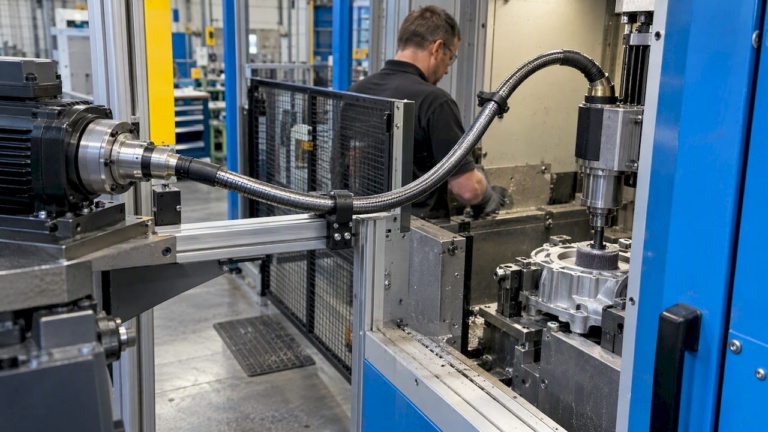
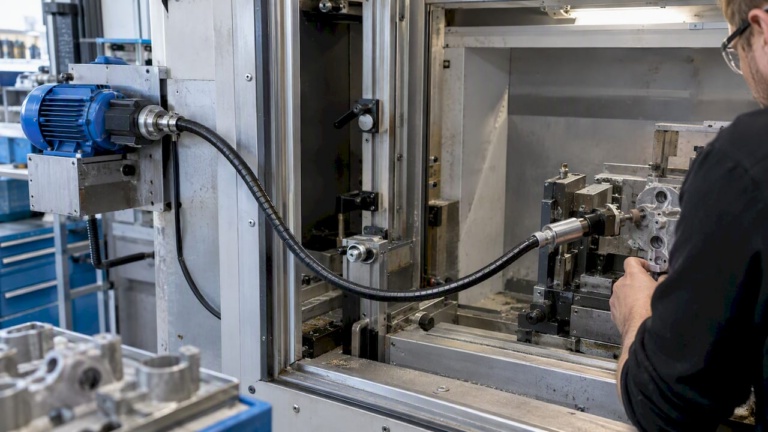
A flexible shaft is a torsionally stiff but laterally compliant drive element. It consists of a multi-layer wound core housed within a protective sheath, transmitting rotation and torque from a motor to a remote tool head. The core’s construction allows it to bend around obstacles or through curved paths while continuing to rotate at consistent speed. This distinguishes flexible shafts from rigid spindle extensions, which require precise alignment between the motor axis and the tool axis.
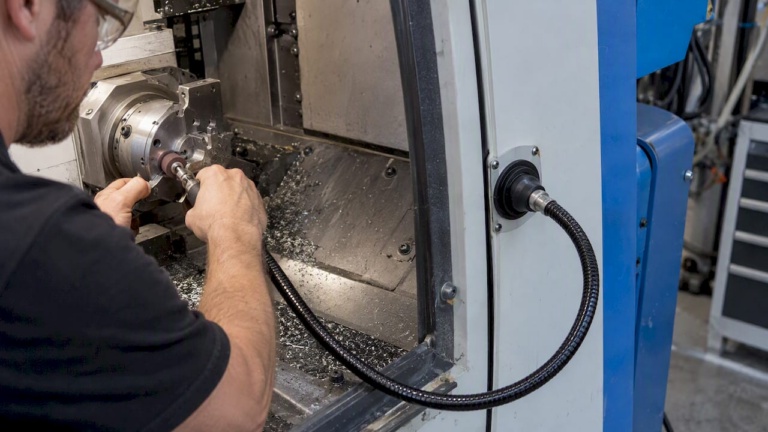
In deburring, that lateral compliance becomes a functional advantage. The abrasive element at the working end floats against the part surface rather than being forced against it at a fixed angle. This self-aligning behavior is precisely what tight-space finishing with flexible shafts relies on to produce consistent results in awkward geometries. The tool follows the feature, not a programmed path.
The Brush Research FLEX-HONE is a representative example. Its abrasive globules are mounted on flexible nylon filaments that deflect independently as the tool rotates inside a bore. This floating action prevents over-removal at any single contact point. The result is controlled edge breaking across the full circumference of an internal hole, including cross-drilled ports and angled entries where rigid hones would skip or chatter.
Key mechanical characteristics of flexible shaft systems include:
- Core construction: Multiple layers of wire wound in alternating directions, providing torsional rigidity while allowing lateral deflection
- Protective sheath: Prevents core abrasion, guides the shaft path, and contains lubricant in sealed designs
- Tool coupling: The distal end accepts standardized or custom tool interfaces for brushes, burrs, or honing tools
- Operating speed range: Typically 500 to 30,000 RPM depending on core diameter and length
- Torque transmission efficiency: Generally 85 to 92 percent at moderate bend radii, declining with tighter curves
| Property | Flexible shaft system | Rigid spindle extension |
|---|---|---|
| Lateral compliance | High | None |
| Minimum bend radius | Defined by core specs | Cannot bend |
| Self-alignment capability | Yes | No |
| Access to angled bores | Effective | Very limited |
| Programming dependency | Low | High |
These characteristics make flexible shafts particularly effective for industrial manufacturing applications where part geometry varies or where access requires routing the drive around structural obstacles.
“Mechanically compliant flexible shaft deburring works for internal holes and deep and angled features because the abrasive element floats and self-aligns, maintaining controlled contact throughout the feature.”
The mechanical advantage: compliance and adaptive contact
With a basic understanding of flexible shaft deburring established, it is important to examine why mechanical compliance is the operationally significant factor for engineers dealing with real manufacturing tolerances.
No production environment is perfect. Castings vary dimensionally. Fixtures wear. Clamping repeatability drifts over thousands of cycles. In rigid tooling scenarios, these variances translate directly into inconsistent edge quality. The tool either presses too hard in one zone or lifts away in another, producing burrs that remain or edges that are over-broken. Maintaining consistent results requires either frequent recalibration or contour-perfect CAM programming updated every time a drawing revision occurs.
Flexible shaft systems respond differently. The mechanical compliance converts geometric mismatch into controlled contact pressure rather than into tool deflection errors. When the edge is not exactly where the program expects it, a compliant abrasive element adjusts its contact angle and pressure automatically. The edge break remains consistent without requiring a program change.

Pro Tip: When specifying flexible shaft tooling for a new deburring application, run a short trial across the full dimensional tolerance range of the part, not just nominal geometry. The compliance characteristic that makes flexible shafts effective is most visible at the extremes of part variation, and that trial data provides the strongest justification for process adoption.
Edge-break control treated as a precision requirement is a standard expectation in aerospace, hydraulic manifold, and precision gear manufacturing. In these sectors, a 0.1 mm variation in chamfer radius can cause seal failure or stress concentration. Flexible shaft deburring maintains contact and pressure despite part or fixture variance, which is exactly the behavior needed to meet tight edge-break specifications without investing in adaptive control systems.
| Deburring method | Response to part variance | Programming dependency | Edge consistency |
|---|---|---|---|
| Rigid spindle deburring | Poor, contact errors increase | High | Inconsistent without recalibration |
| Multi-axis CNC deburring | Moderate, requires updated paths | Very high | Good when geometry is known |
| Flexible shaft deburring | Good, compliance absorbs variance | Low | Consistent across tolerance range |
| Manual deburring | Operator-dependent | None | Highly variable |
The precision finishing access that flexible shafts enable goes beyond geometry alone. Because the shaft routes around obstacles, it also reduces the need for specialized fixturing designed solely to present a feature to a rigid tool. That fixture simplification directly reduces tooling cost and changeover time.

Applications: Where flexible shaft deburring delivers best results
Now that the adaptive capabilities of flexible shafts are clear, the practical question for engineers and production managers is: where do these tools produce the best return?
Flexible shaft deburring is most effective in the following application types:
- Cross-hole deburring: Intersecting bores in hydraulic blocks, valve bodies, and fuel system components produce burrs at the intersection that rigid tools cannot reliably reach. A flexible hone or brush routes through the primary bore and contacts the cross-hole entry consistently.
- Internal feature edge blending: Counterbores, relief grooves, and undercuts with sharp edges require controlled material removal. The floating abrasive action blends these edges without removing significant bulk material.
- Polishing of internal surfaces: After rough machining, flexible honing tools improve surface finish in bores from Ra 1.6 to Ra 0.4 in a single pass, particularly in cylinder liners and hydraulic cylinders.
- Chamfering on external shafts: High-speed chamfering and deburring on external shafts benefits from continuous rotation and the shaft’s mechanical reach, removing heavy burrs at speeds that manual operations cannot match.
- Angled and deep-feature finishing: Features at compound angles or at significant depth inside a housing are reliably accessed by routing the flexible shaft to the correct entry angle.
Pro Tip: For cross-hole deburring in hydraulic manifolds, match the hone diameter to 1.1 to 1.2 times the bore diameter. This ensures consistent filament contact at the cross-hole intersection without excessive material removal in the primary bore.
Flexible shaft deburring also supports maintenance tool applications in the field. Portable drives paired with flexible shafts allow technicians to deburr and finish features on installed components without removal, a significant advantage in MRO (maintenance, repair, and overhaul) operations. See maintenance tools for specific examples of this application category.
Not every deburring scenario is well suited to flexible shafts. Key limitations include:
- Selectivity constraints: When only one surface of an intersection must be deburred, the floating action of the flexible element may contact unintended surfaces, over-removing material in adjacent areas.
- Complex part envelopes: For parts with many intersecting features at precise tolerances, dedicated fixtures and multi-axis solutions offer better control over which surfaces are contacted.
- Burr size limitations: Very heavy burrs, particularly on hard alloys, may exceed what flexible abrasive tools can remove efficiently. In these cases, a preliminary rigid deburring step followed by flexible shaft finishing is more effective.
- Appearance-critical surfaces: Where surface finish uniformity is an aesthetic requirement alongside functional edge quality, the distributed contact of a flexible hone may produce slight pattern variation compared to a controlled rigid grinding pass.
Understanding these boundaries allows engineers to position flexible shaft deburring correctly within the process sequence rather than treating it as a universal replacement for all finishing steps.
Integrating flexible shafts into production workflows
Once the application fit is confirmed, effective integration into the production workflow determines whether flexible shaft deburring delivers its full efficiency benefit. Poorly integrated deburring adds cycle time rather than saving it.
The primary opportunity is consolidation into the CNC cycle. Rather than routing parts to a secondary deburring station, the flexible shaft tool can be loaded into the spindle or driven from an auxiliary spindle interface at the end of the machining cycle. This approach, described in detail in cycle consolidation guidance, shifts the management focus to spindle-time budgeting, tool change optimization, and burr removal verification rather than inter-operation scheduling.
Key considerations for workflow integration:
- Spindle-time allocation: Estimate deburring cycle time from tool entry to exit, including dwell at cross-holes. Add this time to the machining cycle and confirm it falls within the takt time available.
- Tool change strategy: If the flexible shaft tool occupies a magazine position, evaluate whether automatic tool change is feasible or whether a dedicated auxiliary spindle is more cost-effective for high-volume lines.
- Drive selection: Match the flexible shaft drive motor to the torque and RPM requirements of the chosen abrasive tool. Undersized drives cause inconsistent speed under load, which directly affects edge-break consistency.
- Coolant and chip management: Determine whether the deburring step runs wet or dry. Flexible hones perform better with lubrication, while some brush tools run dry. Coolant compatibility with the sheath and tool materials must be confirmed.
- Burr removal verification: Integrate a check step, either in-process probing or post-process visual or tactile inspection, to confirm burr removal before the part proceeds to assembly.
A structured integration checklist helps production managers avoid omissions:
- Confirm part fixturing remains stable during the deburring pass (no re-clamping needed)
- Verify flexible shaft routing path clears all fixture elements and part features
- Define entry speed, operating speed, and dwell time for each feature
- Set tool change position and confirm magazine compatibility
- Establish pass/fail criteria for edge-break specification
- Document the process in the control plan and update the FMEA for the deburring step
Reducing re-clamping and rescheduling overhead is where manufacturing precision insights show the most measurable impact. Each additional handling step adds queue time, handling damage risk, and operator labor. Consolidating deburring into the machining cycle eliminates these costs directly.
A fresh perspective: Why flexible shafts aren’t just a workaround
A common perception among engineers encountering flexible shaft deburring for the first time is that it represents a compromise: a less precise alternative used when proper tooling is unavailable or too expensive. That perception is incorrect, and it leads production teams to undervalue a capability that experienced manufacturers treat as a deliberate process choice.
The float and mechanical compliance of a flexible shaft system are not deficiencies. They are engineered properties. The fact that the abrasive element self-aligns means that the process outcome is less sensitive to upstream variation in machining, fixturing, and part dimensions. That reduced sensitivity translates directly into higher first-pass yield and fewer escapes reaching assembly.
Engineers who have worked extensively with flexible shaft machining advantages consistently report the same operational benefit: the deburring step stops being a source of rework. With rigid tooling, any dimensional shift in the machined part requires a process review. With a properly specified flexible shaft system, the same dimensional shift is absorbed by the tool’s compliance, and the edge quality remains within specification.
This matters most in high-mix, lower-volume environments where frequent part changeovers are common. Reprogramming a multi-axis deburring path for each revision costs engineering time and introduces the risk of errors in the new program. A flexible shaft setup with a correctly sized abrasive tool typically transfers to a revised part with no program change at all.
The broader lesson for production managers is that adaptive tools are not a fallback. They are a strategy for building robustness into the process at the finishing stage, where the cost of a nonconforming part is highest. Choosing flexibility at the deburring step protects yield without adding programming or calibration overhead.
Explore efficient deburring solutions with BIAX Flexwellen
BIAX Flexwellen, part of Schmid & Wezel GmbH, designs and manufactures industrial flexible shafts for demanding finishing and deburring applications. The product range covers standard configurations and fully custom designs, including specified torque and RPM ratings, protective sheath materials, and coupling interfaces for CNC spindles or auxiliary drive systems. Engineers working on internal bore deburring, cross-hole finishing, or external chamfering can use our application resources to match shaft specifications to their exact process requirements. Learn more about improving machine design efficiency with flexible shaft integration, or explore the full range of flexible shaft applications in industrial manufacturing. Contact the BIAX Flexwellen engineering team directly through the website to request application guidance or a custom configuration review.
Frequently asked questions
What makes flexible shafts ideal for deburring complex features?
Their mechanical compliance allows the abrasive element to self-align and maintain controlled contact, making them effective for internal holes, cross-holes, and angled surfaces where rigid tools lose consistent contact.
Are flexible shafts suitable for all deburring scenarios?
No. Flexible shafts can sometimes lack selectivity or remove material from unintended surfaces. Dedicated fixtures and multi-axis solutions are more appropriate for high-accuracy parts with complex feature envelopes.
How can flexible shaft deburring improve production efficiency?
By integrating deburring into the CNC cycle, flexible shafts reduce re-handling and scheduling overhead. This cycle consolidation shifts management focus to spindle-time optimization rather than inter-operation logistics.
What types of deburring tools use flexible shafts?
Common tools include flex-hone brushes for internal bore polishing and edge blending, and rotary deburring tools for high-speed chamfering on external shafts and heavy burr removal.
Recommended
- How flexible shafts improve access for precision finishing
- Flexible shaft applications for industrial manufacturing
- Custom flexible shaft benefits: boost precision and reliability
- Torsional flexibility for precision industrial drive solutions
Related Topics
Send your spec inquiry
Custom flexible shafts for your application — we quote within 1 working day.