Custom flexible shaft benefits: boost precision and reliability
15 April 2026TL;DR:
- Custom flexible shafts match application-specific parameters, reducing premature failure and maintenance costs.
- Tailored designs extend service life and improve operational precision in demanding environments.
- Investing in custom shafts mitigates risks of downtime and unplanned maintenance, ensuring production reliability.
Many engineers in the DACH region rely on standard, off-the-shelf flexible shafts without questioning whether those components are truly suited to their application. That default choice carries real risk. When shaft parameters do not match the actual operating environment, the result is accelerated wear, misalignment, and unplanned downtime. Custom flexible shafts address these gaps directly by aligning length, torque capacity, bend radius, and material selection to the specific demands of each application. For precision machining and finishing operations, that alignment is not a minor refinement. It is the difference between reliable, long-term performance and recurring maintenance problems.
Table of Contents
- Why customization matters: The limits of off-the-shelf shafts
- Key benefits of custom flexible shaft solutions
- How customizing shaft specifications optimizes application performance
- Custom flexible shafts in DACH-region precision machining and finishing
- A fresh perspective: Why going custom is worth the investment
- Next steps: Unlock custom shaft solutions for your applications
- Frequently asked questions
Key Takeaways
| Point | Details |
|---|---|
| Off-the-shelf risks | Standard shafts often cause early failure and lack the precision or durability needed in advanced manufacturing. |
| Custom solutions last longer | Tailoring material, core size, and parameters delivers decades of low-maintenance reliability in harsh environments. |
| Parameter matching optimizes results | Adjusting specs like bend radius and torque ensures each shaft powers applications efficiently and safely. |
| DACH expertise delivers value | Local engineering support and industry experience ensure custom solutions meet regional standards and precision requirements. |
| Strategic investment | Investing in custom flexible shafts leads to long-term cost savings and higher operational efficiency. |
Why customization matters: The limits of off-the-shelf shafts
Standard flexible shafts are designed to cover a broad range of general applications. That breadth is their strength in catalog terms, but it is also their core limitation in demanding engineering environments. A shaft built to average specifications will rarely match the exact torque range, minimum bend radius, or rotational speed required by a specialized finishing or machining process.
The consequences are predictable. A shaft that is too rigid for a tight routing path generates excess stress at contact points. One that is undersized for the required torque will fatigue prematurely. Both scenarios lead to early failure, unplanned downtime, and replacement costs that accumulate quickly in production environments.
As noted in BIAX technical resources, tailoring shaft parameters optimizes performance, prevents premature failure, and balances flexibility with power transmission. That principle applies across deburring, grinding, polishing, and cleaning operations where consistent torque delivery is critical.
For engineers working on the custom shaft design guide, the starting point is always a clear specification of operating conditions. The following comparison illustrates the key differences between standard and custom shaft configurations:
| Parameter | Off-the-shelf shaft | Custom flexible shaft |
|---|---|---|
| Length | Fixed catalog sizes | Specified to installation path |
| Bend radius | Generalized minimum | Matched to routing geometry |
| Torque rating | Averaged across use cases | Calculated for actual load |
| Material | Standard steel | Application-specific alloy |
| Core size | Limited options | Optimized for speed and torque |
| Service life | Variable | Extended through fit-for-purpose design |
The most common failure modes in off-the-shelf applications include:
- Fatigue cracking from repeated flexing beyond the shaft’s actual bend radius tolerance
- Torsional overload when operating torque exceeds the shaft’s rated capacity
- Corrosion in humid or chemically active environments where standard steel is insufficient
- Vibration and runout caused by length or coupling mismatches
Pro Tip: Before specifying any flexible shaft, document the full operating envelope: maximum torque, rotational speed, minimum bend radius, and environmental exposure. That data set is the foundation for a reliable custom specification.
“A shaft that fits the catalog but not the application is not a solution. It is a scheduled maintenance event.”
For DACH-region production environments where uptime and precision standards are high, the gap between a standard shaft and a correctly specified custom unit is measurable in both performance and cost.
Key benefits of custom flexible shaft solutions
Custom flexible shafts deliver advantages that extend well beyond the initial installation. The benefits are most visible in three areas: material performance, maintenance reduction, and operational precision.
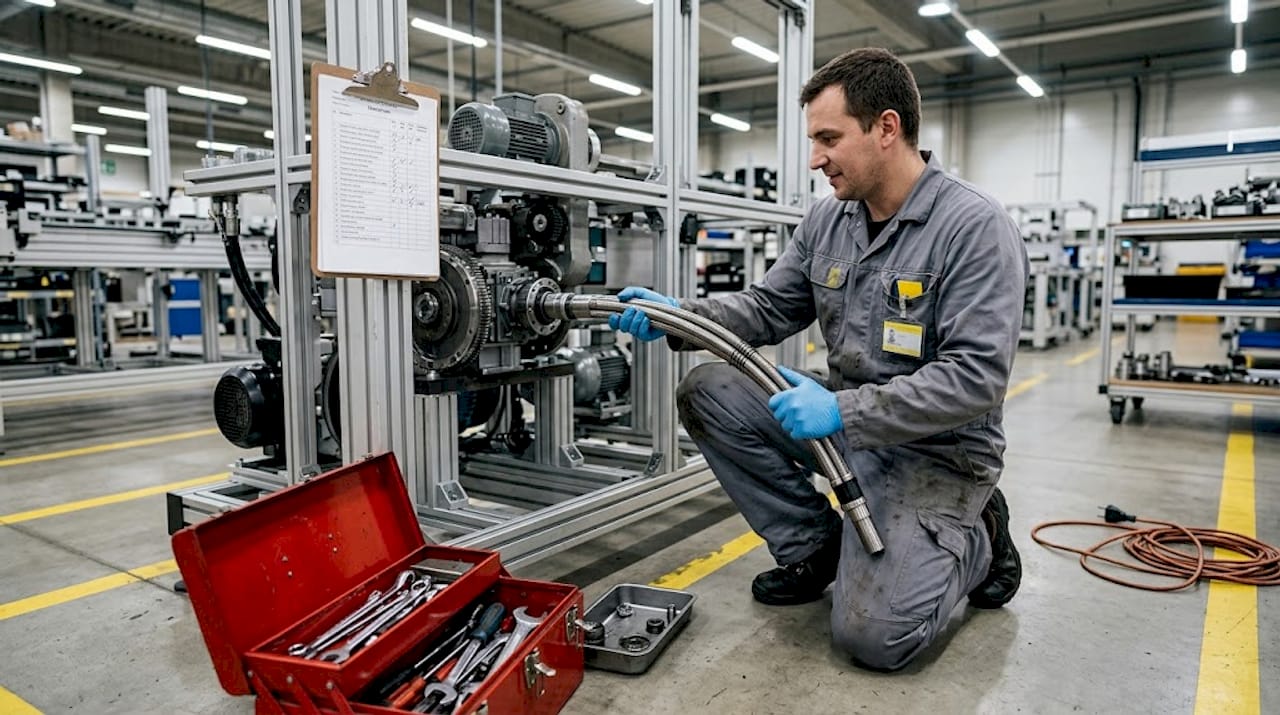
Material selection is the first lever. Stainless steel cores and sheaths provide corrosion resistance in wet, chemical, or high-humidity environments. High-strength alloy cores support elevated torque and speed requirements without increasing shaft diameter. As documented in BIAX industry applications, custom designs using specific materials and core sizes extend lifespan in harsh environments, with shafts capable of operating for decades without servicing.
The maintenance impact is significant for production managers. A shaft that is correctly specified from the outset does not require frequent inspection cycles or early replacement. That translates directly to reduced labor costs and fewer unplanned production stops.
The following table summarizes the performance gains typically associated with custom shaft configurations:
| Benefit area | Standard shaft outcome | Custom shaft outcome |
|---|---|---|
| Service life | 1 to 3 years typical | 10 or more years in matched applications |
| Maintenance frequency | Regular inspection required | Minimal servicing needed |
| Torque consistency | Variable under load | Stable across operating range |
| Corrosion resistance | Limited to standard environments | Matched to specific exposure |
| Downtime risk | Higher due to misfit | Substantially reduced |
For engineers reviewing the shaft configuration guide, the key steps in specifying a custom shaft are:
- Define the full torque and speed range for the application
- Measure the minimum bend radius required by the installation path
- Identify environmental conditions including temperature, moisture, and chemical exposure
- Select core diameter and material based on load and environment
- Specify coupling interfaces to match existing drive and tool connections
- Validate the design against the actual duty cycle before production deployment
For industrial shaft applications in sectors such as automotive assembly or precision tool manufacturing, this structured approach eliminates the guesswork that leads to premature failure.
Pro Tip: When evaluating total cost, include the cost of unplanned downtime in your calculation. A custom shaft that costs more upfront but eliminates two or three unplanned stops per year will typically recover its price difference within the first production year.
Operational precision is the third benefit. Consistent torque delivery at the tool tip is essential for deburring and grinding applications where surface quality is a production requirement. A correctly specified shaft maintains that consistency across the full operating range.
How customizing shaft specifications optimizes application performance
Customization is not a single adjustment. It is a process of matching multiple interdependent parameters to the actual operating conditions of the application.
The primary parameters are length, minimum bend radius, torque rating, rotational speed, horsepower, core diameter, and rotation direction. Each one affects the others. Increasing core diameter raises torque capacity but reduces flexibility. Shortening the shaft changes its resonant frequency. Tightening the minimum bend radius requires a more flexible core construction, which may affect torque transmission efficiency.
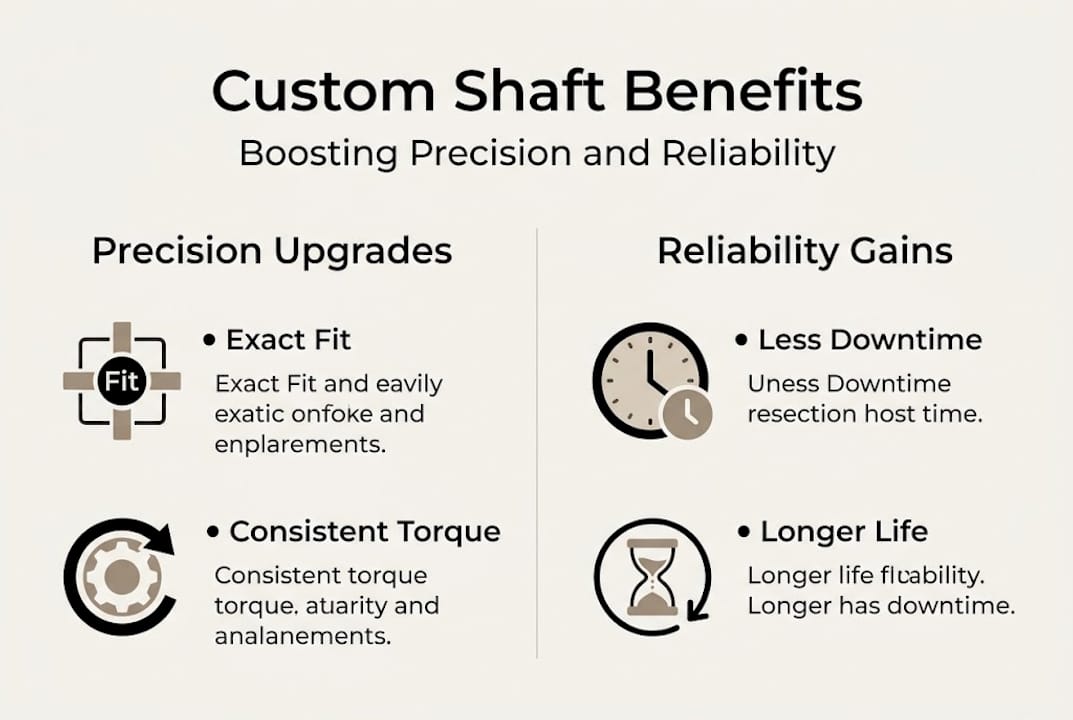
As confirmed in BIAX technical resources, tailoring shaft parameters such as length, minimum bend radius, torque, speed, horsepower, and rotation direction optimizes performance and prevents premature failure. That interdependency is why a structured specification process matters more than selecting individual parameters in isolation.
For compact or hard-to-reach installation environments, the tight-space shaft design process focuses on minimizing the bend radius while preserving torque transmission. This is directly relevant to automotive assembly lines where tool access is constrained by surrounding components.
The following parameters are critical starting points for any custom specification:
- Length: Measured along the actual routing path, not point to point
- Minimum bend radius: The tightest curve the shaft must navigate in operation
- Torque: Peak and continuous values, not just the nominal tool rating
- Speed: Operating RPM range including startup and peak conditions
- Core diameter: Determines both flexibility and torque capacity
- Rotation direction: Single or reversible, affecting core winding configuration
- Coupling interfaces: Drive-side and tool-side connection geometry
For engineers focused on improving access for finishing, the bend radius and length parameters are often the most critical. A shaft that cannot reach the work surface without exceeding its minimum bend radius will fail regardless of how well other parameters are matched.
Pro Tip: Always specify torque at the tool tip, not at the drive motor. Transmission losses through the shaft, especially in tight-radius configurations, can reduce delivered torque by 10 to 20 percent depending on shaft length and bend geometry.
In precision tool applications, consistent rotational accuracy at the working end is a direct function of how well the shaft specification matches the application. A correctly designed shaft transmits rotation smoothly without backlash or torsional oscillation.
Custom flexible shafts in DACH-region precision machining and finishing
The DACH region has specific industrial requirements that make custom flexible shaft solutions particularly relevant. Automotive manufacturing in Germany, precision tool construction in Switzerland, and specialized mechanical engineering in Austria all demand components that meet tight tolerances and perform reliably over long production cycles.
BIAX Flexwellen (Schmid & Wezel GmbH) has operated in this environment for over a century. As noted in the BIAX company overview, BIAX offers DACH-region expertise in custom flexible shafts for mechanical engineering, with ISO 9001 certification and over 100 years of experience. That combination of longevity and certified quality management is directly relevant for production managers who require documented performance standards.
For shaft finishing in DACH applications, the practical advantages of local expertise include:
- Rapid response to specification changes without extended lead times
- Engineering support aligned with German, Austrian, and Swiss industry standards
- Familiarity with the specific tooling and drive systems common in DACH-region plants
- Documentation and certification support for quality management systems
- On-site consultation capability for complex or high-volume applications
Production managers in the DACH region consistently prioritize low-maintenance durability. A flexible shaft that requires minimal servicing over a decade of operation reduces the total cost of ownership substantially compared to a standard shaft replaced every two to three years.
“For DACH-region production environments, the combination of ISO 9001 quality assurance and over a century of application engineering means that custom shaft specifications are backed by both documented process control and deep practical knowledge.”
In automotive assembly applications, BIAX custom shafts are used for deburring and grinding in confined spaces where standard tools cannot reach. In precision tool manufacturing, they transmit rotation with the consistency required for surface finishing to tight tolerances. These are not edge cases. They represent the core demand profile of DACH-region industrial production.
A fresh perspective: Why going custom is worth the investment
The conventional argument against custom flexible shafts is cost and lead time. Standard catalog items ship faster and carry a lower unit price. That argument is correct in the short term and misleading over any meaningful production horizon.
Most cost analyses stop at the purchase price. They do not account for the labor cost of replacement, the production loss from unplanned downtime, or the quality risk of a shaft that delivers inconsistent torque during a precision finishing operation. When those factors are included, the economics shift decisively toward custom configurations.
The deeper issue is risk. A standard shaft that fails during a critical production run does not just cost the price of a replacement component. It costs the time to diagnose the failure, source the replacement, complete the installation, and verify the process. In a high-output DACH-region facility, that sequence can easily represent thousands of euros in direct and indirect costs.
Custom shaft drive solutions eliminate that risk by design. When the shaft is specified to match the application precisely, failure modes are addressed before the first installation. That is not a premium feature. It is the baseline expectation for precision manufacturing. In the DACH region, where reliability and quality are competitive requirements, custom flexible shafts are not an optional upgrade. They are the correct engineering choice.
Next steps: Unlock custom shaft solutions for your applications
Ready to turn insights into measurable improvements? Here’s where to begin.
BIAX Flexwellen provides engineering guidance and custom shaft configurations for industrial shaft solutions across the full range of DACH-region precision machining and finishing applications. Whether the requirement is a specific torque rating, a tight minimum bend radius, or a corrosion-resistant material for a harsh production environment, BIAX engineering support covers the full specification process.
Explore the options available through engineering custom shafts to review standard configurations and identify the parameters relevant to your application. For applications with specific or complex requirements, get expert support directly from BIAX engineers who understand DACH-region industry standards and can provide tailored recommendations.
Frequently asked questions
What parameters can be customized in flexible shafts?
Length, bend radius, torque, speed, horsepower, rotation direction, core diameter, and material can all be adjusted to fit the specific requirements of an application.
How does a custom flexible shaft reduce maintenance?
Specific materials and core sizes matched to the operating environment extend service life substantially, with correctly specified shafts capable of operating for decades without routine servicing.
Are custom flexible shafts cost-effective for manufacturing?
Yes. When total cost of ownership is calculated including downtime, replacement labor, and quality risk, custom shafts consistently reduce overall expenditure compared to repeated replacement of standard units.
Is DACH-region engineering support available for shaft customization?
BIAX provides localized support tailored to German, Austrian, and Swiss industry requirements, including on-site consultation and documentation aligned with regional quality management standards.
What industries benefit most from custom flexible shafts?
Automotive assembly, precision tool manufacturing, mechanical engineering, and production finishing operations gain the most from custom configurations, particularly where access constraints or high torque consistency requirements make standard shafts unsuitable.
Recommended
- How flexible shafts improve access for precision finishing
- Flexible Shafts for Tight Spaces: Boosting Precision
- Custom flexible shaft design explained: engineer better solutions
- Key benefits of flexible shaft technology for manufacturing
Related Topics
Send your spec inquiry
Custom flexible shafts for your application — we quote within 1 working day.