0.1–5 µm Compliance: Cleanroom Flexible Shafts for Engineers
30 September 2026A flexible shaft can be cleanroom suitable, but only when the complete assembly, meaning the wire core, sheath, lubricant, end fittings and installation geometry, is evaluated against a representative operating mode following ISO 14644-14. Before specifying a shaft, engineers should confirm three things: particle emission at the target class, lubricant outgassing behavior, and the integrity of sheath terminations and coupling interfaces under load. Gather your operating rpm, torque profile and bend geometry first, then request a standards based assessment rather than a generic product label.
TL;DR:
- Flexible shafts must be tested as complete assemblies under real operating conditions, including load, speed, and bend geometry, to ensure cleanroom suitability.
- Particle emission, lubricant outgassing, and sheath interface integrity are critical factors, with assessment covering particles from 0.1 to 5 micrometers.
- Material selection depends on application-specific load and test parameters; a component suitable for pharmaceuticals may not meet semiconductor standards.
- Lubricants should be evaluated for vapor pressure, shear stability, and compatibility with cleaning agents, emphasizing low outgassing formulations like PFPE and MAC oils.
- Proper installation techniques, such as increasing bend radius and supporting unsupported lengths, help minimize wear and internal debris generation over time.
Table of Contents
- Key selection criteria for cleanroom-suitable flexible shafts
- Materials, surface finish and cleanability
- Lubrication, sealing and tribology for contamination-sensitive operation
- Design and installation constraints that drive particle generation
- Assessing and qualifying cleanroom suitability
- What we check when qualifying an assembly for cleanroom use
- Requesting a cleanroom suitability assessment
- Sources
- FAQ
Key selection criteria for cleanroom-suitable flexible shafts
Matching a flexible shaft to a cleanroom application starts with defining the cleanroom class and the particle limits that apply to the process, since a shaft evaluated for one class cannot be assumed suitable for a tighter one. From there, the mechanical and environmental parameters need to be specified in enough detail that a supplier can propose a configuration and a test plan rather than guess at one.
The parameters that matter most for a qualification request are:
- Cleanroom class and particle limits: define the target ISO class and the size range of concern, since acceptance criteria differ by application.
- Operational profile: continuous rpm, peak torque, duty cycle and reversal frequency, which together determine wear rate and heat generation at the core.
- Mechanical constraints: minimum bend radius, number and severity of bends, and unsupported shaft length between supports.
- Environmental exposure: operating temperature range, cleaning or disinfection media, and any process chemicals the shaft contacts.
- Design hotspots: sheath terminations, coupling interfaces and any gaps in the housing where particles generated internally could escape.
Flexible shafts transmit torque across non-collinear axes, and the transferable torque depends on shaft length and bend geometry, which means the same core diameter can behave very differently in a tight routing versus a straight run. High-reversal duty, common in flap and slat actuation or valve override linkages, accelerates wear at the same rated torque, so the duty cycle has to be documented alongside the peak load.
Materials, surface finish and cleanability
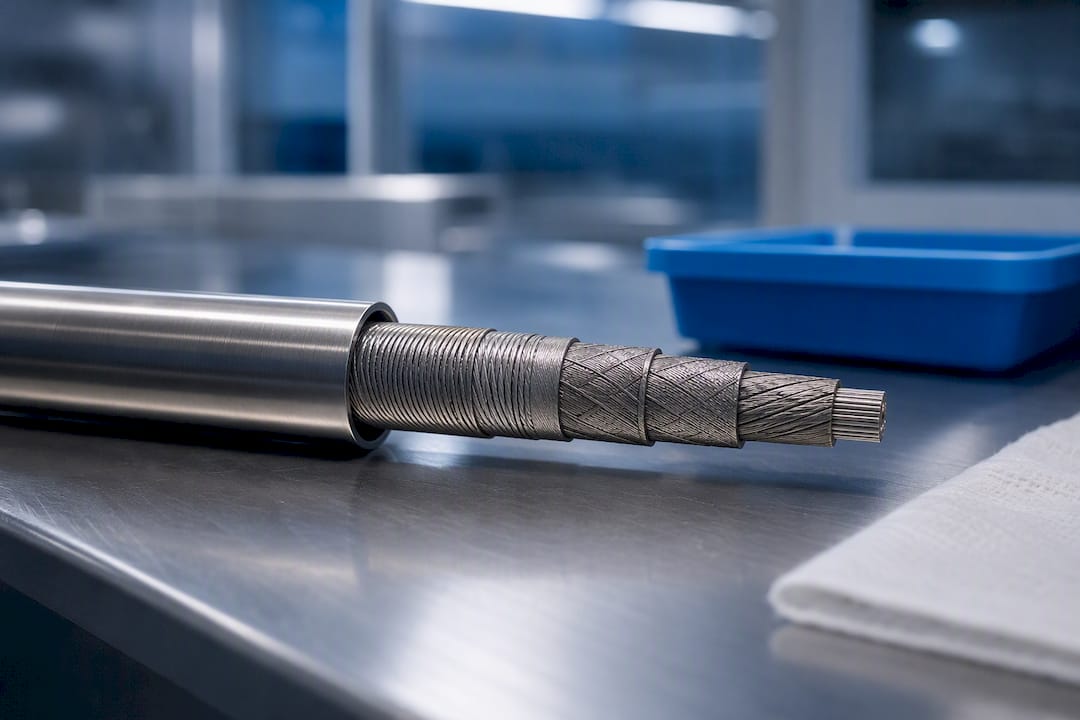
Material suitability and cleanroom suitability are not the same thing. VDI 2083 guidance makes clear that materials and components do not carry an inherent cleanroom class: suitability depends on defined load and test parameters tied to the specific process, not on a material datasheet alone. A stainless sheath that performs well in a pharmaceutical fill line may still be unacceptable in a semiconductor environment if it introduces particulate at a rate the process cannot tolerate.
Selection should weigh the following:
- Abrasion and corrosion resistance: surfaces that resist wear also resist the particle generation that comes from surface breakdown.
- Cleanability: smooth, low-porosity finishes clean and disinfect more reliably than textured or coated surfaces with hidden crevices.
- Outgassing potential: any polymer, coating or adhesive in the assembly needs to be evaluated for VOC release, not just the metal core.
- Sector-specific sensitivity: semiconductor work adds ESD constraints that pharma and general industrial cleanrooms do not share.
Pro Tip: Request material certificates and a documented test protocol together, since a material property sheet without stated boundary conditions cannot support a cleanroom suitability claim.
Lubrication, sealing and tribology for contamination-sensitive operation
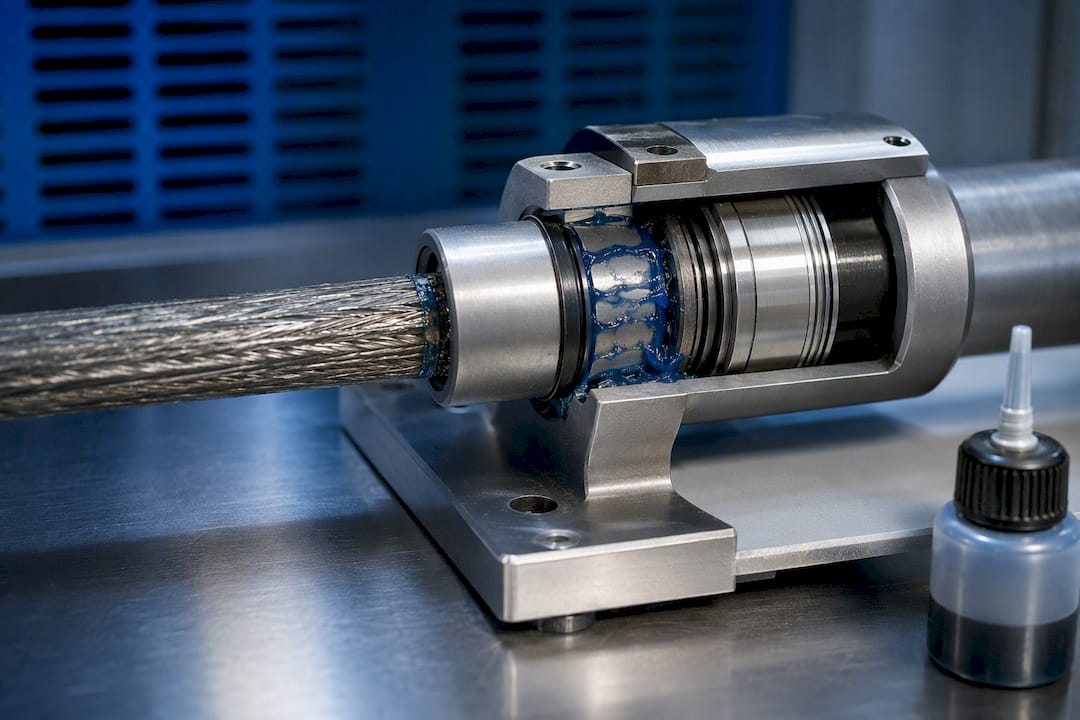
Lubricant choice is often the deciding factor in whether a flexible shaft assembly holds its particle and outgassing budget over time. Recent tribology research on cleanroom and vacuum compatible formulations points to PFPE and MAC base oils as common choices for low-outgassing service, but formulation differences affect oil separation, outgassing rate and shear-induced degradation under load, so the base oil family alone does not settle the question.
When evaluating lubricants, request:
- Vapor pressure and outgassing test results, ideally from residual gas analysis under conditions close to the intended use.
- Shear-stability data at the shaft’s expected rpm and load, since grease structure can break down well before the stated service life.
- Compatibility data with cleaning agents, particularly for disinfectants used in pharmaceutical and medical device cleanrooms.
Sealed housings, protective boots or purge systems reduce particle escape at the interface, but they add complexity and are only justified once bench testing shows the bare assembly cannot meet the target class on its own.
Design and installation constraints that drive particle generation
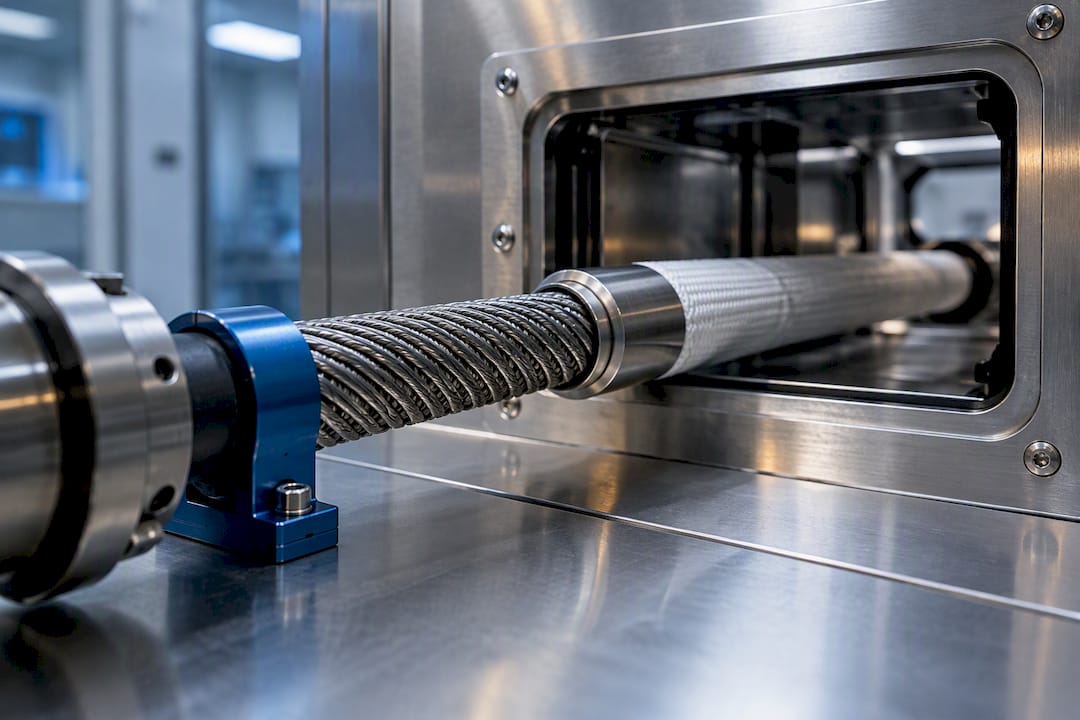
Most particle generation in a flexible shaft traces back to wear at contact points inside a multi-layer wire core, where combined bending and torsion create relative sliding between wire layers. An outer sealed sheath retains some of this debris, but it cannot be treated as proof of cleanliness without testing at the terminations and dynamic interfaces where the sheath meets the end fitting.
- Increase bend radius wherever the routing allows it, since tighter bends raise inter-wire contact stress and accelerate wear.
- Shorten unsupported length between fixed points to reduce whip and cyclic flexing that fatigues the core over time.
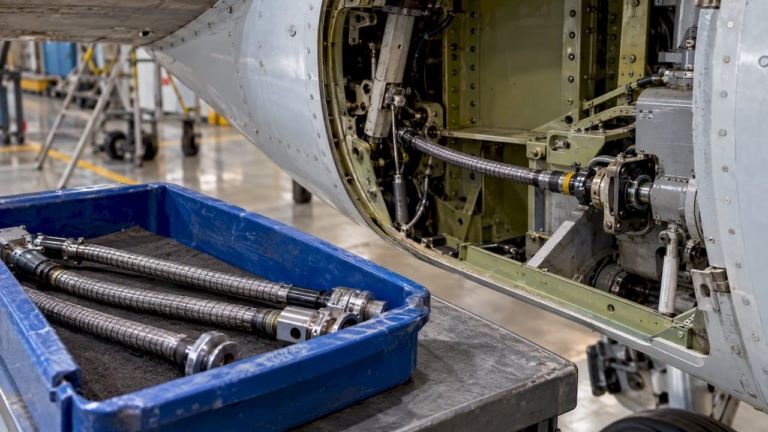
- Add continuous support such as guide tubes in confined installation environments, including synchronization shaft runs behind panels or within nacelle structures.
- Inspect sheath terminations and coupling interfaces during commissioning, checking for gaps, loose crimps or seal wear before the assembly goes into service.
These same principles apply directly to torque transmission through flexible shafts in confined aerospace installations, where routing constraints often force smaller bend radii than the shaft’s rated minimum.
Assessing and qualifying cleanroom suitability
Qualification follows a defined sequence rather than a single pass or fail test. ISO 14644-14 specifies that assessment must cover particle sizes from 0.1 micrometers up to 5 micrometers and larger, and that testing must reflect a representative operating mode rather than an idle or no-load condition. A shaft tested at low rpm with no torque tells an engineer very little about its behavior at rated duty.
A workable qualification approach includes:
- Defining the representative operating mode first: rpm, torque, bend configuration and duty cycle that match actual service.
- Measuring at the interfaces most likely to leak, including sheath terminations, couplings and any dynamic seal.
- Running worst-case cycles, not just steady-state operation, since reversal and transient loads generate more wear debris than continuous rotation.
- Documenting boundary conditions, following VDI 2083’s recommendation to record test parameters so results remain comparable across suppliers and revisions.
Outgassing or ESD testing should be added whenever the application involves vacuum exposure or electrostatic sensitivity, and every result needs traceable documentation tied to the specific configuration tested, not the shaft family in general.
What we check when qualifying an assembly for cleanroom use
Before proposing a configuration, we ask for the operating rpm and torque profile, the bend geometry and installation length, the expected service life in cycles, the cleaning or disinfection agents involved, and the target cleanroom class. This lets us match core construction, sheath material and lubricant to the actual duty rather than to a generic rating. A shaft that has never seen the intended bend radius or reversal pattern has not been qualified for it, regardless of what the base material can theoretically tolerate.
— Uli
Requesting a cleanroom suitability assessment
BIAX Flexwellen designs and manufactures both standard and custom flexible shaft cores, including refined cores with surface treatments suited to contamination-sensitive service, alongside actuation shafts and prototype runs for low-volume qualification projects. Before contacting us, prepare your target cleanroom class, operating rpm and torque range, bend radius, installation length, expected duty cycle, and any cleaning agents the assembly will encounter. Our custom configuration guide outlines the data points that speed up an engineering review, and our prototype and small-series solutions support qualification builds ahead of full production.
Sources
Engineers specifying or qualifying cleanroom flexible shafts should reference ISO 14644-14 for assessment methodology, VDI 2083 for material and equipment suitability guidance, and current tribology literature on lubricant outgassing for contamination-sensitive drive components.
- ISO 14644-14: Assessment of suitability for use of equipment by airborne particle concentration
- VDI 2083: Guidance on material suitability and cleanliness
- Formulation development for cleanroom and vacuum compatibility (2025)
- Flexible rotary shaft operation, uses and advances
FAQ
What makes a flexible shaft cleanroom suitable?
A flexible shaft becomes cleanroom suitable only after the full assembly, including the core, sheath, lubricant and end fittings, is tested in a representative operating mode against ISO 14644-14’s particle assessment methodology. No individual component carries suitability on its own; the conclusion applies to the tested configuration and operating conditions, not the product family generally.
Which particle sizes does cleanroom testing cover?
Assessment under ISO 14644-14 covers particle sizes ranging from 0.1 micrometers to at least 5 micrometers, including larger sizes. Testing has to reflect the shaft’s actual duty cycle, since idle or no-load testing does not represent real particle emission.
Can the same flexible shaft material work in different industries?
Not automatically. VDI 2083 guidance notes that material suitability depends on defined load and test parameters tied to a specific process, so a core acceptable for a pharmaceutical line may fail semiconductor requirements due to ESD or tighter particulate limits.
What lubricant data should engineers request for cleanroom applications?
Request vapor pressure and outgassing results, shear-stability data at the expected rpm and load, and compatibility data against the cleaning agents used in the facility. Tribology research on cleanroom compatible formulations shows that PFPE and MAC base oils are common choices, but formulation differences affect performance enough that bench data under representative conditions is necessary.
Does BIAX perform cleanroom suitability testing directly?
BIAX Flexwellen designs and manufactures custom and standard flexible shaft assemblies, including refined cores and prototype builds, and supports engineers with configuration guidance ahead of qualification testing. For a specific project, reach out through our contact page with your operating parameters and target cleanroom class.
Recommended
- Flexible Shafts for Tight Spaces: Boosting Precision
- Custom flexible shaft design explained: engineer better solutions
- Flexible shaft guide: Engineering compact drive solutions
- How to Select Flexible Shafts for Precision Machinery
Related Topics
Send your spec inquiry
Custom flexible shafts for your application — we quote within 1 working day.