Flexible Shaft Explosion Protection: 5 Inputs Engineers Need
14 October 2026A flexible shaft can be used safely in a potentially explosive atmosphere when two conditions are met: the design follows ATEX 2014/34/EU and ISO 80079-36/37, and the manufacturer provides complete technical documentation that is matched by correct installation and maintenance in the field. Without both, the shaft is not qualified for the zone, regardless of its mechanical quality.
TL;DR:
- Specify the zone category, medium, torque and RPM across the full duty cycle, run time, and coupling dimensions; peak torque alone cannot define the application.
- Set a documented continuous thermal limit before finalizing torque and RPM, then verify materials, bearings, lubrication, sealing, and grounding against the zone’s ignition risks.
- Request the declaration of conformity, technical file reference, protection test reports, and change records; motor assemblies may require separate mechanical and electrical assessment.
- A competent person sets inspection intervals by duty cycle and zone category; log grounding and cleaning, since disturbed 1 mm dust can form ignitable clouds.
Table of Contents
- When Does a Flexible Shaft Fit an Explosive Atmosphere?
- Applicable Standards and Certification Routes
- Design Considerations Unique to Ex-Rated Flexible Shafts
- Constructive Protection Measures Around the Shaft
- Manufacturing Conformity and Required Documentation
- Inspection, Testing, and Maintenance Over the Shaft’s Life
- How We Support Ex-Capable Flexible Shaft Projects
- What Engineers Should Prioritize When Specifying Ex Shafts
- Request an Engineering Quote for Your Application
- FAQ
- Sources
When Does a Flexible Shaft Fit an Explosive Atmosphere?
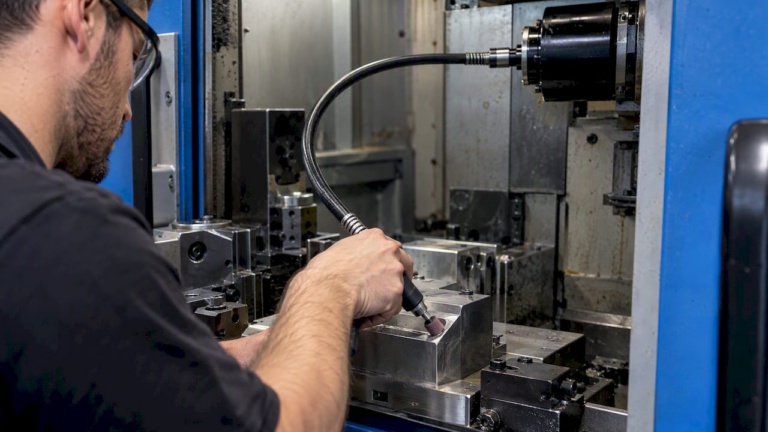
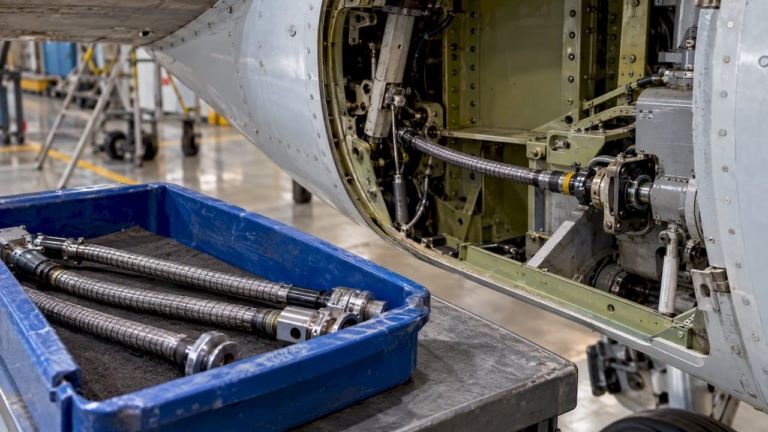
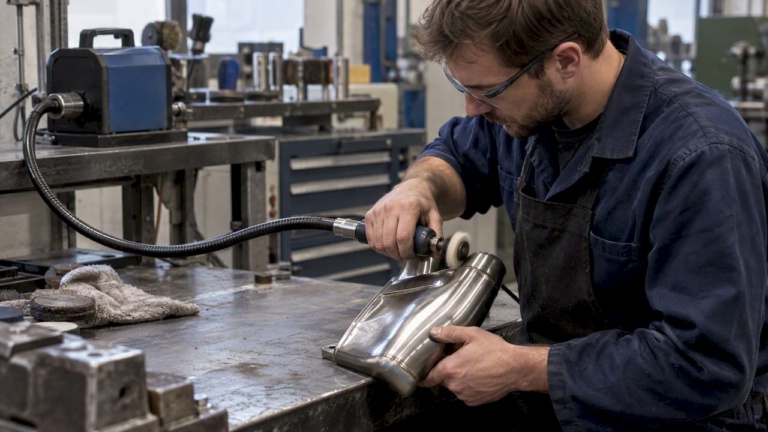
Flexible shafts suit explosive atmospheres when a rigid drivetrain cannot reach the working point: confined actuation inside housings, finishing tools operating within enclosed cells, and confined linkages found in aerospace installations such as thrust reverser mechanisms or flap and slat actuation runs. The shaft’s ability to route torque around obstructions is the same property that makes it attractive in these tight, often sealed, installation environments.
Before specifying a shaft for one of these duties, we need several inputs settled:
- Hazardous zone classification (gas/vapor zone or dust zone, and the zone category within it)
- Medium present (gas, vapor, or combustible dust) and its ignition characteristics
- Torque and RPM profile across the duty cycle, not just the peak value
- Duty cycle and expected run time between rest periods
- Contamination load and the cleaning regime the installation can support
A shaft becomes unsuitable when frictional heating cannot be controlled at the required duty point, when dust generation cannot be contained, or when the installation geometry prevents enclosure or earthing. These constraints often decide the question before material selection even starts; see our selection guide for industrial drives for the broader rigid-versus-flexible trade-off.
Applicable Standards and Certification Routes
Mechanical equipment, including flexible shafts, falls under the same directive that governs electrical Ex devices. ATEX 2014/34/EU sets essential health and safety requirements in Annex II, requires manufacturers to compile technical documentation, and defines the conformity assessment modules a device must pass through before it carries CE and Ex marking.
For the mechanical side specifically, ISO 80079-36 and ISO 80079-37 define the basic method and the protection concepts for non-electrical equipment intended for explosive atmospheres, complementing the IEC 60079 series used for electrical devices. This gives designers a single international framework to work from, whether the final device is a flexible shaft, a gearbox, or a pump.
In practice, conformity follows one of a few routes:
- Self-certification under manufacturer responsibility for lower-risk categories, where permitted by the directive
- EU-type examination through a notified body (benannte Stelle) when the category requires third-party assessment
- Reference to PTB Prüfregeln for test methods and certification procedure specific to explosion-protected drives
PTB publishes the Prüfregeln that German certification bodies use to test and certify explosion-protected drives, and these rules are commonly cited in RFQs for both electrical and non-electrical Ex components.
Design Considerations Unique to Ex-Rated Flexible Shafts
A flexible shaft intended for a hazardous zone carries constraints that a standard shaft does not. Each one needs to be specified, not assumed:
- Select core and sheath materials that limit electrostatic charge buildup and avoid creating localized hot spots under load.
- Choose bearing types and lubricants compatible with the target zone; grease chemistry and bearing friction both affect ignition risk.
- Specify surface finishes that reduce frictional heating at the shaft-to-sheath interface, particularly at sustained high RPM.
- Correlate shaft geometry, RPM, and torque against self-heating behavior, and set a documented thermal limit for continuous operation.
- Define sealing against dust ingress and limit surfaces where a dust layer could accumulate undisturbed.
- Build in cleaning access so maintenance can remove accumulated dust without opening the enclosure to the hazardous zone.
- Set grounding and earthing requirements, including a target surface resistivity for the shaft assembly.
Pro Tip: Treat the thermal limit as a hard design input, not a derived result. Confirm it before finalizing torque and RPM targets, not after.
Constructive Protection Measures Around the Shaft
The shaft itself is only one part of the protection concept. The housing and system design around it carry much of the risk reduction:
- Closed housings that physically separate the rotating shaft from the surrounding atmosphere
- Purge or pressurization where the installation can support an air or inert gas supply
- Geometry that avoids ledges and recesses where dust layers can form undisturbed
- Grounding and equipotential bonding across housing, shaft, and any adjacent conductive parts
- Encapsulation or pressure-resistant housings where active purge or pressurization is impractical
ISO 80079-37 describes these as distinct protection concepts, constructive safety, ignition-source monitoring, and liquid immersion, each with its own validation approach. Choosing between them depends on how accessible the installation is for maintenance versus how much ignition-source control the duty cycle demands.
Pro Tip: Where the installation allows only intermittent access, favor constructive safety over active monitoring. A passive measure that cannot fail in service outperforms an active one that needs periodic verification.
Manufacturing Conformity and Required Documentation
Procurement and quality teams should request a defined document set before accepting a shaft rated for an explosive atmosphere. The technical file must identify the applicable protection concept, describe materials and test results, and support the EU declaration of conformity that states the directive, the standards applied, and the device’s category and group.
When the final assembly combines a mechanical component with electrical parts, such as a motor-driven flexible shaft unit, the conformity procedure and documentation split between mechanical and electrical scope. The PTB Merkblatt on mechanical part documentation sets out when the mechanical technical file must be deposited with a notified body as part of a combined product’s EU-type examination.
For traceability, ask suppliers for:
- The declaration of conformity and the technical file reference it points to
- Test reports supporting the stated protection concept
- Change control records showing how material or geometry revisions were assessed against the original certification
Our engineering standards guide walks through how these documents map to specific shaft design choices.
Inspection, Testing, and Maintenance Over the Shaft’s Life
Commissioning should confirm sealing integrity, grounding continuity, and, where relevant, an initial electrostatic check before the shaft enters service.
- Verify grounding continuity and surface resistivity against the documented target at commissioning.
- Set periodic inspection intervals based on duty cycle and zone category, carried out by a competent person.
- Repeat electrostatic discharge or frictional heating checks at defined intervals, and log every result.
A dust layer as thin as 1 mm can form an ignitable cloud if disturbed, which is why BAuA guidance treats cleaning records as part of the maintenance file, not a separate housekeeping task.
How We Support Ex-Capable Flexible Shaft Projects
Flexible shafts can be configured from the torque and RPM profile, coupling interface, and required sealing to suit the duty described, using standard components and custom engineering as needed.
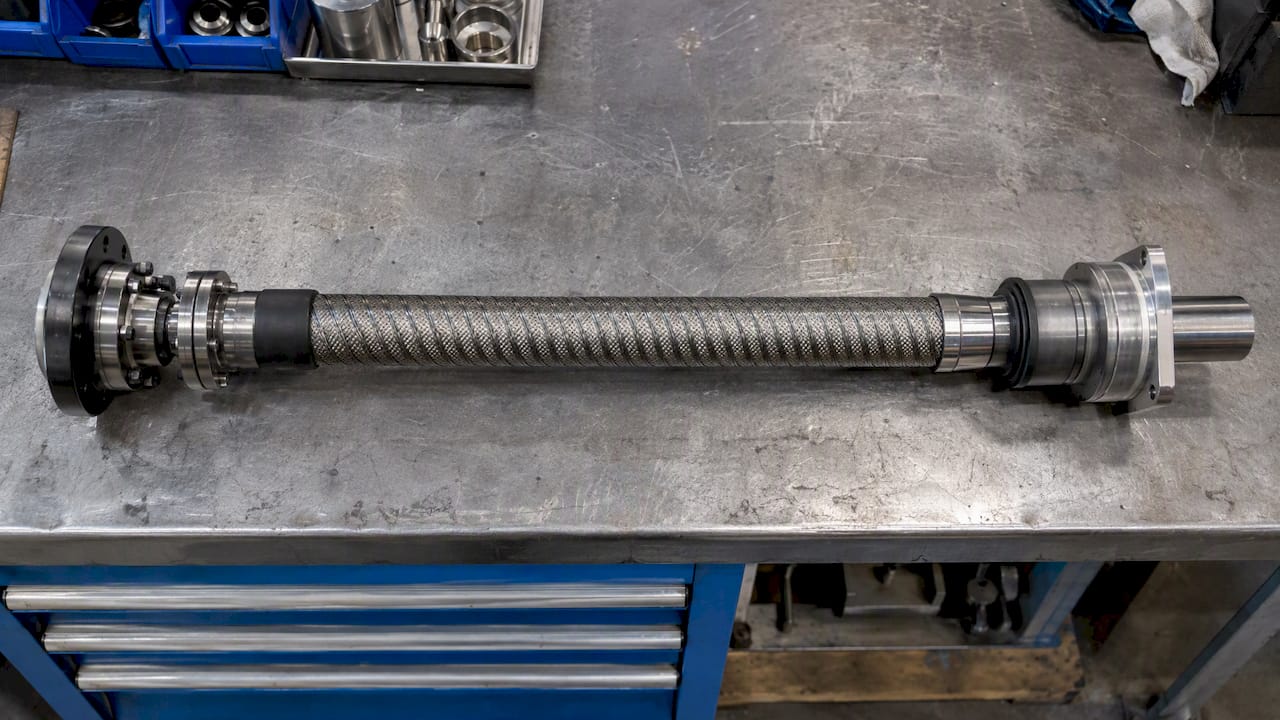
For bespoke geometries or low-volume runs, our custom and small-batch solutions cover prototype quantities through to short production series, with a datasheet and installation/maintenance limits provided alongside the shaft.
To get a workable proposal back quickly, include in your RFQ:
- Hazard zone classification and the medium present
- Full duty cycle (torque, RPM, run time) rather than a single peak value
- Interface drawings showing the coupling and envelope constraints
What Engineers Should Prioritize When Specifying Ex Shafts
The trade-off that matters most is safety margin against marginal throughput gains: a shaft sized for peak torque with no thermal headroom is a liability in a hazardous zone, whatever its nominal rating suggests. Encapsulation buys safety at the cost of maintainability, and that balance deserves as much attention as material selection. Documentation and correct installation carry the actual risk level into service; a well-designed shaft installed or maintained incorrectly no longer matches its certification.
— Uli
Request an Engineering Quote for Your Application
We size and configure flexible shafts against the torque and RPM profile, hazardous-zone classification, medium, and coupling interface you provide. Share those details through our Betätigungswellen or Antriebs- und Werkzeugwellen product pages, or send your specification directly through our contact page to start a quote.
FAQ
Can a standard flexible shaft be modified for Ex use?
Generally no. A shaft intended for an explosive atmosphere needs materials, sealing, and grounding chosen against the target zone from the start, along with the documentation that supports its ISO 80079-36/37 protection concept. Retrofitting a standard shaft does not produce a traceable conformity file.
What zone information do I need before requesting a quote?
You need the zone category (gas/vapor or dust), the specific medium present, and the full duty cycle including torque, RPM, and run time. This information determines which protection concept and sealing strategy apply under ATEX 2014/34/EU.
How often should an explosion-protected flexible shaft be inspected?
Inspection intervals depend on duty cycle and zone category, and should be set by a competent person rather than a fixed calendar figure. Commissioning checks and periodic follow-up inspections, including grounding continuity, are both part of the maintenance record.
Does BIAX certify flexible shafts for explosive atmospheres?
We configure shaft cores, sheaths, and coupling interfaces against the technical requirements you specify, including inputs relevant to Ex-zone applications. Certification and conformity assessment under the applicable directive remain a separate step carried out through the appropriate notified body or testing authority.
What is the difference between ATEX and ISO 80079-36/37?
ATEX 2014/34/EU is the EU directive setting legal requirements and conformity procedures for equipment used in explosive atmospheres. ISO 80079-36 and -37 are the technical standards that define how non-electrical equipment, including flexible shafts, meets those requirements in practice.
Sources
- Richtlinie 2014/34/EU (ATEX)
- ISO 80079-36:2016 – Explosive atmospheres — Part 36: Non-electrical equipment for explosive atmospheres — Basic method and requirements
- Ptb
- BAuA – Brand- und Explosionsgefährdung – Handbuch Gefährdungsbeurteilung
Recommended
- Engineers: 10 Point RFQ Checklist for Dustproof Flexible Shafts
- Flexible shaft guide: Engineering compact drive solutions
- Engineering Grade Bend Protection and Field Fixes for Flex Shafts
- 7 Expert Flexible Shaft Maintenance Tips for Engineers
Related Topics
Send your spec inquiry
Custom flexible shafts for your application — we quote within 1 working day.