Engineers: 10 Point RFQ Checklist for Dustproof Flexible Shafts
5 October 2026Yes, flexible shafts can be made dustproof using IP-rated protective conduits, elastomer bellows, or sealed shaft interfaces, and the right choice depends on bend radius, torque, and abrasive load. Conduits with an internal plastic-coated steel helix handle tight bend radii and abrasive particulates well, while bellows and radial seals suit lower-flex, higher-cycle applications. Minimum bend radius and torque or RPM limits determine which architecture fits a given installation, and the specification checklist later in this guide helps structure an RFQ around those constraints.
TL;DR:
- Conduit designs with an internal plastic-coated steel helix can achieve IP68 ratings and tolerate tight bend radii, but depend on proper end-fittings for sealing integrity.
- Bellows seals are suitable for lower-flex, high-cycle applications with water or chemical exposure but require larger bend radii and have shorter service lives in abrasive environments.
- Material choices for dustproof shafts, such as NBR seals or EPDM bellows, must align with operating temperature, chemical exposure, and particulate abrasiveness to ensure durability.
- Proper installation and maintenance, including respecting bend radius and regular seal inspections, are crucial to preserve ingress protection and prevent early failure.
- Certification for aerospace uses demands strict material traceability, thermal-mechanical testing, and design considerations that account for torsional shifts due to sealing components.
Table of Contents
- How dustproofing is achieved: enclosures, conduits, and bellows
- Materials and sealing components: conduits, bellows, and radial seals
- Procurement and specification checklist for dustproof flexible shaft RFQs
- Installation, mounting, and maintenance practices that preserve sealing
- Aerospace and precision constraints: synchronization and certification
- Common failure modes and troubleshooting for dustproof flexible shafts
- Publisher perspective: how we approach dustproof flexible shaft design
- Requesting a dustproof flexible shaft design or quote
- FAQ
- Sources
How dustproofing is achieved: enclosures, conduits, and bellows
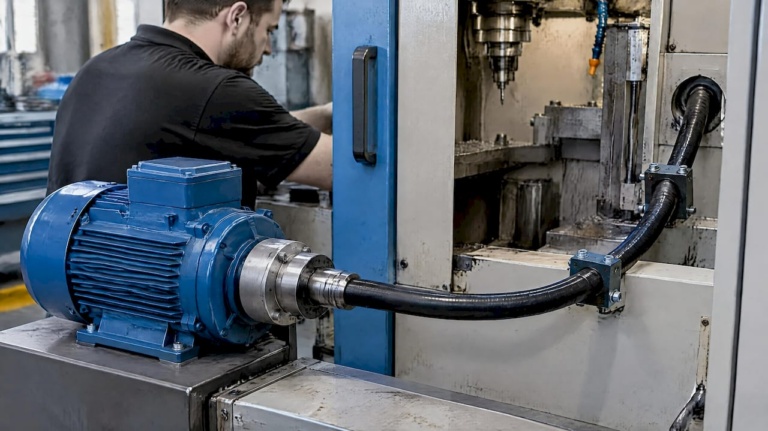
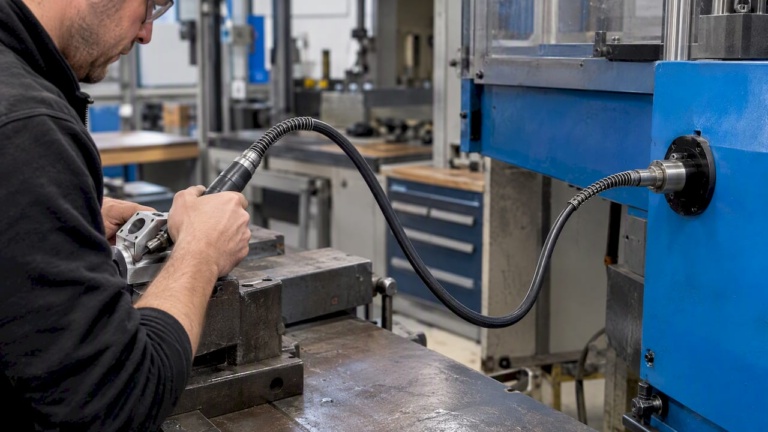
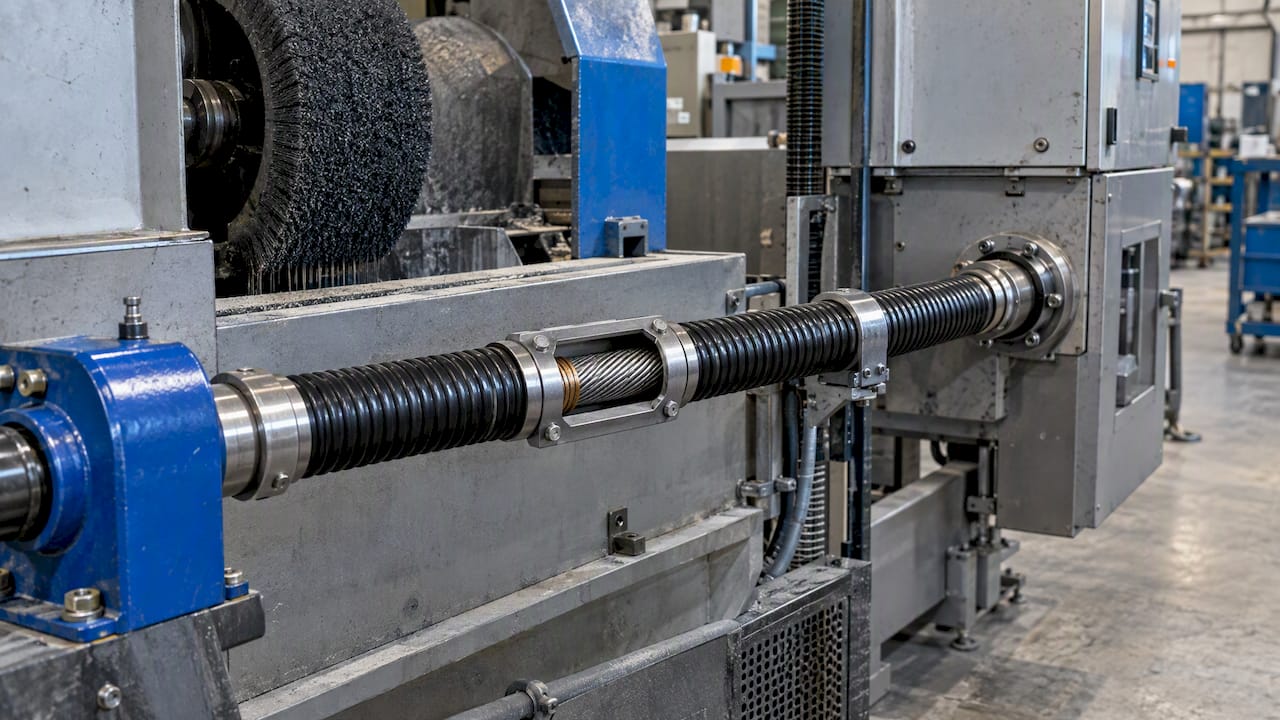
Three mechanical architectures keep particulates out of a rotating flexible shaft while still allowing it to transmit torque around bends. A flexible conduit built around an internal helix, typically a plastic-coated steel coil inside a PVC outer jacket, forms a closed path for the shaft core and resists abrasion from grit, swarf, or dust. A fully enclosed bellows wraps the shaft in a continuous elastomer skin that flexes with the assembly, avoiding the end-fitting complexity of a conduit but tolerating a larger bend radius. A hybrid approach combines conduit protection along the run with localized seals at the housing penetrations, where ingress risk concentrates.
Each approach trades differently against mechanical constraints:
- Conduit-and-helix designs achieve small bend radii and strong abrasion resistance but depend on correctly designed end fittings to maintain the ingress rating at the shaft exit.
- Bellows provide continuous sealing along the flex path but generally require a larger bend radius and show shorter service life under heavy abrasive loading.
- Hybrid conduit-plus-seal designs balance the two, concentrating sealing effort at the interfaces most exposed to ingress.
IP ratings describe a static test condition, so a moving shaft assembly has to demonstrate that rotation and flexing do not open a path for dust or water at the seal lines. Conduit-based designs achieve high ingress protection rating equivalent to IP68 through a plastic-coated internal steel helix combined with a tight, small bend radius, which keeps the sealing geometry stable even while the assembly flexes.
Materials and sealing components: conduits, bellows, and radial seals
Material selection for a dustproof flexible shaft follows from three variables: operating temperature, chemical exposure, and the abrasivity of the surrounding particulate.
- PVC or plastic-coated steel helix conduits deliver IP68-capable sealing with a bend radius approximately equal to the outer diameter, along with resistance to oils and common process chemicals.
- Silicone bellows suit wide temperature swings and ozone exposure but offer lower abrasion resistance than NBR.
- NBR bellows handle mineral oil environments well and resist abrasive wear better than silicone, at the cost of a narrower temperature window.
- EPDM bellows perform well with water, steam, and many cleaning agents, making them a common choice in washdown environments.
- Radial shaft seals with a dust lip in BS form, built to DIN 3760, block particulate ingress at the shaft-to-housing interface and are commonly specified in NBR 70 for mineral-oil compatibility up to roughly 100°C.
NBR 70 radial shaft seals in BS form to DIN 3760 tolerate continuous operation up to about 100°C in mineral-oil environments, which makes them a practical default at housing penetrations where a conduit terminates. In corrosive or caustic process media, corrosion-resistant metals and protective coatings on the helix or housing extend service life beyond what elastomer sealing alone provides. Material compatibility notes for specific industrial applications are covered in our guide to flexible shaft applications for industrial manufacturing.
Procurement and specification checklist for dustproof flexible shaft RFQs
A complete RFQ for a dustproof flexible shaft assembly should give a supplier enough data to select the sealing architecture without back-and-forth clarification. The following sequence covers the items most often missing from early-stage inquiries.
- State required torque in newton-meters, along with continuous and intermittent RPM limits.
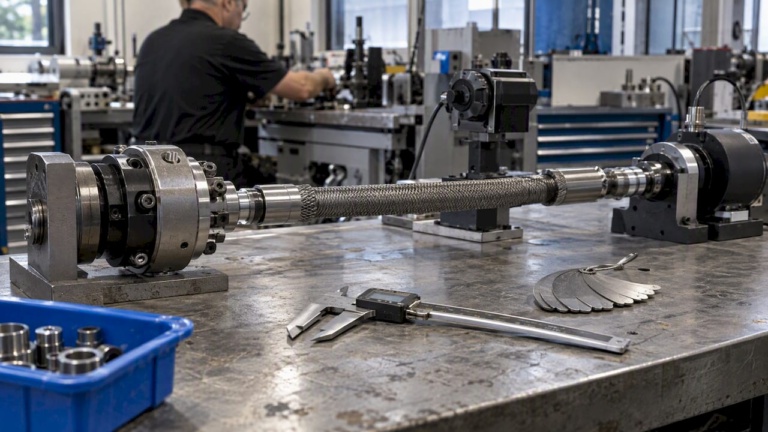
- Specify shaft core diameter, overall length, and minimum bend radius for the installed routing.
- List maximum radial and axial loads expected at the shaft ends.
- Name the target IP rating for the dynamic assembly, not just the static enclosure.
- Identify the preferred sealing architecture: conduit with helix, bellows, radial seal, or a hybrid.
- Describe the expected particulate type and size range, and how abrasive it is.
- Define the coupling type at each end and the bearing or support spacing along the run.
- Detail the housing penetration geometry, including gland or clamp style and seal preload.
- Request material certificates or a certificate of conformity for traceable alloys and elastomers.
- Ask for recommended maintenance intervals, available test reports for IP or dust testing, and spare parts lead time.
Engineers preparing this data before contacting a supplier typically shorten the quotation cycle; our guide on custom shaft configuration advantages walks through how torque, RPM, and coupling data translate into a configured design.
Installation, mounting, and maintenance practices that preserve sealing
A dustproofed flexible shaft that is installed or maintained incorrectly loses its ingress protection well before the sealing materials themselves wear out.
- Respect the specified minimum bend radius and keep unsupported spans within the manufacturer’s recommended distance to avoid excess bending and torsional stress on the core.
- Route the conduit or bellows away from fixed edges that could abrade the outer jacket during operation, and use clamps or glands rated for the specified seal preload.
- Follow a lubrication schedule for the shaft core, typically through a grease nipple, and inspect bellows, helix sheaths, and radial seal lips on a fixed interval rather than only after a failure.
- In heavily abrasive environments, add secondary shielding or a sacrificial sleeve over the primary conduit, since replacing a sleeve is cheaper than replacing the sealed assembly.
Pro Tip: Log bend radius and support spacing at installation, since both drift during maintenance and are the most common causes of premature seal wear.
Aerospace and precision constraints: synchronization and certification
In flight-critical installations, a flexible shaft often functions as a mechanical synchronizer between actuators, and sealing choices cannot be allowed to change its torsional response. Adding a conduit or bellows changes the effective stiffness of the assembly, so synchronization error budgets have to account for that shift rather than treat sealing as a purely mechanical add-on.
- Torsional rigidity governs how much angular deviation accumulates along the shaft, which directly affects synchronization accuracy between linked actuators.
- Designers sometimes choose electro-hydrostatic actuation over mechanical flexible-shaft synchronization when tighter synchronization tolerances are required; patent documentation on thrust reverser actuation describes electro-hydrostatic systems achieving flow-rate synchronization differences below 10% between actuators.
- Certification work for flight-critical shafts includes material traceability, cyclic thermal and mechanical testing, and functional-safety review tied to the installation’s criticality level.
- Confined installations such as thrust reverser petal mechanisms and flap or slat linkages impose their own bend radius and envelope limits that narrow the available sealing architectures before dust protection is even considered.
Our explanation of torque transmission through flexible shafts covers how torsional stiffness is calculated and specified for synchronized drive applications.
Common failure modes and troubleshooting for dustproof flexible shafts
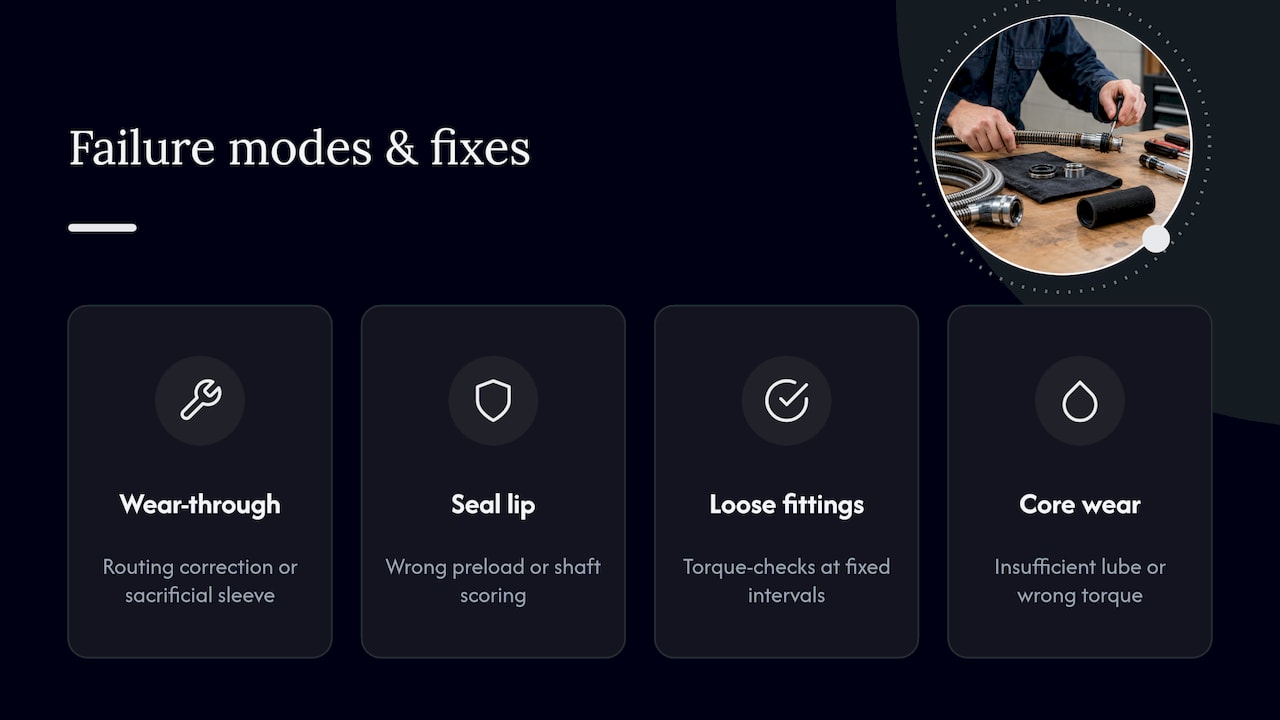
Most sealing failures in dustproof flexible shaft assemblies trace back to a small set of recurring causes rather than material defects. Abrasive wear-through of the conduit jacket or bellows skin is the most common, typically appearing where the assembly rubs against a fixed edge or where the installed bend radius is tighter than specified. The fix is usually routing correction or a sacrificial sleeve rather than a change in base material.
Seal lip failure at housing penetrations shows up as grease or process contaminant migrating past a radial shaft seal, often because the seal was installed with the wrong preload or because the shaft surface finish at the sealing diameter degraded over time. Replacing the seal alone will not resolve recurring failures if the shaft surface itself is scored or pitted.
End-fitting loosening on conduit assemblies breaks the IP rating at the point where it matters most, since the conduit’s abrasion resistance is irrelevant if dust enters through a loose termination. Torque-checking end fittings on a fixed interval, rather than only during a full teardown, catches this before it causes a secondary core failure.
Premature core wear inside a conduit or bellows usually signals either insufficient lubrication or a mismatch between the specified torque and the actual operating load. Reviewing the lubrication interval against the operating manual’s guidance, and confirming the applied torque against the original specification, resolves most of these cases without redesigning the sealing architecture itself.
Publisher perspective: how we approach dustproof flexible shaft design
We configure flexible shaft assemblies around the torque, RPM, coupling, and sealing requirements each installation presents, rather than fitting a project to a fixed catalog item. That means working through test evidence and maintenance planning alongside the mechanical specification, not after it. For technical questions specific to your installation, our contact page is the direct route to an engineering discussion.
— Uli
Requesting a dustproof flexible shaft design or quote
Both standard flexible shaft cores and custom-engineered assemblies are available, with advice on sealing architecture selection and the testing evidence needed to support a given IP target. For raw cores to integrate into your own sealed housing, our Biegsame Wellen Meterware line covers standard diameters and lengths. For a fully specified sealed assembly built around your torque, RPM, and coupling requirements, our Sonderlösungen und Prototypen line covers custom designs and small-batch production.
- Bring your target IP rating, bend radius, and torque/RPM data to the first conversation.
- Include the procurement checklist from this guide in your inquiry to reduce clarification cycles.
- Use our contact page for technical RFQs that need engineering input before a quote.
FAQ
Can a flexible shaft achieve an IP68 rating while rotating?
Yes, flexible shaft assemblies reach IP68-rated performance through a conduit built around a plastic-coated steel helix, combined with a bend radius approximately equal to the outer diameter. The rating depends on the end-fitting design maintaining that seal geometry under flex, not on the conduit material alone.
What is the difference between a bellows and a conduit for shaft sealing?
A bellows is a continuous elastomer skin that flexes with the shaft and seals along its entire length, while a conduit uses a helix-reinforced jacket that resists abrasion but typically needs sealed end fittings. Bellows generally require a larger bend radius, while conduits handle tighter bends and more abrasive particulates.
What elastomer should a radial shaft seal use for dust protection?
NBR 70 is a common choice for radial shaft seals built to DIN 3760 in BS dust-lip form, since it tolerates mineral-oil environments up to roughly 100°C. EPDM or silicone may suit different chemical or temperature profiles depending on the process environment.
Why do aerospace designs sometimes avoid flexible-shaft synchronization?
Flexible shafts introduce torsional compliance that limits synchronization accuracy between linked actuators, which matters in tight tolerance applications. Some thrust reverser actuation designs use electro-hydrostatic actuation instead, reporting flow-rate synchronization differences under 10% between actuators.
How often should a sealed flexible shaft be inspected?
Inspection intervals depend on the operating manual’s guidance for the specific assembly, covering lubrication, bend radius, and seal condition rather than a single universal figure. A fixed inspection schedule that checks bellows, helix sheaths, and seal lips catches most wear before it causes a failure.
Sources
- Flexiguard NS – flexibler Schutzschlauch mit Stahlwendel
- RWDR WBS Schutzlippe 145 x 170 x 13 mm 70 NBR | Gottwald
- Electro-hydrostatic actuation system for a thrust reverser for an aircraft turbojet engine nacelle (patent)
Recommended
- How to Select Flexible Shafts for Precision Machinery
- Custom Flexible Shaft Configuration Guide for Engineers
- Shaft Design Checklist for Mechanical Engineers
- 7 Expert Flexible Shaft Maintenance Tips for Engineers
Related Topics
Send your spec inquiry
Custom flexible shafts for your application — we quote within 1 working day.