Engineering Grade Bend Protection and Field Fixes for Flex Shafts
16 September 2026For most torque-transmitting flexible shafts operating in confined or repeatedly flexed installations, knickschutz (bend protection) is not optional. An internal PTFE or nylon sleeve is the right default for tight-radius routing, while a rubber or thermoplastic boot suits exposed sections needing abrasion and contamination resistance. Aerospace and other safety-critical installations, including including thrust reverser actuation and synchronization shaft runs, generally warrant a custom-engineered solution from a manufacturer such as BIAX Flexwellen rather than an off-the-shelf sleeve.
TL;DR:
- External boots are ideal for sealing against dust and debris in exposed applications but increase the shaft diameter and reduce flexibility at tight bends.
- Internal sleeves offer low friction and minimal stiffness additions, but they provide little abrasion resistance and are unsuitable for exposed contact.
- Metal overbraids deliver high abrasion resistance but add weight and stiffness, which can limit flexibility and raise torque losses at small radii.
- Proper installation relies on thorough surface cleaning, precise alignment, and appropriate adhesive selection, with common failures originating from poor prep or overheating.
- Custom protection schemes become necessary in safety-critical aerospace applications with extreme duty cycles, temperature ranges, or confined routing, requiring tailored engineering inputs.
Table of Contents
- What Types of Knickschutz Work Best for a Flexwelle?
- How Do You Install and Fix a Flexwelle With Knickschutz?
- How Does Bend Protection Affect Shaft Performance and Life?
- BIAX Engineering Guidance: What to Specify Before You Order
- What Are the Common Failure Modes and How Do You Maintain a Flexwelle?
- When Does Custom Knickschutz Make Sense for Safety-Critical Systems?
- Requesting a Custom Flexwelle Configuration From BIAX
- Sources
- FAQ
What Types of Knickschutz Work Best for a Flexwelle?
Bend protection for a flexible shaft, or flexwelle, comes in three general families, each solving a different failure mode at the flex core’s outer surface.
External boots, typically molded from rubber or thermoplastic, wrap the shaft where it exits a housing or transitions between fixed and moving components. They seal against dust, coolant, and moisture, which matters in grinding and polishing applications where debris ingress accelerates wear. The trade-off is added outer diameter and, in stiffer compounds, reduced flexibility exactly where the shaft needs to bend.
Internal sleeves, usually PTFE or nylon, sit between the flex core and an outer conduit or coupling bore. They reduce friction against the core during rotation and cut down on localized wear at contact points, which is why they show up often in tool-shaft applications running at higher RPM. They don’t provide much abrasion resistance to outside contact, so they’re rarely used alone in exposed installations.
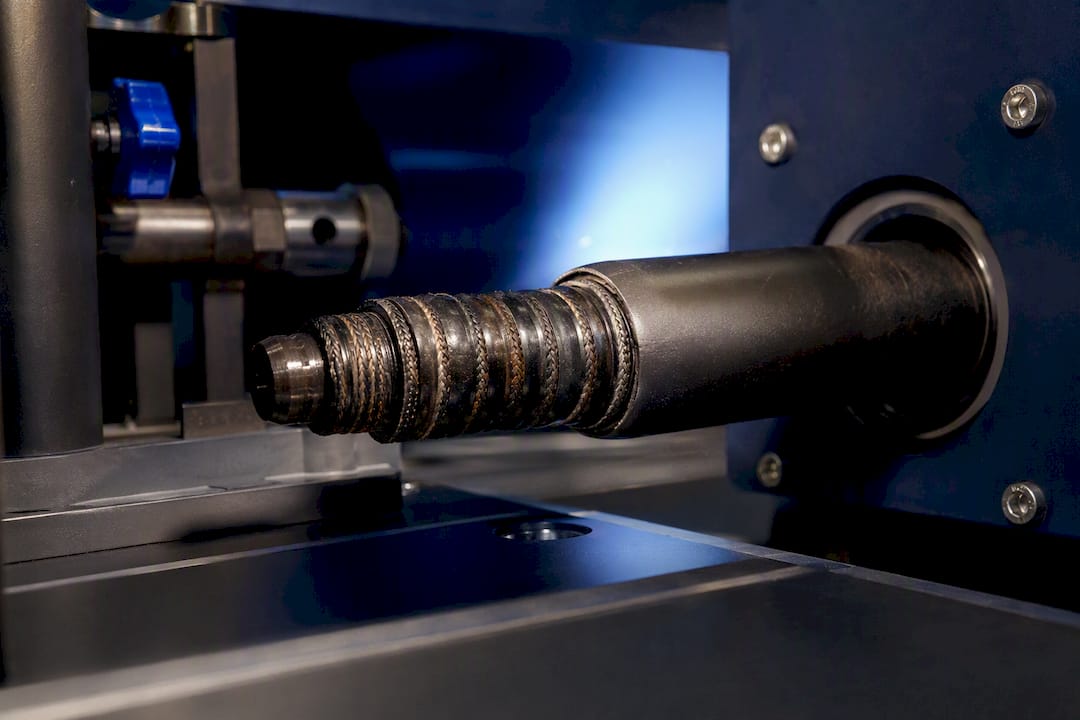
Spiral or overbraid metal guards wrap the shaft in a helical metal wind or woven mesh. This gives excellent resistance to cutting, crushing, and abrasion in harsh environments but adds mass and stiffness, which raises the effective bend radius and can increase torque loss under tight curvature.
- Rubber boots: good sealing, moderate cost, degrade above roughly 80 to 100°C depending on compound
- PTFE/nylon inner sleeves: low friction, minimal added stiffness, poor cut resistance
- Metal overbraid: highest abrasion resistance, added weight, reduced flexibility at small radii
Retail listings sometimes market accessory items explicitly as “mit Knickschutz,” confirming these protective components are sold as discrete parts rather than always integrated into the shaft assembly, as shown in one Conrad product listing.
How Do You Install and Fix a Flexwelle With Knickschutz?
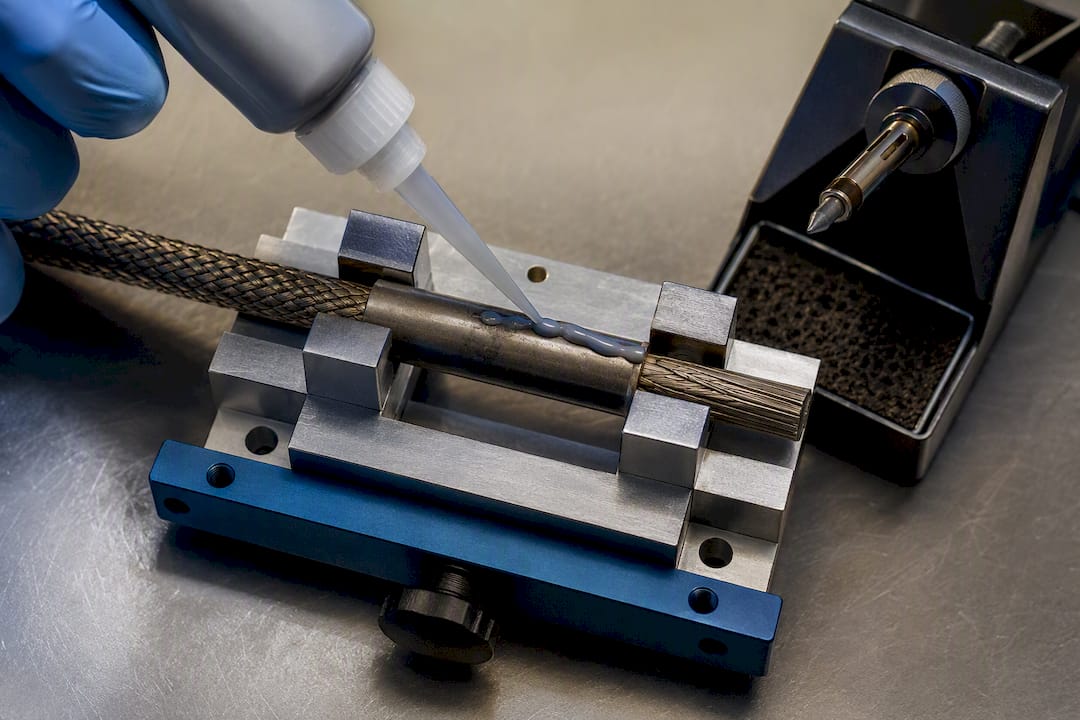
Reliable bend protection depends less on the material chosen and more on how well it’s bonded and aligned during installation. The sequence below reflects both manufacturer end-fitting practice and documented hobbyist technique.
- Clean the shaft surface with acetone. Remove oils and manufacturing residue from the bond area. Avoid aggressive acids sometimes mentioned in hobby forums; they can pit the core wire and weaken the substrate instead of preparing it.
- Lightly abrade the bonding surface. A fine abrasive pad increases surface area for adhesive mechanical keying without gouging the core strands.
- Choose a fixation method matched to the application. Soldering or tinning the flexwelle end works for some wire-wound cores before insertion into a metal end piece. Structural adhesives, including two-part epoxies like UHU Endfest 300 or anaerobic products in the Loctite 648 family, are widely used for bonding into end fittings, according to documented hobbyist practice. Mechanical crimping and press-fit sleeves suit high-volume production; overmolding is common on manufacturer-supplied end fittings, per SZW Prophet’s flexwelle documentation.
- Fix alignment during cure. Use a straight fixture or the shaft’s operating bend radius, whichever applies, and hold position until the adhesive reaches handling strength.
- Respect the adhesive’s temperature and cure window. Structural epoxies typically need a minimum cure temperature; some hobbyists report an oven post-cure step to raise ultimate bond strength.
Pro Tip: Never apply heat near the flex core to speed a cure. Localized overheating can anneal wire strands and quietly reduce fatigue life long before any visible damage appears.
The most common installation failures reported in forum threads are insufficient surface prep, uneven adhesive cure across the bond line, and overheating the core during soldering or an accelerated cure cycle.
How Does Bend Protection Affect Shaft Performance and Life?
Adding external support at a bend point changes the local bending stiffness of the shaft assembly. Where a rigid boot or metal overbraid ends and the unprotected flex core resumes, stiffness changes abruptly. That transition point concentrates bending stress and is where fatigue cracking most often initiates, a mechanism consistent with general bending-wave behavior in flexible drive elements described in background engineering literature.
A basic inspection routine catches most degradation before it becomes a failure:
- Visual check for surface cracking, discoloration, or sleeve separation at the bond line
- Temperature rise at support bearings or end fittings during a load run
- Audible noise, particularly a change in pitch or a new rattle under rotation
- Runout and wobble at the output end, measured with a dial indicator where practical
Three simple bench checks give a reasonable acceptance baseline: a low-speed run-in of several minutes to settle any bond, an RPM spin test under representative load to confirm no abnormal heat or vibration, and a cyclic bend test at the installed radius to surface any early delamination. A shaft that stays within its baseline runout and shows no temperature climb across these checks is generally acceptable for service.
BIAX Engineering Guidance: What to Specify Before You Order
Selecting the right protection scheme, standard or custom, comes down to a small set of operating parameters. Custom shaft configuration guidance from BIAX identifies these as the inputs that actually drive sleeve thickness, material choice, and whether spiral reinforcement is warranted:
- Required continuous and peak torque
- Continuous and peak RPM
- Minimum bend radius under installed and dynamic load
- Expected duty cycle, in cycles per day or per flight hour for aerospace use
- Ambient temperature range and any chemical exposure
- Coupling interface geometry, including press-fit, overmolded, or splined ends
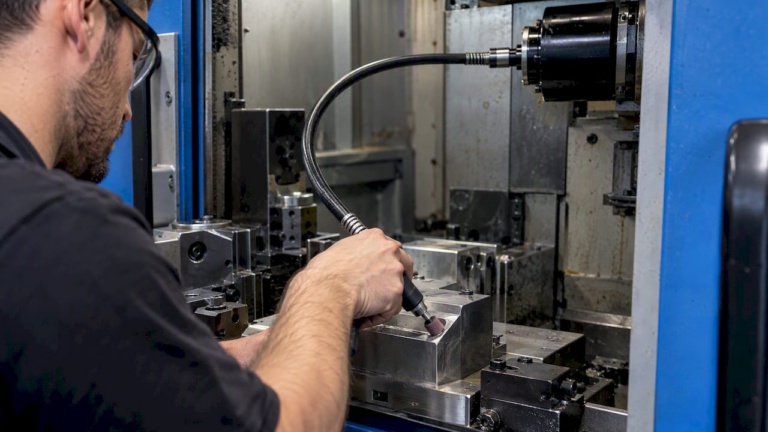
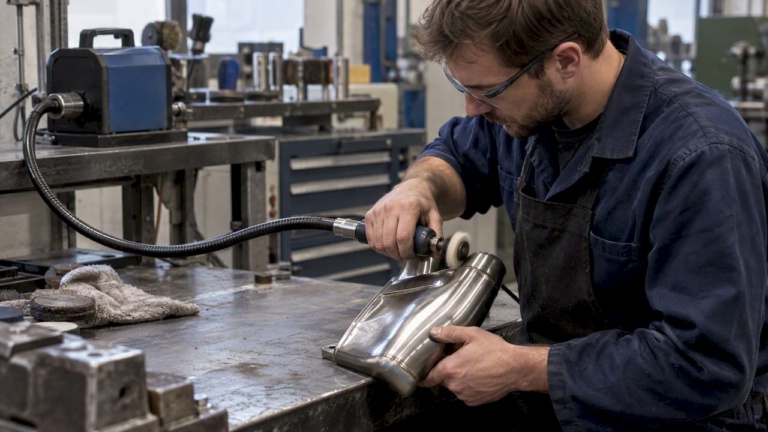
Conservative starting ranges illustrate how these parameters translate into hardware choices. A small tool-drive shaft handling light deburring work typically runs low torque at high RPM, favoring a thin PTFE inner sleeve to limit added inertia. A medium industrial shaft in a machine-tool feed application usually carries moderate torque at moderate RPM, where a rubber boot balances sealing against flexibility. A high-speed tool shaft approaching the upper end of common tool-shaft RPM ratings needs protection with minimal added mass, since even small increases in rotating inertia raise bearing loads disproportionately at speed.
Pro Tip: Request a custom configuration whenever duty cycle exceeds a few hundred thousand bend cycles or the installation routes through a confined, hard-to-reach envelope. Standard sleeve stock is rarely optimized for both conditions at once.
What Are the Common Failure Modes and How Do You Maintain a Flexwelle?
Four failure modes account for most field issues: adhesive bond failure at the end fitting, abrasion wear-through of an inner or outer sleeve, repeated kinking below the rated bend radius, and fatigue cracking at the stiffness transition where the knickschutz ends.
- Inspect visually every service interval for cracking, discoloration, or separation at bond lines and sleeve edges.
- Check runout and temperature at bearings and end fittings during a representative load run, comparing against baseline values recorded at installation.
- Listen for changes in operating noise, since a new rattle or tonal shift often precedes visible wear by weeks.
- Decide repair versus replacement based on location of damage. Wear confined to a replaceable sleeve usually justifies a sleeve swap. Damage at the bond line or core itself, particularly cracking near a transition point, generally calls for full shaft replacement rather than a field repair.
Maintenance intervals should scale with duty cycle rather than calendar time. A shaft running continuous high-cycle duty needs inspection far more often than one used intermittently.
When Does Custom Knickschutz Make Sense for Safety-Critical Systems?
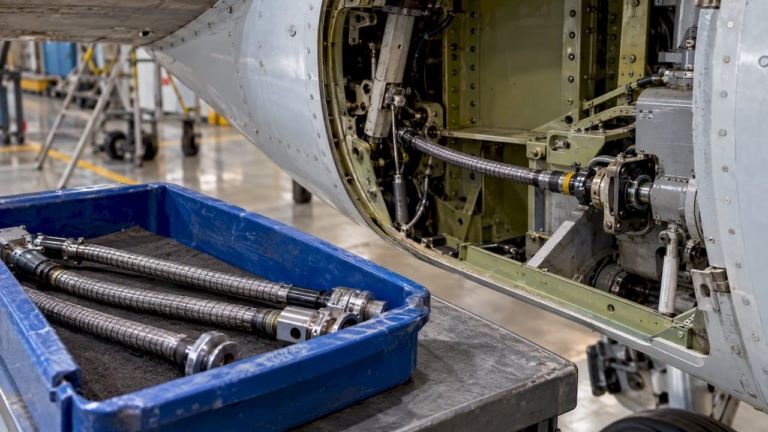
Off-the-shelf sleeves and boots work for most industrial finishing and general machine-tool applications. Aerospace-critical installations, such as flap and slat actuation, valve override systems, and thrust reverser mechanisms, operate under duty cycles, temperature extremes, and confined routing that standard stock rarely accounts for. In these cases, a custom-engineered protection scheme, sized against actual load and geometry, is the more defensible choice.
Before opening an inquiry, gather torque (continuous and peak), RPM, minimum bend radius under load, and expected duty cycle. Those four numbers determine whether a standard sleeve suffices or a reinforced, application-specific design is required.
— Uli
Requesting a Custom Flexwelle Configuration From BIAX
A manufacturer designs both standard components and fully custom flexible shaft assemblies with integrated bend protection for machine builders and OEM engineering teams. Where a stock sleeve or boot can’t meet duty-cycle or confined-routing demands, particularly in aerospace actuation or synchronization shaft applications, a tailored configuration lets the sleeve material, thickness, and reinforcement match the actual load case instead of a generic catalog spec.
Before submitting an inquiry, prepare the following: required torque (continuous and peak), continuous and peak RPM, minimum bend radius under installed load, coupling interface type, and expected duty cycle in cycles per day or per flight hour. This is the same data set outlined in the custom shaft configuration guide, and it’s what BIAX’s engineering team needs to size a sleeve or overbraid correctly.
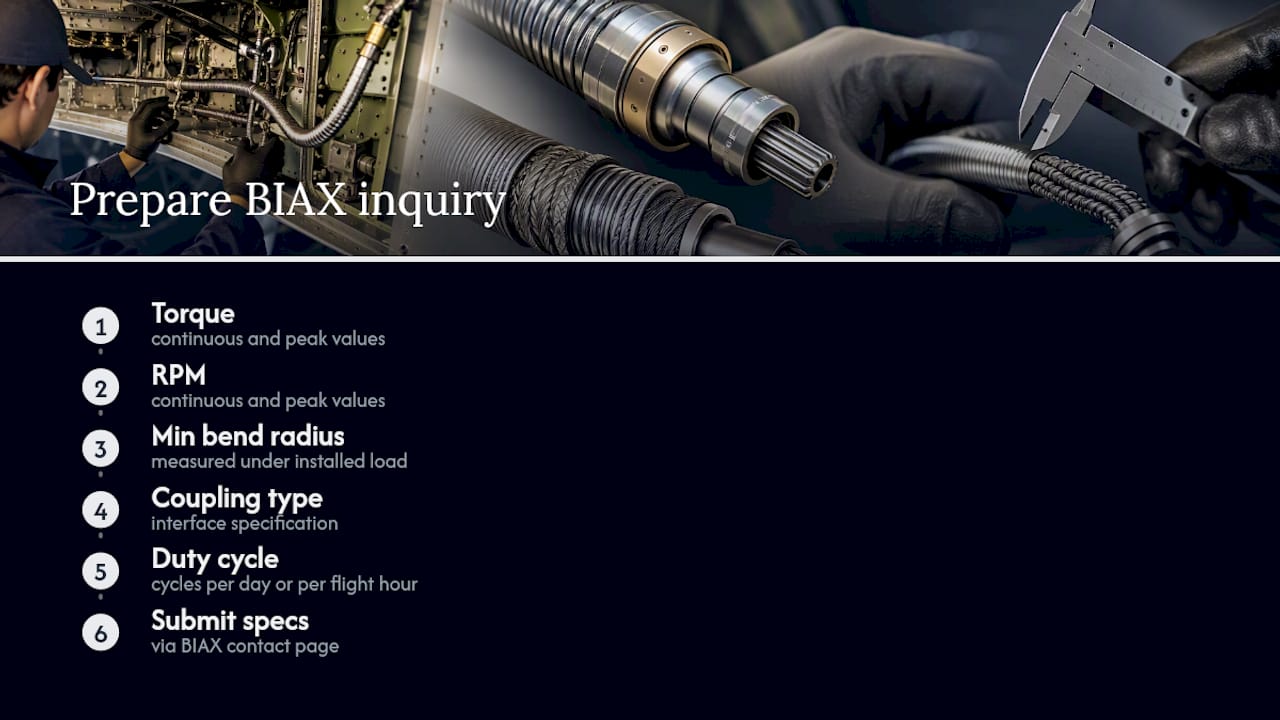
Engineers ready to scope a project can submit specifications directly through the BIAX contact page.
Sources
FAQ
Is Knickschutz Necessary for Every Flexwelle Installation?
Not always. Short, straight, low-cycle runs may not need added protection, but any installation with tight bend radii, repeated flexing, or abrasive exposure benefits from an internal sleeve or external boot.
What’s the Difference Between an Internal Sleeve and an External Boot?
An internal sleeve, typically PTFE or nylon, reduces friction and wear at the core’s contact points, while an external boot, usually rubber or thermoplastic, seals against dust and abrasion from outside the shaft.
Which Adhesive Works Best for Bonding a Flexwelle End Fitting?
Structural two-part epoxies such as UHU Endfest 300 and anaerobic adhesives in the Loctite 648 family are commonly reported as effective, provided the bonding surface is cleaned with acetone and lightly abraded first.
How Often Should a Flexwelle With Knickschutz Be Inspected?
Inspection intervals should track duty cycle rather than a fixed calendar schedule; high-cycle continuous applications warrant checks for runout, bearing temperature, and sleeve wear far more frequently than intermittent-use shafts.
When Should I Contact BIAX Instead of Using a Standard Sleeve?
Contact BIAX when duty cycle exceeds a few hundred thousand bend cycles, routing is confined or hard to reach, or the application is safety-critical, since a custom-engineered sleeve or overbraid can be sized to the exact torque, RPM, and bend radius involved.
Recommended
- 7 Expert Flexible Shaft Maintenance Tips for Engineers
- Shaft Design Considerations for Engineers: A Technical Guide
- 4 Checks OEM Engineers Must Run for Axial Thrust in Flexible Shafts
- Custom Flexible Shaft Configuration Guide for Engineers
Related Topics
Send your spec inquiry
Custom flexible shafts for your application — we quote within 1 working day.