RoHS and REACH for Flexible Shafts: What Engineers Need
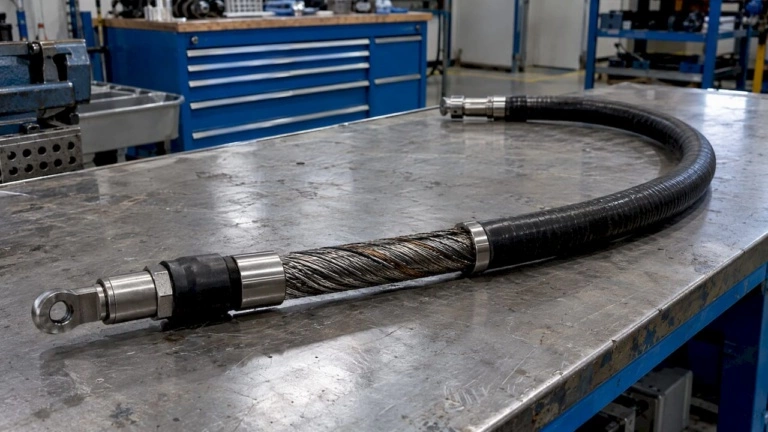
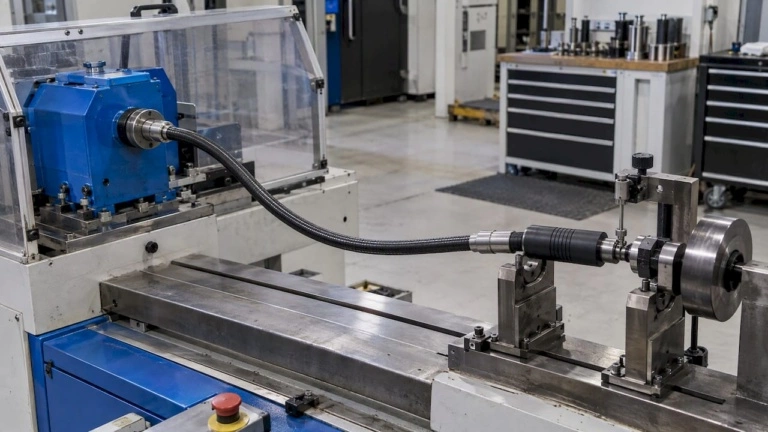
20 November 2026A flexible shaft is a mechanical torque-transmitting component, so RoHS and REACH apply to it differently. REACH applies to it as an article, with supply-chain information duties for substances of very high concern (SVHC) above 0.1 percent by weight. RoHS applies to the equipment the shaft is built into, and only if that equipment falls inside the directive’s scope. This article sets out how to decide which rules apply, what to ask a supplier for, and how the questions look in confined aerospace and industrial installations such as thrust reverser actuation, flap and slat drives, valve overrides and synchronization shafts.
TL;DR
- REACH applies to flexible shafts as articles: if a candidate-list SVHC exceeds 0.1 wt% in the article or a component of it, the supplier must pass the substance name and safe-use information to industrial customers at delivery.
- RoHS regulates electrical and electronic equipment (EEE). A purely mechanical shaft is not EEE itself, but the machine or drive it sits in may be, and then the equipment’s homogeneous materials must meet the limits.
- RoHS has explicit exclusions, including space equipment, certain transport vehicles, professional non-road mobile machinery and large-scale fixed installations. Time-limited exemptions are in Annexes III and IV.
- Identify the shaft by part number, revision and material build-up, and request a declaration that names the applicable rule, the limits and any claimed exemption.
- Re-check SVHC status after each candidate-list update. RoHS and REACH data go out of date.
Table of Contents
- Two regulations with different objects
- RoHS: what it limits and when a shaft is touched by it
- REACH: duties that attach to the shaft as an article
- Applying this to aerospace and confined installations
- What to request from a shaft supplier
- Worked example: a flap drive shaft revision
- Perspective
- Related BIAX product lines
- FAQ
- Contact
- Sources
Two regulations with different objects
RoHS and REACH are often written together as one compliance line on a drawing or purchase specification. They regulate different things.
RoHS (Directive 2011/65/EU, the restriction of hazardous substances) applies to electrical and electronic equipment in the listed categories, including cables and spare parts. The substance limits apply to each homogeneous material, meaning each part that cannot be separated mechanically into different materials. The consolidated text on EUR-Lex is the legal basis. In Germany the directive is implemented through the ElektroStoffV.
REACH (Regulation (EC) No 1907/2006) is a horizontal chemicals regulation. It covers substances, mixtures and articles, and it places duties on every actor in the supply chain. A flexible shaft is an article: a body whose shape and design matter more for its function than its chemical composition. That is why REACH is the regulation that reaches a shaft directly, whatever machine it ends up in.
The practical consequence is simple. A request for a “RoHS and REACH declaration” for a flexible shaft needs to be split into two questions:
- Does REACH Article 33 information apply, that is, does any component contain a candidate-list SVHC above 0.1 wt%?
- Is the shaft a part of EEE in scope of RoHS, and if so, are the ten restricted substances within the limits?
RoHS: what it limits and when a shaft is touched by it
The ten restricted substances
The limits per homogeneous material are 0.1 wt% for lead, mercury, hexavalent chromium, polybrominated biphenyls (PBB), polybrominated diphenyl ethers (PBDE) and four phthalates, and 0.01 wt% for cadmium. The IHK Nürnberg RoHS leaflet (2023) lists the substances and the exemptions. The ten-substance basis is Directive 2011/65/EU as supplemented by Delegated Directive (EU) 2015/863, as the consolidated EUR-Lex version shows.
For a flexible shaft the relevant materials are those in the construction:
- Core: wound steel wire layers, sometimes with a surface treatment on the wire or a lubricant film.
- Protective sheath or casing: metal, polymer or composite layers. Polymers and plasticizers are where phthalates would appear.
- End fittings and couplings: machined or cold-formed metal parts, typically with a plating or passivation. Hexavalent chromium and cadmium are historically associated with coatings of this kind, which is why the coating system, not just the base metal, belongs in a declaration.
- Lubricants and sealing elements: greases, seals and boots, which are separate homogeneous materials.
The homogeneous-material rule matters for the evidence. A declaration at assembly level (“the shaft is RoHS compliant”) says little unless it can be traced to each material. Material declarations or supplier statements should be attributable to the specific parts or material definitions.
When the shaft falls under RoHS
RoHS applies to EEE, that is, equipment that depends on electric currents or electromagnetic fields to work. A flexible shaft transmits rotation mechanically. Taken alone, without any electrical function, it is not EEE. The scope question therefore usually moves up one level: is the drive system, tool or machine that includes the shaft EEE in scope?
Typical cases in industrial engineering:
- Portable or hand-guided finishing tool with a motor and a flexible shaft (deburring, grinding, polishing): the tool is electrical equipment, and the shaft may be a part of it. The tool manufacturer is the party responsible for RoHS conformity of the tool and for the technical documentation behind the EU declaration of conformity.
- Fixed machine tool with a flexible shaft for a tight-space spindle: large-scale fixed installations and large-scale stationary industrial tools are excluded in Article 2(4), as the EUR-Lex text states. Whether a particular machine qualifies is a case-by-case judgment about size, permanent installation and professional use.
- Robot or automation cell: an integrator needs to decide whether the cell is a large-scale fixed installation or EEE placed on the market as a unit.
In each case the person who decides is the manufacturer of the finished equipment, not the component supplier. The component supplier’s job is to supply the material information the manufacturer needs.
Exclusions relevant to aerospace and mobile machinery
RoHS also contains scope exclusions. According to the IHK Nürnberg leaflet, these include equipment for essential national-security interests, space equipment, specified transport vehicles, professional non-road mobile machinery and equipment designed exclusively for inter-company research and development.
For aerospace engineers this has two consequences:
- Do not assume that an aircraft system is outside RoHS or inside it because it is “aerospace”. Read the exact wording of Article 2(4) for the product concerned and document the reasoning in the compliance file.
- Exclusion from RoHS does not remove REACH. Aircraft actuation components, including actuation shafts for thrust reverser systems, flap and slat drives, valve override systems and synchronization shafts, are articles. Chemical duties apply to them in the same way as to any other article placed on the EU market.
Exemptions in Annexes III and IV
Separately from scope exclusions, RoHS allows time-limited exemptions for specific uses in Annexes III and IV. The IHK Nürnberg advises checking the current consolidated EU version because the lists are updated regularly. An exemption claimed for a shaft component should be named in the declaration with its number and the application it covers, so that the equipment manufacturer can see when it expires.
REACH: duties that attach to the shaft as an article
SVHC above 0.1 percent by weight
REACH maintains a candidate list of substances of very high concern. According to the German Federal Environment Agency (UBA), suppliers of articles must inform industrial and professional customers when a candidate-list SVHC is present at more than 0.1 wt% in the article or a component of it, and the information must be provided at the time of delivery. The Baden-Württemberg REACH portal states that the supplier must give the substance name and, where available, safe-use information.
Two points matter for flexible shafts:
- The 0.1 percent applies to each component of a complex article. A shaft with a core, a sheath, end fittings and a coating is assessed by component, not by the mass of the whole assembly. A small plasticizer-containing sheath can trigger the duty even if the assembly’s average is far lower.
- The duty runs down the chain. The shaft manufacturer informs the drive or machine builder, and the machine builder passes the information on to its own industrial customers. Consumers have a right to the information on request; UBA states that companies have 45 days to respond.
Candidate list updates
The candidate list is updated periodically. UBA notes that no transitional period applies to supply-chain information when a substance is newly identified as an SVHC. In practice this means a declaration is a snapshot. It is valid for the candidate-list version against which it was prepared. The Baden-Württemberg portal recommends checking SVHC status after each update of the list. A long-running aerospace program with a ten-year supply agreement should define who re-checks, how often, and how a change is communicated.
Restrictions under Annex XVII
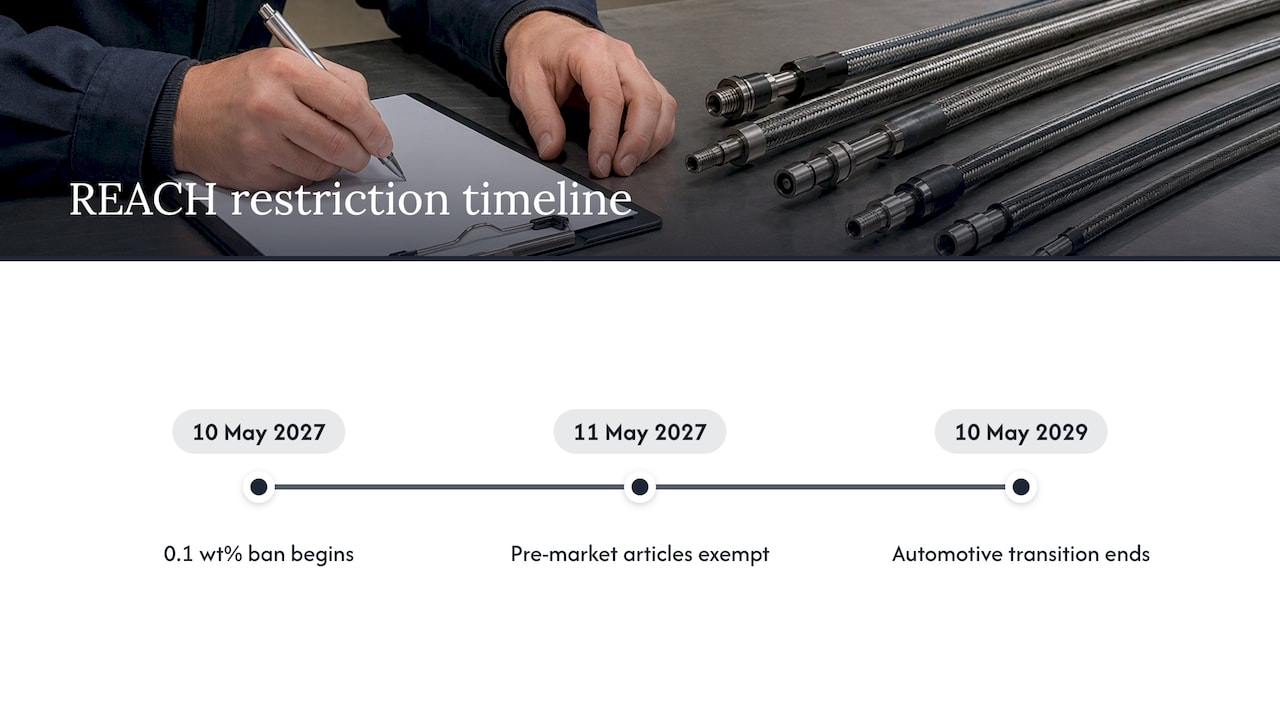
Beyond SVHC communication, REACH also contains restrictions that ban substances in articles. A recent example from the Bavarian environment portal: from 10 May 2027, articles containing at least 0.1 wt% 2,4-dinitrotoluene may not be placed on the market or used if they are meant for professional users or the general public. There are exceptions for articles already on the market before 11 May 2027 and for certain regulated product groups, and some automotive applications have transitional rules until 10 May 2029. Check whether the substance can occur in any polymer, adhesive or coating in your shaft assembly, and confirm the wording of the restriction in the current regulation text.
Applying this to aerospace and confined installations
The shaft types used in aircraft and in compact industrial equipment have common features that shape the compliance question.
| Application | Function of the shaft | Typical compliance focus |
|---|---|---|
| Thrust reverser actuation | Transmits rotation between drive unit and actuators along a routed path | REACH article duties; material build-up of core, casing and end fittings; documentation retained over long service life |
| Flap and slat actuation | Synchronized torque transmission along a wing structure | REACH for coated and plated components; scope check for any electrical equipment in the drive |
| Valve override systems | Manual or auxiliary actuation of a valve from a remote position | Casing materials and lubricants; SVHC communication at delivery |
| Synchronization shafts | Keeps two or more actuators in step | Traceability by part number and revision; change notification |
| Compact industrial drives and finishing tools | Delivers rotation to a tool in a tight space | RoHS scope of the tool or machine; REACH information for the shaft |
Operating conditions affect which materials are used and, with them, which compliance questions arise. Bend radius, rotational speed, torque, temperature range and exposure to fluids dictate the choice of core wire, sheath and lubricant. If a material is changed for a technical reason, for example a different sheath polymer for temperature resistance, the substance declaration for that revision needs to be updated, not carried over. Our guide to flexible shaft design for tight-space applications covers how bend radius and speed limit the design, and the page on engineering standards for flexible shafts lists related specification topics.
Cleanroom installations add another layer. Where particle emission is specified, material choice is further constrained. See cleanroom-suitable flexible shafts for the engineering side of that requirement.
What to request from a shaft supplier
A purchasing specification that asks only for “RoHS and REACH conformity” tends to get a generic statement in return. A more useful request is specific. A buyer in Germany should ask for the following.
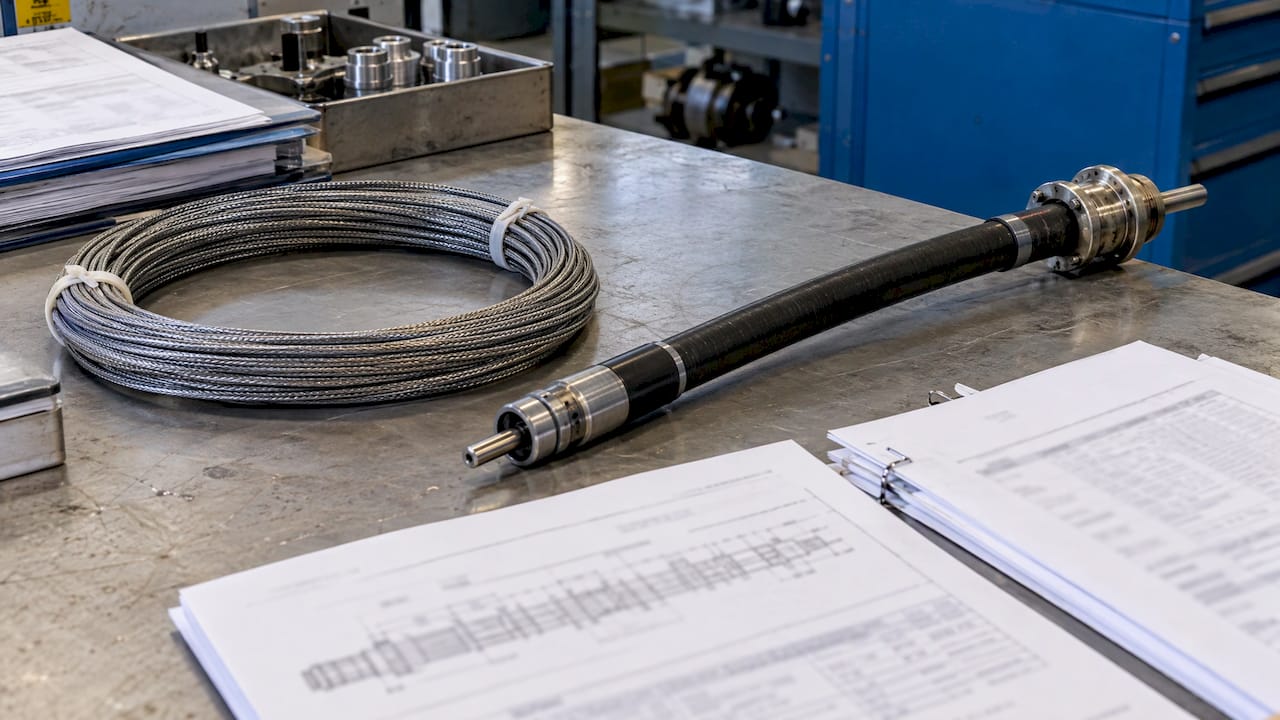
- Unambiguous identification. Part number, revision and material build-up of the shaft: core, casing, end fittings, coatings, lubricant. Without a revision, a declaration cannot be linked to the part you actually received.
- RoHS applicability statement. Does the supplier consider the shaft EEE or part of EEE? Which limits apply, and is an exemption claimed? If so, which one, under which annex entry, and until when? The directive requires technical documentation and an EU declaration of conformity for equipment in scope, as the EUR-Lex text sets out. A component supplier’s statement feeds into that file.
- REACH Article 33 statement. Whether any component contains a candidate-list SVHC above 0.1 wt%, and if so, the substance name and safe-use information. State the candidate-list version or date the statement refers to.
- Evidence basis. Supplier declarations, material declarations or analytical results. A 2024 article on RoHS practice notes that EN IEC 63000:2018 describes risk-based documentation and chemical analysis where needed, and that the choice of evidence depends on supplier reliability and material risk.
- Change and update procedure. How the buyer is notified when a revision changes materials or when a new SVHC listing affects the part.
- Coatings and bonded layers. Identify whether the article may be coated or bonded, since the supplier’s information on those layers is the starting point for the assessment, as the Baden-Württemberg guidance describes.
For aerospace programs, add the contractual items your quality system requires, such as retention periods and notification of process changes. Those belong in the supply agreement, not in the declaration.
Worked example: a flap drive shaft revision
Assume a design engineer specifies a flexible shaft with a steel wire core, a polymer-lined metal casing and plated end fittings for a synchronization drive. The question is which statements the file needs.
- Step 1, scope. The shaft is mechanical. The aircraft system is assessed against the Article 2(4) exclusions by the equipment manufacturer. The result and the reasoning are written into the compliance file.
- Step 2, REACH. The supplier states for each component whether a candidate-list SVHC exceeds 0.1 wt%. The sheath liner and the plating system are the components most likely to need a closer look.
- Step 3, revision control. Later the casing liner is changed to meet a temperature requirement. The part number or revision changes, and the supplier issues a new statement for the new material build-up.
- Step 4, list update. The candidate list is updated. The engineer’s process checks the new entries against the material list of the shaft and records the result.
The example is simple on purpose. The work is in keeping the chain of statements aligned with the part revisions.
Perspective
From our work with machine builders and equipment manufacturers, the compliance question about a flexible shaft is rarely a chemistry question first. It is an identification question. A declaration only helps if it refers to a defined part, a defined revision and a defined material build-up.
This is one reason we treat the shaft as an engineered assembly. Standard components, custom configurations and prototypes all start from the same data: torque, speed, bend radius, coupling interface and the environment in which the shaft runs. Material choices follow from those inputs, and so the material build-up is part of the specification from the first inquiry, not something added at the end.
For design engineers this means the compliance information and the technical specification can be handled in one exchange. After 100 years of building flexible shafts, and under a quality system certified to ISO 9001, we support customers with both the technical definition and the documentation that has to accompany it.
Uli
Related BIAX product lines
The product lines below cover the main shaft types discussed here. Material and construction details are defined per application in the inquiry.
- Drive and tool shafts for rotation transmission to tools at speeds up to 50,000 rpm.
- Actuation shafts for remote actuation and synchronization tasks.
- Special solutions and prototypes for custom configurations and small batches, where torque, speed and coupling interface are defined for the individual installation.
- Machine elements for flexible drive elements as alternatives to universal joints in compact layouts.
For retrofit situations, the engineering guide for installed drives describes what to define before replacing a rigid drive path.
FAQ
Is a flexible shaft subject to RoHS?
RoHS applies to electrical and electronic equipment. A purely mechanical shaft is not EEE on its own, but it can be part of EEE, such as a motor-driven finishing tool. In that case the equipment manufacturer must show that the homogeneous materials meet the limits, and the shaft supplier provides the material information. Scope exclusions in Article 2(4) can also apply to the end product.
Does REACH apply to aerospace actuation shafts?
Yes, REACH duties apply to articles placed on the EU market, and a flexible shaft is an article. If a component contains a candidate-list SVHC above 0.1 wt%, the supplier must pass on the substance name and available safe-use information to industrial customers at delivery, according to UBA. Any RoHS scope exclusion does not change this.
What are the RoHS limit values?
Per homogeneous material the limit is 0.1 wt% for lead, mercury, hexavalent chromium, PBB, PBDE and four phthalates, and 0.01 wt% for cadmium. The IHK Nürnberg leaflet lists the substances. Exemptions in Annexes III and IV are time-limited, so check the current consolidated version.
How often should SVHC status be checked?
After every update of the candidate list. UBA states that no transitional period applies to supply-chain information when a substance is newly identified, so a declaration reflects the list version it was prepared against. Programs with long supply horizons should define the review interval and the notification route in the supply agreement.
What should a procurement specification name for a flexible shaft?
Part number, revision, material build-up, the applicable rule (RoHS scope, REACH Article 33), the limit values, any claimed exemption and the candidate-list version. Add the evidence basis and the change-notification procedure.
Contact
For a flexible shaft specification with compliance requirements, the technical data (torque, speed, bend radius, coupling interface, environment and required declarations) can be sent through the inquiry form on the BIAX Flexwellen website.
Sources
- Richtlinie 2011/65/EU (RoHS), consolidated version, EUR-Lex
- IHK Nürnberg: Beschränkung der Verwendung von Gefahrstoffen in Elektro- und Elektronikgeräten (2023)
- Umweltbundesamt: Chemikalien in Erzeugnissen
- REACH Baden-Württemberg: Information in der Lieferkette
- Bayerischer Umweltpakt: Verordnung (EG) Nr. 1907/2006 (REACH)
- RoHS Update 2024: Legal requirements, current risks and practical challenges
Recommended
- Flexible Shaft Explosion Protection: 5 Inputs Engineers Need
- Engineering standards for flexible shafts: a practical guide
- Custom flexible shaft design explained: engineer better solutions
- 0.1–5 µm Compliance: Cleanroom Flexible Shafts for Engineers
Related Topics
Send your spec inquiry
Custom flexible shafts for your application — we quote within 1 working day.