Flexible Shafts in Dusty Environments: Design and Protection
9 November 2026A flexible shaft can run reliably in a dusty environment if the core is enclosed in a casing, the shaft ends are sealed, and the lubrication and inspection intervals match the contamination load. Dust is not a reason to avoid flexible power transmission. It is a boundary condition that has to be defined before the shaft, casing and end fittings are specified. This article covers the damage mechanisms, sealing options, maintenance practice and the specification data an engineer needs to provide, with attention to confined aerospace installations and dusty finishing processes.
TL;DR
- A closed design with a steel jacket and a protective outer layer shields the shaft core from dirt, moisture and mechanical damage, according to a trade report on remote valve actuation.
- Dust does most damage where it reaches sliding surfaces: the core-to-casing interface, the end fittings and the connected bearings.
- Sealing at the interfaces (brush rings, labyrinth stages, air barriers) matters as much as the shaft itself.
- Lubrication intervals shorten in contaminated service. Rising vibration, heat or torque ripple are the first symptoms of wear.
- Combustible dusts, such as magnesium, add explosion-protection requirements that must be addressed at the system level.
Table of Contents
- Why dust is a design condition, not a maintenance detail
- How the construction protects the core
- How dust damages a flexible shaft and its drive components
- Sealing measures at the shaft ends and interfaces
- Aerospace installations: confined routing and contamination
- Dusty finishing: grinding, deburring and polishing
- Lubrication and inspection in contaminated service
- Specification data for a dusty application
- Perspective
- Product lines for dusty and confined applications
- FAQ
- Sources
Why dust is a design condition, not a maintenance detail
A flexible shaft transmits torque and rotation along a curved path. Its core consists of wire layers wound in alternating directions. This core rotates inside a stationary casing, and the two surfaces are in sliding contact over the whole length. Any particle that enters the casing therefore enters the bearing surface of the shaft itself.
Two questions determine how serious the dust problem is:
- What kind of dust? Fine mineral dust, metallic grinding dust, composite fibers and combustible dust each behave differently. Hardness determines abrasion. Conductivity and ignition properties determine the safety requirements.
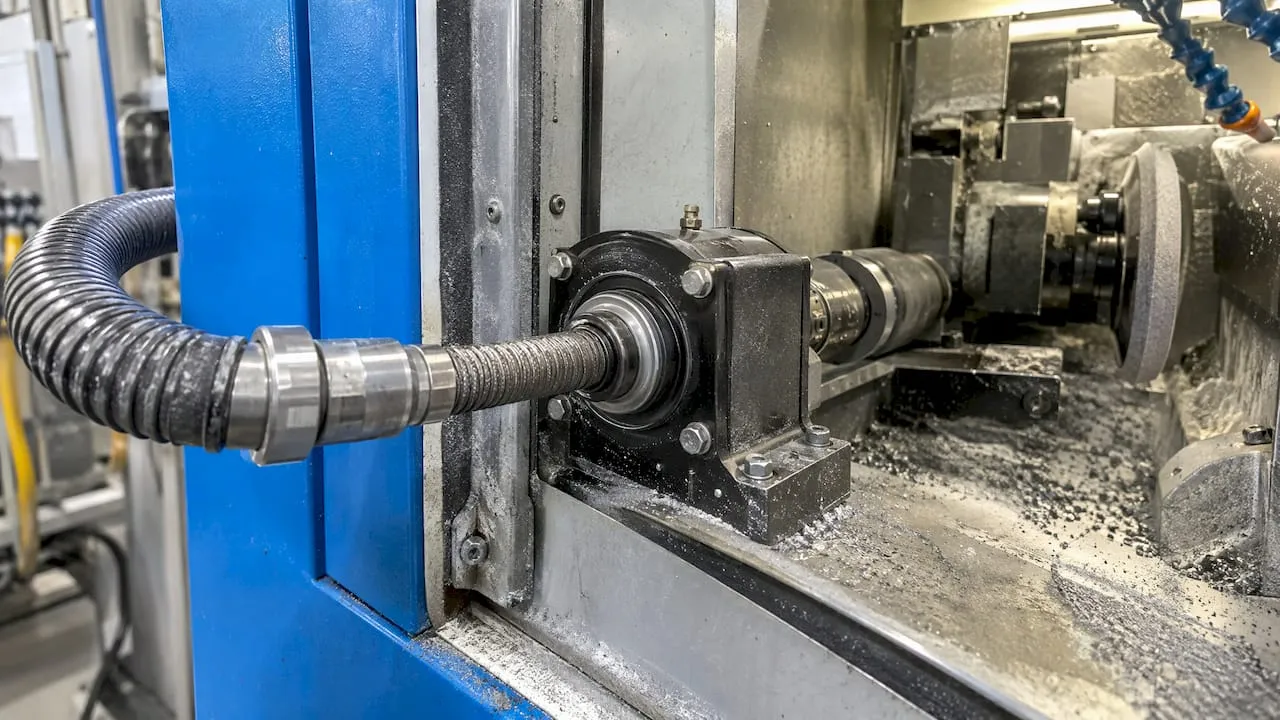
- Where can it enter? The casing along its length is usually closed. The critical points are the end fittings, the couplings to the drive and driven machine, and any open exit of the core.
The design target is therefore not a dust-free shaft. It is a defined ingress path with a defined protection measure at each point.
How the construction protects the core
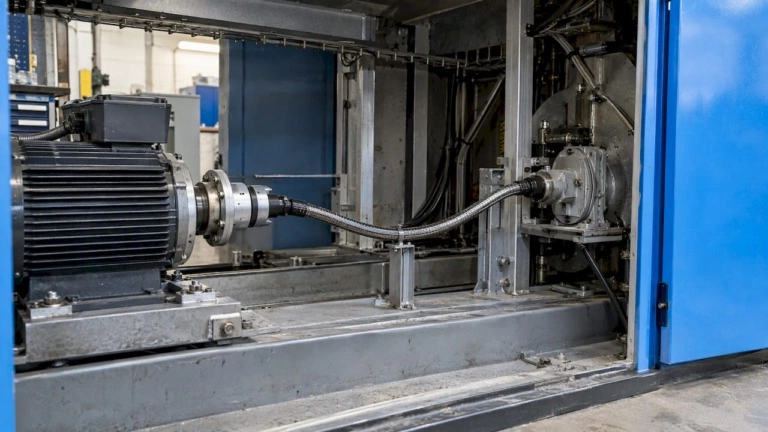
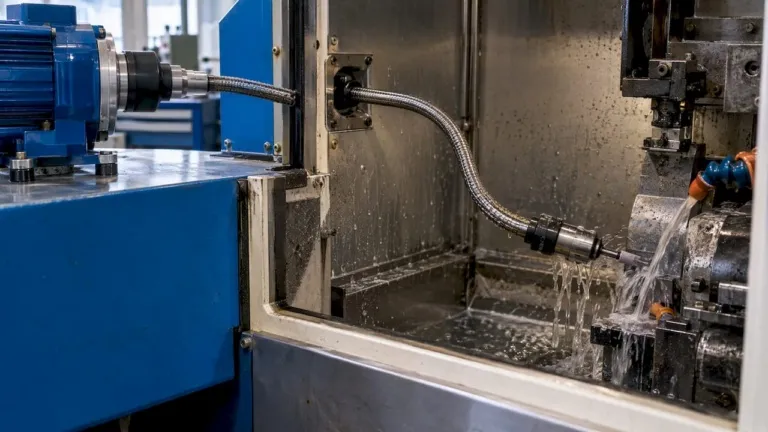
In a protected flexible shaft assembly, the core runs inside a casing. The casing is usually a wound metal sheath with an outer jacket. Reporting on remote-control valve actuation states that a steel jacket and protective rubber layer keep dirt and other external influences away from the shaft, and that the closed design allows use in demanding environments. The same source mentions chemical plants and heavily polluted areas such as sewage treatment plants as use cases.
For a design engineer this has three consequences:
- The casing and jacket are part of the dust protection, not just a guide for the core. Casing selection should follow the contamination class.
- The end fittings are the weak point of any enclosed system. Their sealing needs the same attention as the casing material.
- Bending radius and routing affect sealing. Tight bends load the casing and can open gaps at the fittings if the installation is not strain-relieved.
For the construction principles and torque behavior in more depth, see our explanation of how torque is transmitted through flexible shafts.
How dust damages a flexible shaft and its drive components
The damage mechanisms are well understood from general machine design. Fine dust that gets persistently between sealing faces causes abrasion and premature wear. That statement comes from sealing practice for mixing-tool shafts, but the mechanism applies to any rotating shaft with a dynamic interface.
For a flexible shaft assembly, the typical effects are:
| Mechanism | Where it occurs | Typical consequence |
|---|---|---|
| Abrasive wear | Core surface and casing liner | Loss of cross-section, increased play, noise |
| Lubricant contamination | Grease film between core and casing | Higher friction, local heating |
| Grease thickening or caking | Fittings and casing ends | Increased running torque, torque ripple |
| Bearing damage | Connected drive and driven bearings | Vibration, reduced bearing life |
| Jamming | Low-speed actuation shafts | Higher break-away torque, uneven response |
The interaction between dust and lubricant is the key point. Dust mixes with grease and forms an abrasive paste. This is why sealing and lubrication cannot be treated as separate topics.
Sealing measures at the shaft ends and interfaces
Sealing options fall into contact, non-contact and combined designs.
Brush rings and wipers
Brush rings seal shafts and protect apertures with flexible bristles. A ready-to-mount brush ring system is described by its manufacturer as sealing the shaft while the wiping action of the bristles prevents lubricant from spreading. Brush seals tolerate shaft movement and misalignment, which suits flexible shaft ends where some lateral motion is expected.
Labyrinth and slinger stages
For dry-running processes with fine dust, an external upstream stage such as slinger discs or labyrinth seals is often combined with the main seal. The principle carries over: the first stage removes the bulk of the dust, and the second stage handles what remains.
Air barrier seals
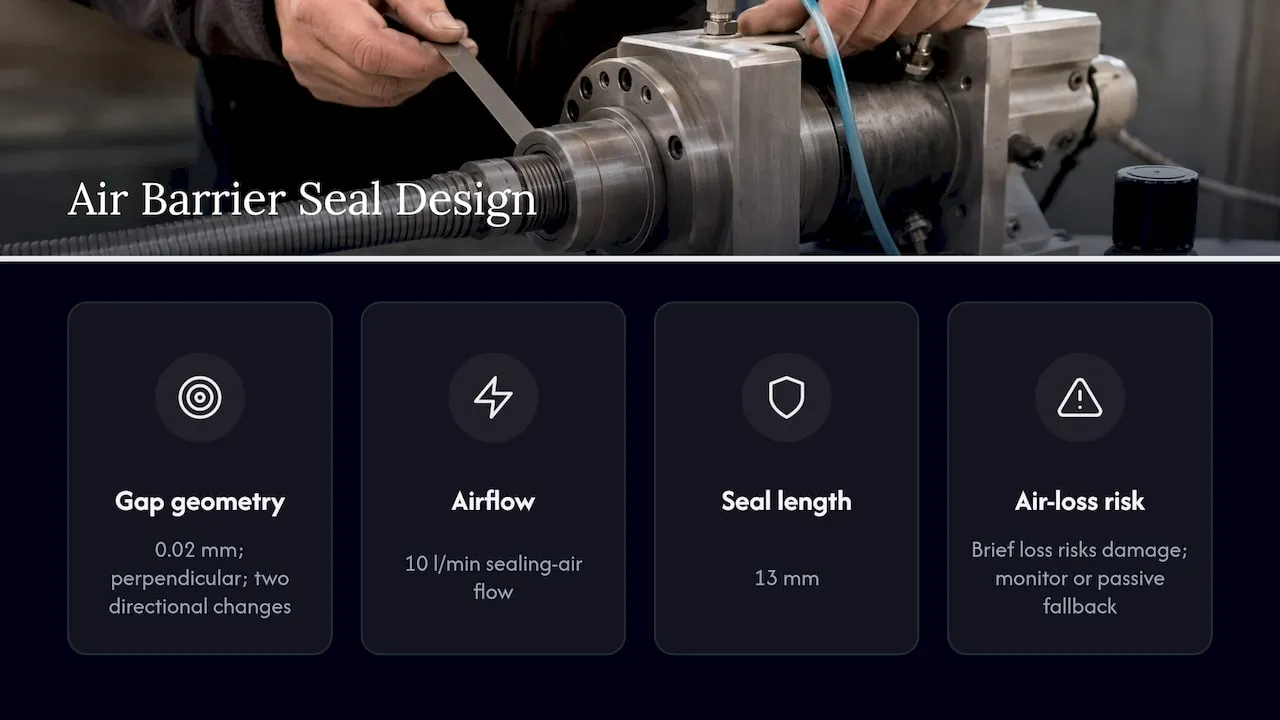
A university study from Stuttgart examined non-contact sealing of rolling bearings against particles. It found that the most effective sealing used a gap height of 0.02 mm, a gap perpendicular to the particle movement, and a gap entrance with two directional changes combined with sealing air. In the same work, a sealing air flow of 10 l/min and a seal length of 13 mm gave a highly efficient system for dust applications. The study also warns that even a short loss of sealing air may cause serious damage. For safety-relevant drives, an air barrier therefore needs monitoring or a passive fallback stage.
Protection class as a specification language
IP ratings give a shared vocabulary between design, procurement and the customer. According to one IP protection guide, IP54 describes dust protection with small amounts tolerated, which suits dusty workshops. IP65 describes complete dust-tightness and is cited for dusty industrial halls. An IP rating applies to an enclosure or a defined assembly, so for a flexible shaft it should be stated for the complete installation including fittings, not for the casing alone.
Aerospace installations: confined routing and contamination
Flexible shafts are used in aerospace where rotation or torque must be routed around structure: synchronization shafts between actuators, drive of flap and slat systems, valve override mechanisms and actuation near thrust reverser components. The common feature is a confined installation space with fixed obstacles, where a rigid shaft with joints would need extra bearings and housings.
Dust is rarely the only contaminant in these locations. Fine particles, fluids and debris from maintenance or ground operation can reach the shaft ends. The design questions are functional:
- Routing: Define the minimum bend radius along the full path and keep it constant under all movement of the structure. Dynamic bending combined with contamination accelerates wear at the fittings.
- Sealing at transitions: Where the shaft passes through a bulkhead or enters a gearbox, define the seal type and its permitted lateral movement.
- Duty cycle: Actuation and override shafts run rarely and at low speed, but must start reliably after long standstill. Dust that has migrated into lubricant over time raises break-away torque. Continuously running synchronization shafts see the opposite load case: sustained wear at the sliding interface.
- Torsional stiffness and windup: Synchronization needs a defined angular error between both ends. Wear changes this value over service life, so the allowable change should be part of the requirement.
- Qualification and documentation: Environmental conditions, test levels and inspection intervals come from the program and certification basis. They are inputs to the specification, not assumptions made by the shaft supplier.
Our actuation shafts page describes the torque cable type used in such actuation tasks. The guide to compact drive solutions covers selection in confined spaces more generally.
Dusty finishing: grinding, deburring and polishing
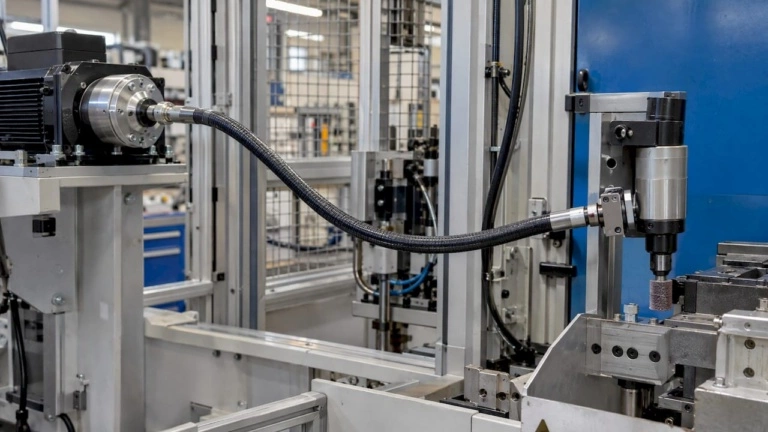
In finishing processes, flexible shafts drive tools directly at the workpiece, which is also where the dust is produced. The motor stays outside the dust zone, and only the shaft and tool enter it. This arrangement reduces the contamination load on the motor, but it moves it to the shaft end and the tool spindle.
Occupational safety rules shape the process around the shaft. Guidance from the German statutory accident insurance states that in continuous dry grinding, grinding dust must be extracted to prevent health damage from inhalation, and that eye protection is required against dust, sparks and chips. Extraction close to the tool also reduces the dust reaching the shaft assembly.
Combustible dusts
Some materials create a hazard beyond wear. DGUV Information 209-090 on magnesium states that grinding, brushing and deburring magnesium components produces ignitable dusts and fine chips that are highly flammable and explosive when whirled up. It requires extraction at the machining point with a system suitable for magnesium dust and a flow velocity above 20 m/s. It also requires that remaining dust is removed by regular cleaning, without compressed air, using suitable industrial vacuum cleaners, and that collection containers are emptied every working day with documented cleaning intervals.
For the drive, this means the equipment selection is part of the explosion-protection concept of the whole workplace. Our overview of flexible shaft explosion protection lists the inputs engineers should define. Magnesium dust work should be planned together with the plant’s safety officer and the applicable DGUV rules.
Lubrication and inspection in contaminated service
Lubrication in dusty service follows a simple principle: the contamination load sets the interval, not the calendar. Operating hours, dust concentration, speed and bend radius all shorten or extend it. The manufacturer’s specification for the specific shaft governs the grease type and the interval.
A practical routine for dusty service:
- Clean the exterior of the casing and fittings before any opening, so dust does not enter during service.
- Remove the core and clean it and the casing liner with a suitable solvent, then dry both.
- Inspect the core for broken wires, discoloration from overheating, and a polished or scored surface.
- Inspect the casing for kinks, flattened sections and damaged jacket areas.
- Re-lubricate with the specified lubricant, applied evenly and without excess that would attract dust at the ends.
- Check the seals at both ends and replace worn brush rings or fittings together with the core if needed.
- Record operating hours, findings and replaced parts, so the interval can be adjusted based on evidence.
High-speed shafts need particular care. The inputs for lubrication above 10,000 rpm are covered in our article on flexible shaft lubrication. General routines are described in the flexible shaft maintenance process and in seven maintenance tips for engineers.
Symptoms that point to dust-related wear
- Rising vibration at constant speed
- Increasing temperature of the casing near the ends
- Audible change in noise, especially a grinding or scraping component
- Higher motor current at the same load
- Increased break-away torque or irregular torque on actuation shafts
- Visible grease contamination at the fittings
These symptoms are not specific to dust. They should trigger inspection of the seals and lubricant first, since contamination is a common and correctable cause.
Specification data for a dusty application
A supplier can only propose a suitable design if the environment is described. The following table lists the data worth stating in an inquiry. The RFQ checklist for dustproof flexible shafts goes through these points in detail.
| Parameter | What to state |
|---|---|
| Dust type | Material, particle size range, hardness, combustibility |
| Concentration and duration | Continuous or intermittent exposure, extraction present or not |
| Torque and speed | Nominal and peak values, direction of rotation, duty cycle |
| Routing | Length, bend radii, number of bends, movement during operation |
| Interfaces | Coupling type at drive and driven side, available sealing space |
| Sealing target | Required IP class or equivalent for the assembly |
| Temperature and media | Operating range, presence of fluids or aggressive agents |
| Service concept | Inspection access, planned intervals, replacement strategy |
| Regulatory basis | Explosion protection zone, industry or certification requirements |
Where the application is new, a prototype or small series allows the sealing concept to be validated under real conditions before series release.
Perspective
From our application work, dust problems with flexible shafts are rarely caused by the shaft core alone. They arise at the interfaces: an end fitting that was chosen for a clean environment, a coupling with no space for a seal, or a lubrication interval copied from a clean-room installation.
We therefore treat the shaft, casing, end fittings and seals as one system. The environment and the duty cycle define the construction. Our design approach is to configure torque and speed capacity, the casing, the coupling interfaces and the shaft design to the stated requirements, whether that is a standard component or a custom configuration.
For confined installations, we recommend defining the routing and the sealing concept together at the start of the design. Changing a bend radius or adding a seal late in the project is usually more costly than specifying it in the first inquiry.
Uli
Product lines for dusty and confined applications
BIAX Flexwellen (Schmid & Wezel GmbH) supplies standard and custom flexible shafts. Relevant lines for contaminated or confined installations include:
- Actuation shafts for remote actuation and torque transmission along curved paths
- Drive and tool shafts for finishing tools at speeds up to 50,000 rpm
- Special solutions and prototypes for application-specific configurations and small batches
Technical data and application details can be provided on request through the BIAX website.
FAQ
Can a flexible shaft be used in a dusty environment?
Yes, when the assembly is closed and sealed for the contamination present. A steel jacket with a protective outer layer shields the core from dirt and external influences. The end fittings and couplings need their own sealing, matched to the dust type and the duty cycle.
What damages a flexible shaft first in dust?
The sliding interface between core and casing, and the lubricant that supports it. Fine dust between moving surfaces causes abrasion and premature wear. Dust that mixes with grease also forms an abrasive paste, which raises friction and heat.
How often should a flexible shaft be lubricated in dusty service?
More often than in clean service, with the interval set by the manufacturer’s specification and adjusted to the measured contamination. Record operating hours and inspection findings, and shorten the interval if the lubricant shows dust or discoloration. Details for high-speed shafts are in our lubrication guide.
Does combustible dust change the choice of shaft?
Yes, because it adds explosion-protection requirements to the whole workplace. Extraction at the machining point, cleaning routines and equipment selection must follow the applicable rules, such as the DGUV information on magnesium. Define the dust type and the protection zone in the inquiry.
What data should an inquiry for a dusty application contain?
Dust type and concentration, torque and speed, routing with bend radii, coupling interfaces, required protection class and service concept. For aerospace installations, add the environmental and qualification requirements of the program. Project data can be submitted through the BIAX Flexwellen website.
Sources
- Reliable remote-control of valves, VALVE WORLD EXPO
- Sealing concepts for mixing-tool shafts, Amixon
- Mink AD-System brush ring brochure
- Non-contact sealing against particles, University of Stuttgart (2007)
- IP protection ratings guide, LichtRechner
- DGUV Information 209-090, Activities relating to Magnesium (June 2020)
- VBG guidance on grinding wheels
Recommended
- Engineers: 10 Point RFQ Checklist for Dustproof Flexible Shafts
- Flexible Shaft Explosion Protection: 5 Inputs Engineers Need
Related Topics
Send your spec inquiry
Custom flexible shafts for your application — we quote within 1 working day.