ATEX Flexible Shafts: Zones, Categories and Ignition Risks
6 November 2026A flexible shaft is not simply “ATEX-rated” as a product type. Whether it can be used in a potentially explosive atmosphere depends on the manufacturer’s ATEX analysis, the equipment category assigned, the zone of the installation and the ignition-source assessment of the complete drive. This article sets out the regulatory frame, the technical criteria and the documents an engineer should have in hand before a flexible shaft is integrated into a machine or workplace in Germany or the EU.
TL;DR
- Directive 2014/34/EU binds the manufacturer who places a product on the market. Directive 1999/92/EC binds the employer who operates it. Both must be satisfied.
- Zone (0/1/2 for gas, 20/21/22 for dust) sets the minimum equipment category: 1, 2 or 3.
- For flexible shafts, the relevant ignition sources are hot surfaces, mechanically generated sparks and static electricity. Couplings, guards and bonding belong to the assessment.
- Check marking (Ex symbol, group, category, type of protection, explosion group, temperature class) and the declaration of conformity or attestation before integration.
- The explosion protection document remains the operator’s responsibility and must cover the shaft as part of the whole installation.
Table of Contents
- What ATEX suitability means for a flexible shaft
- Two directives, two sets of duties
- From zone to equipment category
- Ignition sources in a flexible shaft drive
- Couplings, covers and bonding
- Aerospace-related installations
- Marking and documents to verify
- Selection, installation and maintenance
- Responsibility for the assessment
- Technical inquiry for explosion-protected drives
- FAQ
- Sources
What ATEX suitability means for a flexible shaft
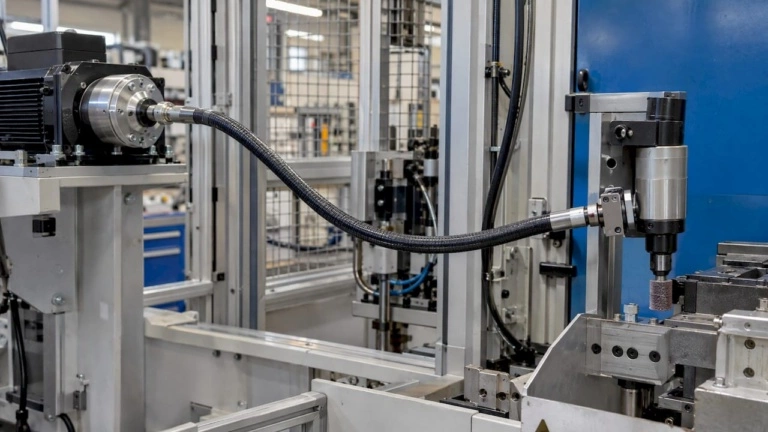
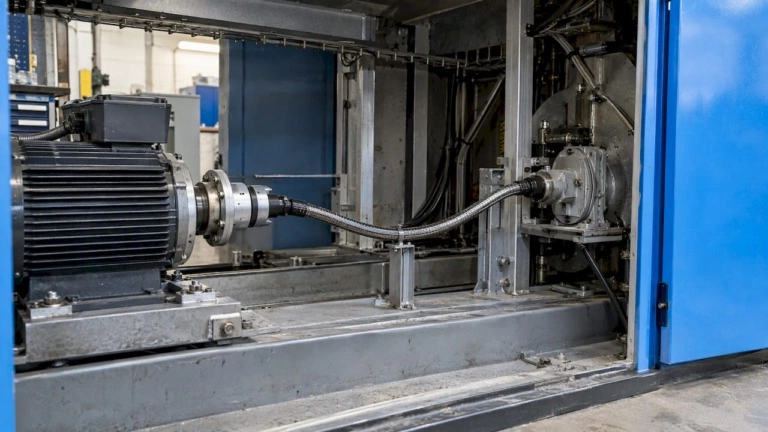
A flexible shaft transmits torque and rotation along a curved path through a protective sheath. It has a rotating core, a casing, end fittings and, usually, a coupling to a motor or tool. None of these elements is an electrical device. The shaft therefore falls under ATEX as non-electrical equipment, and only when it has its own potential ignition source or is built into equipment that has one.
The German Federal Ministry of Labour and Social Affairs states that the directive applies to equipment with its own potential ignition source, to autonomous protective systems, and to components intended to be built into such equipment. A flexible shaft can therefore be assessed as equipment or as a component, depending on how it is supplied and used.
The decision is not left to the buyer. The BG RCI ATEX Guidelines (6th edition, January 2026) state that the manufacturer must decide whether a product is covered by the directive and carry out an ATEX analysis on that basis. The manufacturer must also tell the end user about the intended use, foreseeable misuse, the specific explosive atmosphere and the operating conditions for which the product is suited.
In practice this means a specification should state the atmosphere, not just the word ATEX: gas or dust, the substance, the zone, the ambient temperature range, the maximum speed and torque, and the bending radius.
Two directives, two sets of duties
The separation between product and workplace rules is the most frequent source of confusion in procurement.
| Directive 2014/34/EU | Directive 1999/92/EC | |
|---|---|---|
| Addressed to | Manufacturers, importers, distributors | Employers and operators |
| Subject | Design, conformity assessment, marking of equipment and components | Zone classification, protection measures, explosion protection document |
| German implementation | 11. ProdSV | GefStoffV, TRGS 723 and related rules |
Directive 2014/34/EU has applied EU-wide since 20 April 2016 and replaced Directive 94/9/EC. According to the EUR-Lex summary, the amending Directive (EU) 2024/2749 had to be transposed by 29 May 2026 and applies from 30 May 2026. Documentation for new projects should reference the current consolidated text. The BAM product contact point identifies the German implementation as the 11. ProdSV (Explosionsschutzprodukteverordnung).
The BG RCI guidelines stress that the product directive does not regulate use in an explosive atmosphere. That is covered by the workplace directive and national law. The WEKA overview adds that harmonized standards of the EN 60079 and EN/ISO 80079 series provide the presumption of conformity for products.
From zone to equipment category
The operator classifies the area. The zone then fixes the minimum category of equipment. Annex II of Directive 1999/92/EC specifies the following, provided the equipment is suitable for the gases, vapors, mists or dusts present:
| Zone (gas / dust) | Presence of explosive atmosphere | Permitted equipment categories |
|---|---|---|
| 0 / 20 | Continuous or long periods | 1 |
| 1 / 21 | Likely in normal operation, occasionally | 1 or 2 |
| 2 / 22 | Not likely, short duration only | 1, 2 or 3 |
The WEKA overview explains that equipment group I covers underground mines and their surface installations (categories M1 and M2). Group II covers all other areas, with categories 1G/2G/3G for gases and 1D/2D/3D for dusts. A shaft marked for gas is not automatically suitable for dust, and the reverse holds as well.
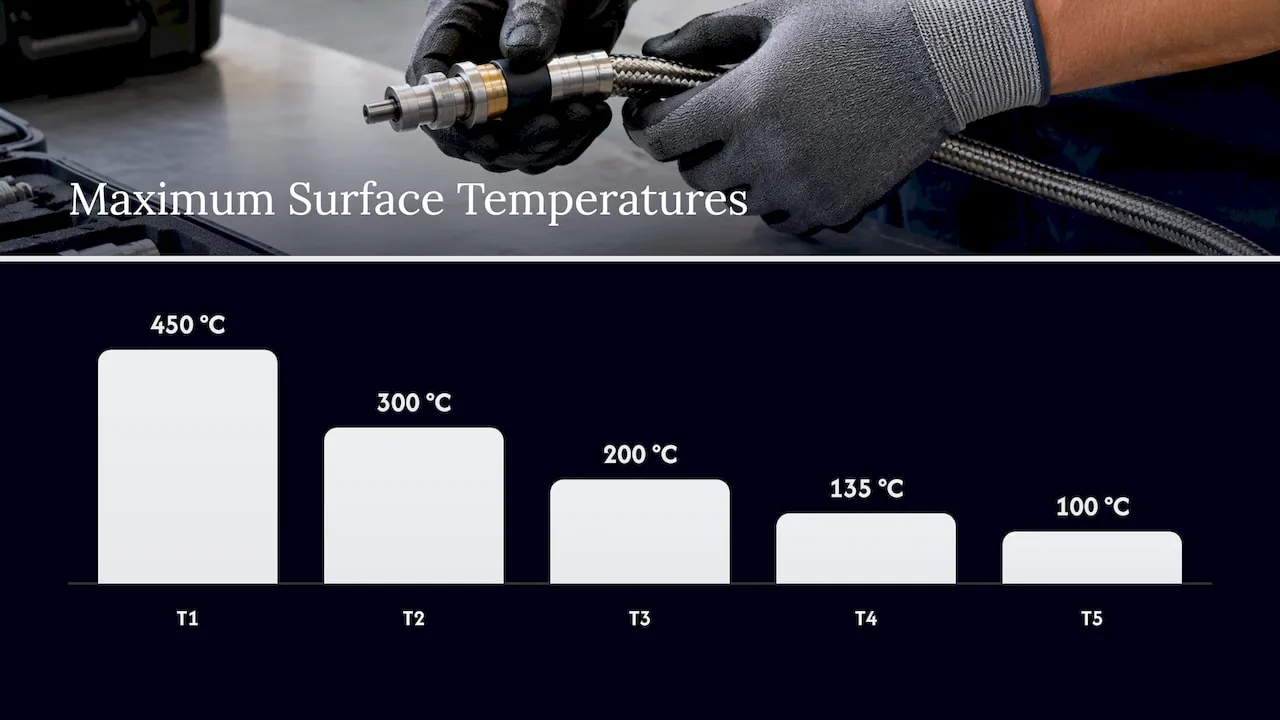
Temperature classes limit the maximum surface temperature. According to the same WEKA overview, they are T1 (450 °C), T2 (300 °C), T3 (200 °C), T4 (135 °C), T5 (100 °C) and T6 (85 °C). The class of the equipment must be below the ignition temperature of the substance present. For a rotating shaft, the surface temperature depends on friction in the casing, lubrication condition, speed and ambient temperature. Our flexible shaft temperature range guide covers how to specify these limits.
Ignition sources in a flexible shaft drive
TRGS 723 lists 13 types of ignition sources in potentially explosive areas. Three of them are directly relevant to a shaft with sheath, coupling and guard:
- Hot surfaces. Friction between a rotating core and its sheath, or in bearings and end fittings, raises surface temperature. Speed, bending radius, lubrication and duty cycle all contribute. Lubrication at high speed is covered in our note on flexible shaft lubrication above 10,000 rpm.
- Mechanically generated sparks. TRGS 723 names friction, impact and abrasion processes. The FSA/BGN guideline for grain processing notes that whether such a spark is effective depends, among other factors, on its energy relative to the minimum ignition energy of the dust-air mixture. Contact between a rotating coupling and a cover, or between a loose guard and a rotating part, is a typical case.
- Static electricity. Non-conductive sheaths, covers and plastic parts can charge. Conductive paths and equipotential bonding must be considered for the complete assembly.
The zone also decides how strict the avoidance must be. According to TRGS 723, in zones 2 and 22 effective ignition sources that can occur continuously or frequently, for example in normal operation, must be avoided. In zones 1 and 21, sources that can occur occasionally must also be avoided. Where an area is not classified into zones, protection measures must be taken as if it were zone 0 or 20, unless the risk assessment states otherwise.
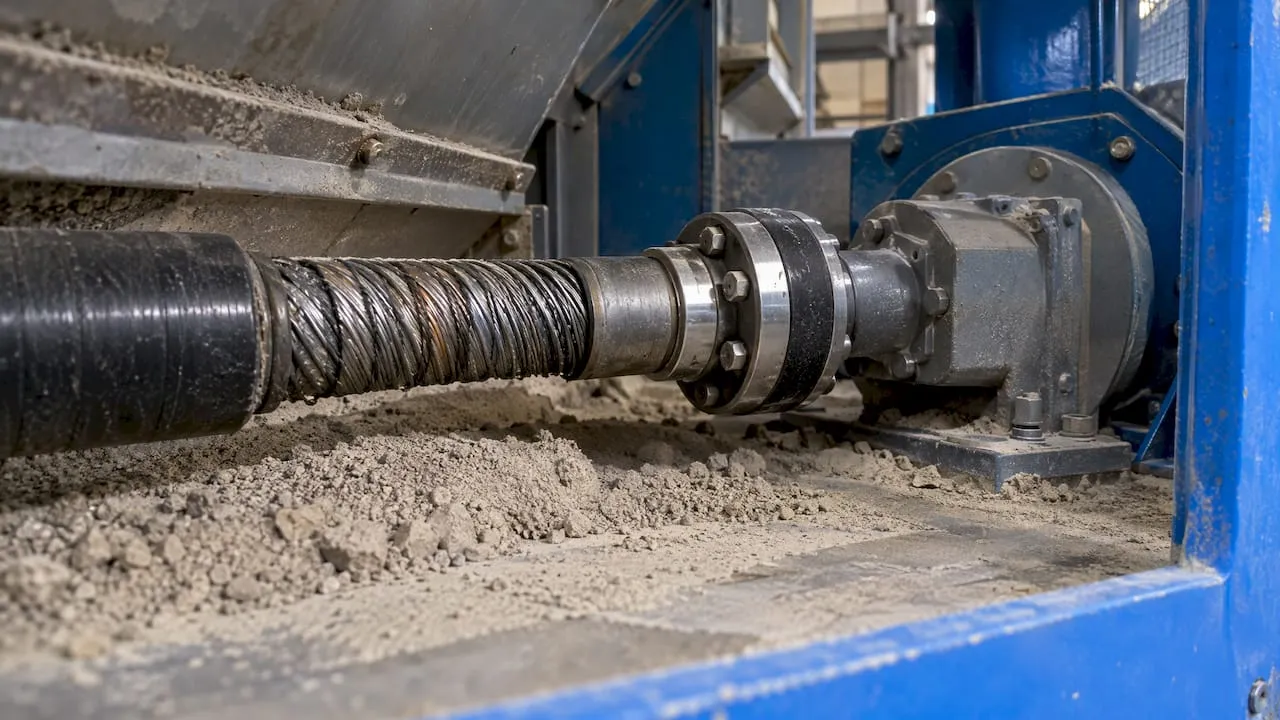
The assessment also covers deposits. TRGS 723 requires that the possibility of igniting combustible dust deposits be documented in the risk assessment. A shaft sheath that runs through a dust layer, or a coupling that rotates in settled dust, changes the ignition scenario.
Couplings, covers and bonding
Most practical ignition risks in a flexible-shaft drive sit at the interfaces, not in the shaft body. The coupling to the drive, the connection to the driven unit and the guard are part of the same assessment. See also our overview of the role of shaft couplings in power transmission and the DIN 5480 coupling interfaces.
The KTR explosion protection brochure (2023), written for rigid and elastic couplings, gives guidance that transfers well to any rotating connection with a guard:
- Minimum cover distance by coupling outer diameter DH: up to 50 mm, 6 mm; 50 to 120 mm, 10 mm; from 120 mm, 15 mm.
- The cover must be electrically conductive and included in the equipotential bonding.
- In dust-hazard areas, no dust may accumulate in dangerous quantities between cover and component, and the component must not run in a dust heap.
- For equipment group II, covers with unsealed openings on top should avoid light metals, preferably stainless steel.
- The guard is the customer’s responsibility and must also prevent contact with rotating parts, as required by DIN EN ISO 12100.
These figures come from a coupling manufacturer’s document. For a flexible-shaft drive, the applicable values must be confirmed against the documentation for the specific coupling and shaft.
Aerospace-related installations
Flexible shafts are used in aerospace for actuation and synchronization: thrust reverser actuation, flap and slat drive trains, valve override systems and synchronization shafts between drive units. The common design constraints are confined routing, limited bending radius, low torque ripple and tolerance for relative movement between structure and drive. The functional principle is the same as in industrial use: a rotating core in a casing transmits torque around obstacles.
ATEX itself applies to equipment used in potentially explosive atmospheres, so its relevance here is on the ground and in related industrial processes. Typical examples are maintenance and test facilities, fuel handling areas, coating and cleaning lines, and production steps with combustible dust or solvent vapors. Airborne installations follow aviation-specific requirements and certification, which are separate from Directive 2014/34/EU and are outside the scope of this article.
For design engineers who work in both environments, the transferable points are these:
- Routing. Minimum bending radius and sheath support determine friction heat and core wear. Tight, unsupported bends raise surface temperature.
- Torque and speed. Both must be stated with duty cycle, because heat generation is cumulative.
- Interfaces. Square, spline and keyed connections each carry different tolerance and wear behavior, and each must be defined at the drawing stage.
- Environment. Ambient temperature, contamination and cleaning agents affect the sheath and lubricant.
For actuation duties, see our overview of actuation shafts. For rotational drives, see the tool shaft range up to 50,000 rpm.
Marking and documents to verify
Before a shaft is integrated into a machine in an explosive atmosphere, the following should be on file.
Marking
According to the WEKA overview, ATEX marking includes the Ex symbol, equipment group and category, type of protection, explosion groups and temperature class. A marking that omits any of these cannot be matched to the zone and substance of the installation.
Conformity documents
Per WEKA, categories 1 and 2 require an ATEX certificate from a notified body, while category 3 (zone 2/22) requires the manufacturer’s declaration of conformity. Under § 5 of the 11. ProdSV, the manufacturer must:
- design and build products to the essential health and safety requirements of Annex II of Directive 2014/34/EU,
- draw up technical documentation and carry out the conformity assessment,
- issue an EU declaration of conformity for equipment, or a written attestation of conformity for components,
- keep documentation available for market surveillance authorities for ten years.
The EUR-Lex summary adds that products must bear the CE marking and that documentation must be written in a language easily understood by end users.
Technical information from the manufacturer
The operating instructions must state the intended use and operating limits. Request maximum speed, torque, bending radius, ambient temperature range, lubrication specification and maintenance intervals as binding values. Our guide to engineering standards for flexible shafts lists the parameters that belong in a specification.
Selection, installation and maintenance
The workplace directive requires measures in order of priority: prevent explosive atmospheres from forming, avoid ignition, and limit the effects of an explosion. A drive selection should follow the same order.
- Remove the need where possible. Place the motor outside the classified zone and use the flexible shaft to transmit rotation into it. This is a common reason for choosing a flexible shaft, because the zone boundary can be crossed by a mechanical element. The assessment must still cover the part of the shaft inside the zone and the penetration through any wall.
- Define the zone and substance. Obtain the zone classification, the gas or dust group and the ignition temperature from the operator’s documentation.
- Set the category and temperature class. Use the zone table above and keep the surface temperature margin below the ignition temperature.
- Define the load case. Torque, speed, duty cycle, bending radius and ambient temperature at the actual routing.
- Specify interfaces. Coupling type, guard, bonding path, and materials for covers.
- Document the installation. Record routing, support points and bonding in the commissioning file.
- Maintain to the stated intervals. Lubrication, sheath inspection and core wear checks follow the manufacturer’s instructions. Remove dust deposits near rotating parts.
When a standard configuration does not fit the load case, a defined custom configuration is the usual route. Our custom flexible shaft configuration guide lists the inputs needed, and the explosion protection inputs page covers the five data points that matter most for this topic.
Responsibility for the assessment
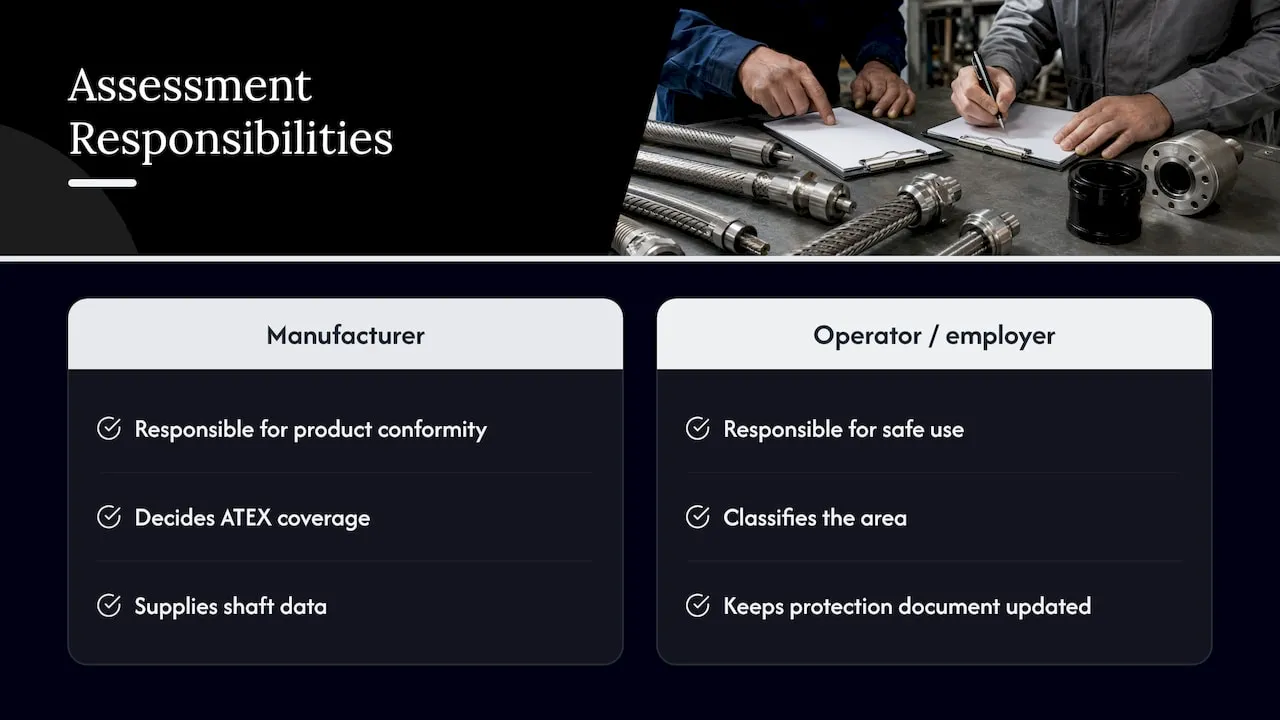
The manufacturer is responsible for the product’s conformity. The operator is responsible for its safe use. Under Directive 1999/92/EC, the employer must draw up and keep up to date an explosion protection document. It must show that explosion risks have been determined and assessed, that adequate measures are taken, which places are classified into zones, and that workplace and work equipment are designed, operated and maintained safely. It must be drawn up before work begins and revised after significant changes.
Annex II of the same directive also requires that equipment, protective systems and connecting devices only be brought into service if the explosion protection document shows they can be used safely. This extends to work equipment and connecting devices not regarded as equipment under the product directive, if their incorporation can itself create an ignition hazard. A flexible shaft that joins a drive outside a zone to a unit inside it falls into this reasoning. In Germany, TRGS 723 specifies that the ignition-source assessment is documented in the risk assessment under § 6 paragraph 9 GefStoffV.
For machine builders this means supplying the shaft’s data in a form the operator can enter into the explosion protection document, and stating which parts of the assessment remain with the operator.
Perspective
From our work with machine builders, the most useful input to an ATEX discussion is a complete load case, not a certification label. A shaft is part of a drive train, and the ignition behavior depends on speed, torque, bending radius, ambient temperature and the coupling at each end.
We therefore treat the ATEX question as an engineering inquiry. The zone, substance, temperature class and routing are agreed first. Then the shaft design, the coupling interface and the supporting documentation are defined together. Our range covers standard shafts, shafts supplied as meter goods, and custom configurations and prototypes, so the same data set can lead to a standard component or to a defined special solution.
Early contact between design engineer and manufacturer shortens the path to a documented, verifiable installation.
Uli
Technical inquiry for explosion-protected drives
For projects in potentially explosive atmospheres, BIAX supports the definition of shaft, core, casing and coupling interfaces against the stated torque, speed and routing. Relevant product lines are custom solutions and prototypes, drive and tool shafts and actuation shafts. An inquiry should state zone, substance group, temperature class target, ambient range, torque, speed and bending radius.
FAQ
Can a flexible shaft carry an ATEX certificate on its own?
It depends on the manufacturer’s ATEX analysis. The directive covers equipment with its own ignition source and components intended for such equipment. Categories 1 and 2 require a notified-body certificate, and category 3 requires the manufacturer’s declaration of conformity. The manufacturer’s documentation states which applies.
Which zone allows which category?
Zone 0 or 20 requires category 1. Zone 1 or 21 permits category 1 or 2. Zone 2 or 22 permits categories 1, 2 or 3. The equipment must also suit the gases, vapors or dusts present.
Who writes the explosion protection document?
The employer or operator does, under Directive 1999/92/EC, before work starts and updated after significant changes. The manufacturer supplies the technical data, marking and conformity documents the operator needs for it.
Which ignition sources matter most for a flexible shaft drive?
Hot surfaces from friction, mechanically generated sparks at couplings and guards, and static electricity are the main candidates. Dust deposits around rotating parts also need assessment. The full list of 13 ignition source types is in TRGS 723. Project-specific questions can be sent through the BIAX contact options.
Sources
- Produktsicherheit, BMAS
- ATEX 2014/34/EU Guidelines, 6th edition, January 2026, BG RCI
- EUR-Lex summary: Equipment used in potentially explosive atmospheres
- BAM Product Contact Point: ATEX
- Directive 1999/92/EC, EUR-Lex
- ATEX-Richtlinie 2014/34/EU: Überblick und Anwendung, WEKA
- TRGS 723, Gefährliche explosionsfähige Gemische
- Leitfaden zur Erstellung eines Explosionsschutzdokumentes, FSA/BGN
- Explosionsschutz brochure, KTR, 2023
Recommended
Related Topics
Send your spec inquiry
Custom flexible shafts for your application — we quote within 1 working day.