Advantages of Custom Drive Shafts for Industrial Engineers
8 June 2026TL;DR:
- Custom drive shafts optimize vibration control, material properties, and dimensional fit for enhanced machinery performance and longevity. They are designed to maintain critical speed margins, reduce rotating mass, and ensure precise measurements, addressing specific application demands. Integrating design parameters early, including balancing and surface treatments, is essential for achieving reliable, high-performance power transmission systems.
Custom drive shafts are engineered components that provide precise control over vibration, mass distribution, material properties, and dimensional fit, resulting in measurably improved machinery performance and extended service life. For engineers specifying power transmission systems in industrial manufacturing, aerospace actuation, or heavy equipment, the advantages of custom drive shafts over catalog-standard components are not marginal. They are structural. This article details the primary technical benefits, grounded in engineering principles from manufacturers including Allied CNC, Bull Powertrain, and Zeke Parts, and relevant to any application where rotational precision and system longevity are non-negotiable.
1. Advantages of custom drive shafts: vibration and critical speed control
Every rotating shaft has a critical speed, the rotational frequency at which bending resonance and whirl occur. Operating above this threshold causes destructive vibration that accelerates bearing wear, fatigues couplings, and can fracture the shaft itself. Custom design directly addresses this failure mode.
Practical engineering guidelines specify that critical speed should remain 15% to 20% above maximum operating RPM. This margin is not achievable with a standard off-the-shelf shaft if the application involves modified geometry, elevated speeds, or non-standard span lengths. Custom design allows the engineer to set tube diameter, wall thickness, and material stiffness to place the critical speed at a safe margin above the operating envelope.
Tube geometry is the primary lever. Larger diameter and stiffer materials raise critical speed, while longer spans reduce it. A custom shaft specification accounts for both simultaneously, rather than accepting a compromise dictated by catalog dimensions.
Pro Tip: When specifying a custom shaft for a long-span installation, prioritize tube diameter over wall thickness as the first design variable. Diameter has a stronger influence on bending stiffness and critical speed than wall thickness alone.
Key parameters controlled through custom design to manage critical speed:
- Tube outer diameter and wall thickness
- Shaft span between support bearings
- Material elastic modulus (steel, aluminum, carbon fiber)
- End fitting geometry and mass distribution
- Runout tolerance at the tube centerline
2. Mass optimization and material selection
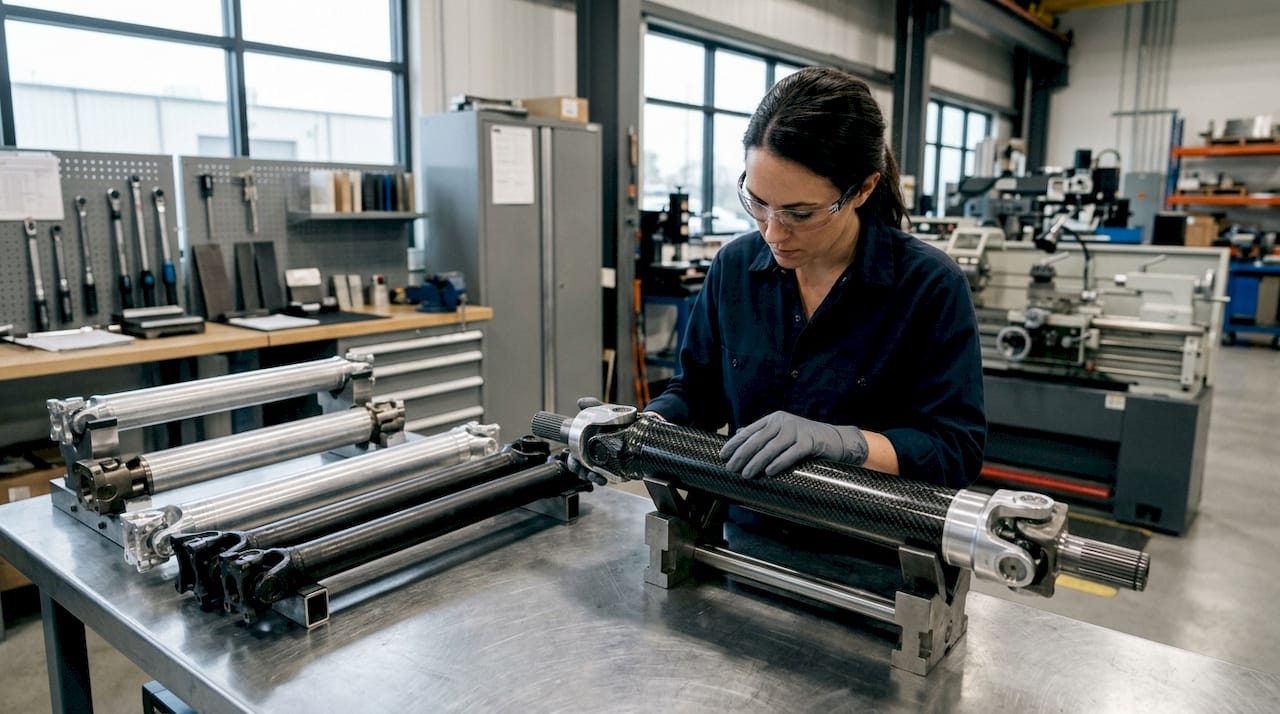
Material selection is the most consequential single decision in custom driveshaft design. Steel, aluminum, and carbon fiber each present distinct trade-offs in weight, stiffness, corrosion resistance, and damping capacity. Selecting the correct material for the application is not a preference. It is a performance specification.
| Material | Relative weight | Stiffness | Damping | Typical application |
|---|---|---|---|---|
| Steel (4130/4340) | High | High | Low | Heavy torque, low-speed industrial drives |
| Aluminum (6061/7075) | Medium | Medium | Medium | Weight-sensitive, moderate-speed systems |
| Carbon fiber composite | Low | Very high | High | High-speed, precision, or aerospace drives |
Carbon fiber shafts reduce rotating mass by 30 to 50% compared to steel equivalents. Reduced rotating mass lowers inertia, which directly improves acceleration response and reduces the load imposed on U-joints, CV joints, and support bearings during speed changes. For systems with frequent start-stop cycles or variable-speed drives, this translates to measurably longer joint service life.
Carbon fiber also provides superior vibration damping relative to steel, which matters in NVH-sensitive applications. However, fiber layup sequence and curing quality critically affect fatigue resistance and final strength. Specifying carbon fiber requires stringent supplier quality controls, including documented layup procedures and non-destructive inspection of finished tubes.
Pro Tip: For industrial washdown environments or outdoor installations, specify aluminum or carbon fiber tubes with anodized or epoxy-coated end fittings. Steel shafts in these environments require zinc plating or powder coating to achieve comparable corrosion resistance.
3. Precision measurement and dimensional fit
A custom driveshaft delivers its performance advantages only when specified to exact dimensional requirements. Incorrect length or slip-yoke clearance introduces interference under suspension travel or thermal expansion, which generates bending loads the shaft was not designed to carry.
Shaft length is measured from the transmission output shaft end to the centerline of the rear yoke U-joint, not from flange face to flange face. This distinction matters because it accounts for the actual working position of the slip yoke within the transmission tail housing. Slip-yoke clearance of 1/2 to 3/4 inch is the accepted standard for most automotive and light industrial configurations, though modified or specialized equipment may require different values.
The consequences of dimensional error are not minor. Poorly measured shafts increase vibration-related failure risk and can destroy transmission output seals, transfer case bearings, and differential pinion bearings. Rework costs and unplanned downtime from a single incorrect shaft specification routinely exceed the cost of the shaft itself.
Custom fit provides additional value in modified or non-standard equipment configurations:
- Lifted or lowered vehicle suspensions with altered driveline angles
- Extended-wheelbase industrial vehicles or specialty platforms
- Machinery with non-standard flange patterns or coupling interfaces
- Aerospace actuation systems with confined installation envelopes
- Synchronized multi-shaft drive systems requiring matched lengths
4. Dynamic balancing and runout control
Dynamic balancing is a manufacturing step, not an optional finishing process. High-speed shafts require balancing grades G6.3 or G2.5, with runout tolerances at or below 0.03 mm, to achieve smooth operation across the operating speed range. These grades define the maximum permissible residual imbalance per unit of rotor mass, and tighter grades directly reduce the vibration forces transmitted to bearings and connected structure.
Precision balancing reduces field vibration by 40% compared to prototype shafts without final dynamic balancing. That reduction translates to lower bearing temperatures, reduced fastener loosening, and extended seal life in connected gearboxes and differentials.
| Balancing grade | Max residual imbalance | Typical application |
|---|---|---|
| G6.3 | 6.3 g·mm/kg | General industrial drives, moderate speed |
| G2.5 | 2.5 g·mm/kg | High-speed shafts, precision machinery |
| G1.0 | 1.0 g·mm/kg | Aerospace, turbine-adjacent applications |
One critical limitation applies: balancing at a specific RPM does not guarantee vibration-free operation if system geometry or bearing clearances change after installation. Residual imbalance forces grow with the square of operating speed, so any post-installation change in bearing preload or alignment can reintroduce vibration even on a correctly balanced shaft. Custom manufacturing addresses this by specifying balancing conditions that match the installed operating state, not a generic test bench configuration.
Proper CNC machining, heat treatment, and profiling are prerequisites for achieving these balancing grades. A shaft with geometric errors introduced during machining cannot be corrected to G2.5 through balancing alone.
5. Joint and seal design for contamination resistance
Universal joints, CV joints, and slip yokes are the most contamination-sensitive elements in a driveshaft assembly. Grease degradation from water ingress, particulate contamination, or thermal cycling is the leading cause of joint failure in industrial and off-highway applications. Custom shaft assemblies allow the engineer to specify joint sealing systems matched to the operating environment rather than accepting the seal design built into a catalog component.
Key design choices available through custom specification:
- Triple-lip seals on U-joint bearing caps for washdown or submersion environments
- Grease-packed and permanently sealed joints for maintenance-free operation
- Stainless steel bearing caps for high-humidity or chemically aggressive environments
- Extended grease nipple configurations for joints in confined or hard-to-access locations
Zinc plating and powder coating protect steel tube and end fitting surfaces from moisture, salt, and chemical exposure. In industrial washdown conditions, uncoated steel shafts develop surface corrosion within months, which accelerates fatigue crack initiation at weld zones and press-fit interfaces. Specifying the correct surface treatment at the design stage eliminates this failure mode without adding significant cost.
Heat treatment of steel components, including induction hardening of slip yoke splines and yoke ears, increases surface hardness and wear resistance at the highest-stress contact zones. This is particularly relevant for shafts operating under high cyclic torque or frequent angular misalignment.
6. Tailored stiffness for NVH management
Driveline noise, vibration, and harshness (NVH) problems are not always resolved by geometry corrections alone. Tailoring shaft stiffness and dynamic properties addresses powertrain-induced NVH issues that persist after conventional alignment and balancing corrections. This is a capability unique to custom shaft design.
Torsional stiffness affects how the shaft transmits torque pulses from the power source to the driven load. A shaft that is too stiff transmits every torque pulse without attenuation, exciting resonances in connected gearboxes and housings. A shaft with controlled torsional compliance acts as a mechanical filter, attenuating high-frequency torque variations before they reach sensitive downstream components.
Tighter balancing grades reduce permissible residual imbalance, improving smoothness for high-speed or NVH-sensitive applications. Combined with material selection for damping and precise runout control, a custom shaft specification can resolve NVH problems that no amount of standard component substitution will fix. For optimizing shaft design in precision industrial machinery, this integrated approach is the standard practice at Biax-flexwellen.
Key takeaways
Custom drive shafts deliver measurable performance advantages through precise control of critical speed, material properties, dimensional fit, and dynamic balance, making them the correct specification for any demanding industrial or aerospace power transmission application.
| Point | Details |
|---|---|
| Critical speed margin | Design shaft geometry to keep critical speed 15 to 20% above maximum operating RPM. |
| Material selection | Carbon fiber reduces rotating mass by 30 to 50% and provides superior vibration damping versus steel. |
| Dimensional precision | Correct length and slip-yoke clearance prevent interference failures and protect connected drivetrain components. |
| Dynamic balancing | Grade G2.5 balancing with runout below 0.03 mm reduces field vibration by up to 40% versus unbalanced shafts. |
| Surface treatment | Zinc plating and powder coating are required specifications for steel shafts in corrosive or washdown environments. |
Why integrated design matters more than individual parameters
The most common mistake I observe in custom driveshaft specifications is treating each design parameter in isolation. An engineer specifies the correct material, then accepts a catalog balancing grade. Or the shaft is balanced correctly, but the installation length is measured from the wrong reference points and the slip yoke bottoms out under full suspension travel. Each parameter interacts with the others.
Vibration problems in particular are almost never caused by a single variable. A shaft that is correctly balanced but operates near its critical speed will still vibrate. A shaft with correct critical speed margin but poor runout control will transmit imbalance forces that shorten bearing life. The only way to capture the full benefits of custom drive shafts is to treat the shaft as a system component, specified in the context of the complete driveline geometry, operating speed range, torque profile, and environmental conditions.
The practical implication is that custom shaft projects require early collaboration between the design engineer and the shaft manufacturer. Waiting until the machine is assembled to specify the shaft means accepting whatever fits, which is the opposite of custom design. The manufacturers who deliver reliable results, including Biax-flexwellen for flexible shaft applications, engage at the design stage, not the procurement stage.
— Uli
Biax-flexwellen flexible shaft solutions for precision drives
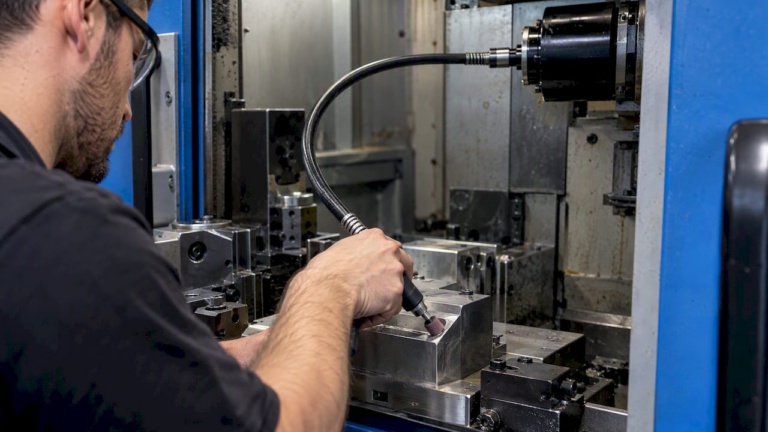
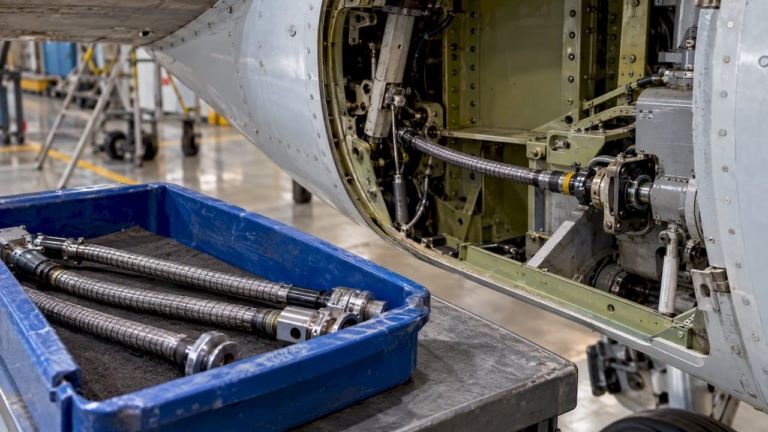
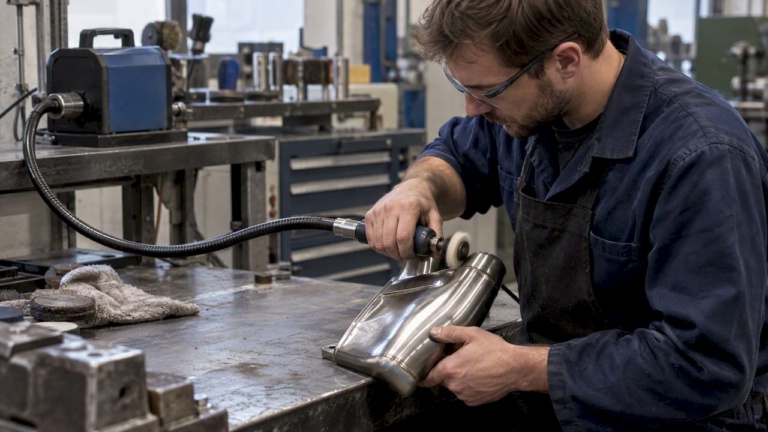
Biax-flexwellen designs and manufactures industrial flexible shafts for applications where rigid shaft geometry is not feasible, including deburring, grinding, polishing, and finishing processes in confined or hard-to-reach installations. Custom configurations cover torque and RPM requirements, coupling interfaces, protective sheath specifications, and shaft core design. For engineers evaluating flexible shaft applications in industrial manufacturing, Biax-flexwellen provides engineering guidance from initial specification through component selection. Custom flexible shaft solutions from Biax-flexwellen address vibration control, dimensional fit, and durability requirements in the same systematic way described throughout this article. Contact the Biax-flexwellen engineering team through the BIAX contact page to discuss your specific drive system requirements.
FAQ
What is the primary advantage of a custom drive shaft over a standard one?
A custom drive shaft is engineered to the exact dimensional, material, and balancing requirements of the application, which prevents vibration failures, interference fits, and premature component wear that standard catalog shafts cannot address.
How does critical speed affect custom driveshaft design?
Critical speed is the RPM at which a shaft enters bending resonance. Custom design sets tube diameter, material stiffness, and span length to keep critical speed 15 to 20% above the maximum operating RPM, preventing resonance-induced damage.
Which material is best for a high-speed industrial drive shaft?
Carbon fiber composite provides the highest strength-to-weight ratio and superior vibration damping, making it the preferred material for high-speed or NVH-sensitive applications. Steel remains the standard for heavy torque at lower speeds.
What balancing grade is required for precision industrial shafts?
High-speed and precision industrial shafts typically require balancing grade G2.5, with runout tolerances at or below 0.03 mm. Grade G6.3 is acceptable for general industrial drives at moderate operating speeds.
How does surface treatment extend custom driveshaft service life?
Zinc plating and powder coating prevent corrosion from moisture, salt, and chemical exposure, which is the primary cause of fatigue crack initiation at weld zones and press-fit interfaces on steel shafts in industrial environments.
Recommended
- Proven tips for optimizing shaft design for industrial efficiency
- Custom flexible shaft benefits: boost precision and reliability
- Industrial shaft applications: 40% longer shaft life
- Streamline your industrial drive solution workflow for precision
Related Topics
Send your spec inquiry
Custom flexible shafts for your application — we quote within 1 working day.