Benefits of Compact Drive Systems for Manufacturing Engineers
17 June 2026TL;DR:
- Compact drive systems combine motor, gearbox, and electronics into a single unit, significantly improving space efficiency and installation simplicity. They reduce wiring, mechanical interfaces, and failure points, enhancing energy efficiency and system reliability across manufacturing applications. Implementing these systems requires careful thermal management, EMI control, and system-level design considerations for optimal performance.
Compact drive systems are integrated assemblies that combine a motor, gearbox, and drive electronics into a single unit, delivering measurable gains in space efficiency, energy performance, and installation simplicity. For manufacturing engineers and automation decision-makers, the benefits of compact drive systems extend well beyond physical size reduction. They reshape how machines are wired, cooled, maintained, and scaled. Technologies from Elmo Motion Control, ATEK Drive Solutions, WITTENSTEIN, and Fraunhofer IZM demonstrate that the advantages of compact drive systems now reach into power density, EMI control, and system-level thermal management.
The industry term for these assemblies is integrated drive systems or integrated servo systems, though “compact drive systems” accurately describes the design philosophy. Both terms appear throughout this article.
What are the benefits of compact drive systems in manufacturing?
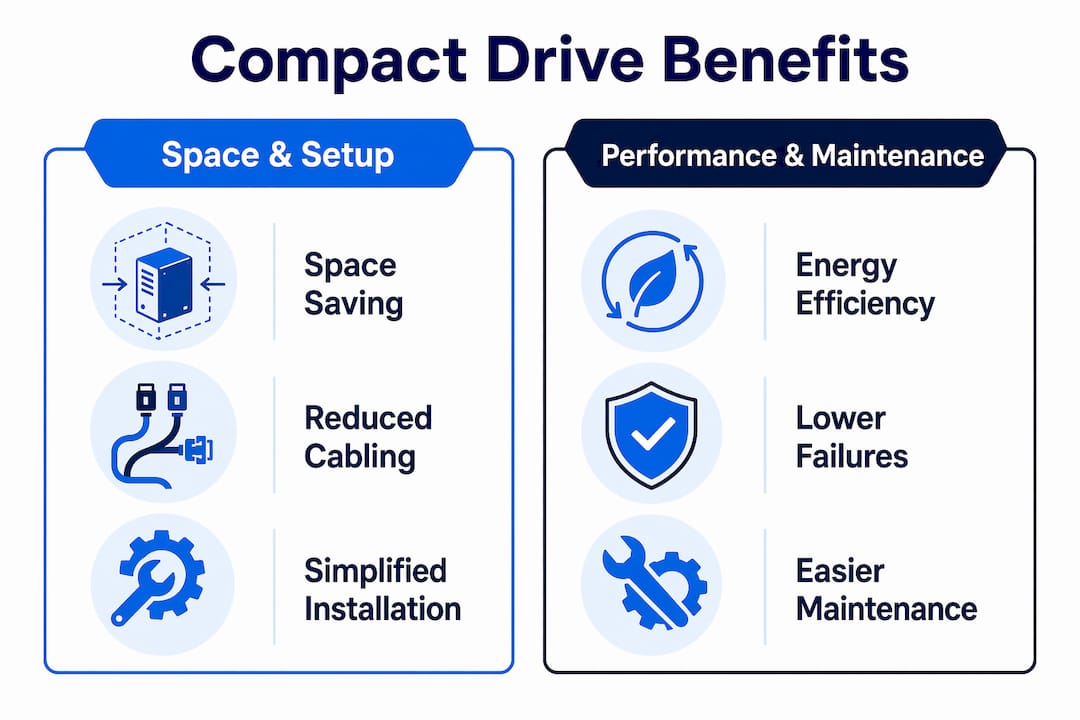
The primary benefits are space savings, reduced cabling complexity, lower energy losses, and simplified commissioning. Each advantage compounds the others. A smaller physical footprint frees floor space. Fewer cables reduce failure points. Tighter integration cuts energy losses at every coupling interface. The result is a machine that is easier to build, easier to maintain, and less expensive to operate over its service life.
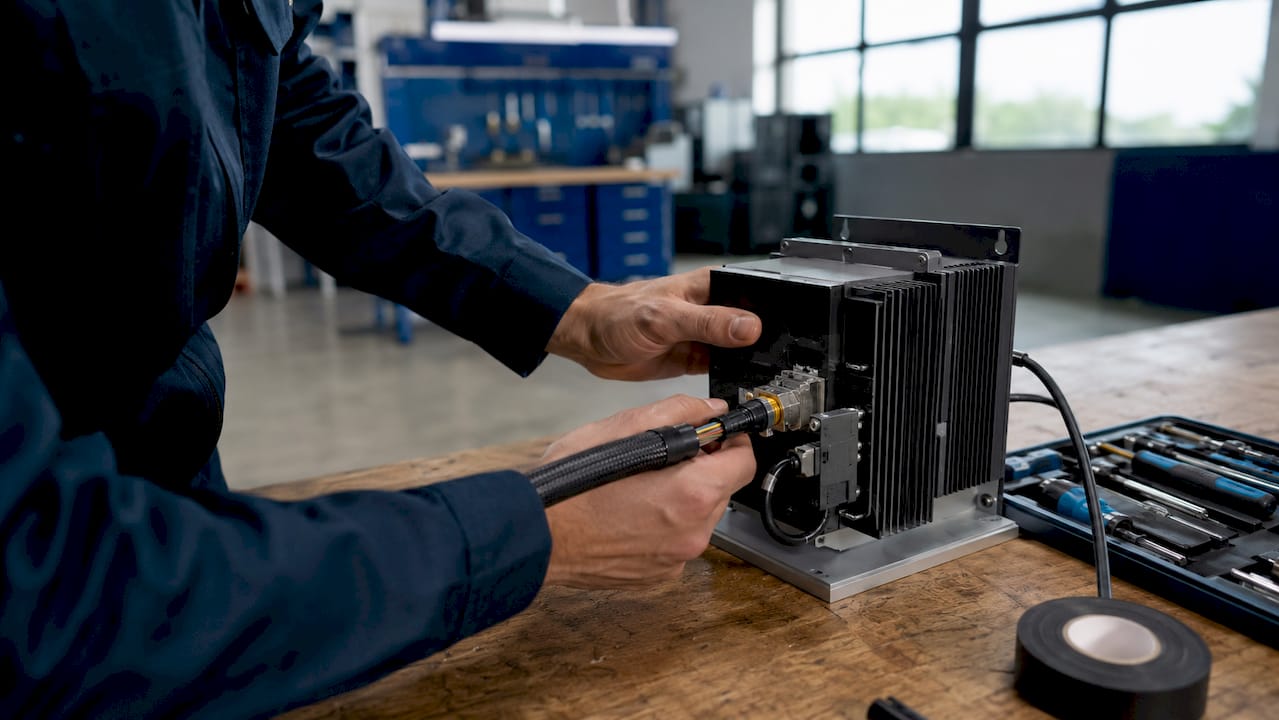
Traditional drive architectures separate the motor, gearbox, and drive controller into discrete components connected by external shafts, couplings, and cable harnesses. Each connection point introduces mechanical loss, potential failure, and installation labor. Integrated units eliminate most of these interfaces by design.
For engineers evaluating drive system components and their impact on energy consumption, the shift from distributed to integrated architecture is the most consequential design decision in modern machine building.
How do compact drive systems improve installation and maintenance?
Cabling complexity is the most immediate installation advantage. A traditional 4-axis machine requires eight continuous cables running between the cabinet and each motor. Integrated servo solutions reduce this to a single hybrid cable per axis through daisy-chaining of power and communication lines. That reduction cuts wiring labor, lowers the risk of connector damage, and shrinks the electrical cabinet or eliminates it entirely.
Smaller or absent electrical cabinets free significant factory floor space. In high-density manufacturing cells, this space directly translates to additional tooling, sensors, or process equipment. The savings are not marginal. Cabinet elimination removes a thermal load from the production environment and reduces the number of components requiring periodic inspection.
Fewer external connectors also change the failure profile of the machine. Drive system failures most commonly originate from cable damage rather than motor or drive electronics failure. Integrated actuators shift failure modes away from external cabling, improving uptime and reducing unplanned maintenance events.
Commissioning time decreases as well. Integrated units arrive pre-configured and tested as a system. The engineer connects power and communication, sets parameters, and the drive is operational. Distributed systems require individual calibration of each component and verification of every cable run.
Key installation advantages of compact drive systems:
- Single hybrid cable per axis replaces multiple discrete power and signal cables
- Cabinet elimination or reduction frees floor space and removes a thermal load
- Fewer connectors lower the probability of cable-related failures
- Pre-integrated units reduce commissioning time and parameter setup
- Simplified service access because fewer external components require periodic attention
Pro Tip: When specifying an integrated drive for a multi-axis cell, confirm that the daisy-chain communication protocol matches your motion controller’s native interface. Mismatched protocols require additional gateway hardware that partially offsets the cabling savings.
What efficiency gains do compact drive systems offer vs. traditional drives?
Energy losses in drive systems accumulate at every mechanical interface. External couplings, intermediate shafts, and misaligned gearbox flanges each dissipate power as heat. Integrated motor-gearbox units eliminate these interfaces through direct coupling, reducing total system losses and improving the CO2 balance of the entire conveyor or manufacturing line.
The quantitative impact is significant. Compact motor-gearbox units for conveyor applications reduce space requirements by 20–30%, and that spatial consolidation directly correlates with efficiency gains. Fewer mechanical interfaces mean less friction, less heat generation, and lower electricity consumption per unit of output.
Power electronics advances amplify these gains at the component level. Fraunhofer IZM has demonstrated 500 kW power density in a 1-liter inverter volume at 99% efficiency. That level of power density means high-performance drives no longer require large enclosures, enabling compact packaging without sacrificing output capability.
The table below compares key efficiency parameters between traditional distributed drive architectures and integrated compact systems:
| Parameter | Traditional Distributed Drive | Compact Integrated Drive |
|---|---|---|
| Mechanical coupling losses | Present at each interface | Eliminated by direct coupling |
| Cable length (inverter to motor) | Several meters | Millimeters to centimeters |
| Cabinet cooling requirement | Active cooling typically required | Machine frame dissipation sufficient |
| Space requirement (conveyor) | Baseline | 20–30% reduction |
| Failure points | Multiple (couplings, cables, connectors) | Significantly reduced |
System-level efficiency extends beyond the motor’s nameplate class. An IE3-rated motor paired with a poorly designed coupling and an oversized cabinet still underperforms a well-integrated compact unit with a lower-rated motor. System coupling losses relate as much to mechanical integration as to motor efficiency class. Engineers who evaluate only motor efficiency ratings miss the larger opportunity.
Pro Tip: Calculate total system efficiency from the power supply to the load shaft, not just the motor nameplate rating. A 20–30% space reduction in a conveyor system often signals a proportional reduction in total system losses.
What technical challenges arise with compact drive implementation?
Thermal management is the primary engineering constraint in compact drive design. When the drive electronics and motor share a single enclosure, heat dissipation requires deliberate design. Integrated servo drives address this by using the machine frame as a thermal mass, conducting heat away from the drive without active cabinet cooling. The drive controller monitors the system’s thermal state continuously and adjusts current limits in real time to prevent overheating.
This approach works well in machines with substantial metal frames and stable ambient temperatures. In environments with high ambient heat or limited frame mass, the engineer must account for thermal path resistance during the design phase. Ignoring this constraint leads to thermal throttling under load, which degrades performance and shortens component life.
EMI reduction is a less obvious but equally important advantage. Inverter-to-motor cable length shrinks from several meters to millimeters in integrated designs. The physics of high-frequency switching circuits dictates that shorter loop areas produce less radiated noise and fewer voltage spikes. Reduced EMI means less commissioning time spent on shielding, filtering, and troubleshooting interference issues.
Additional technical considerations for compact drive implementation:
- Sealing requirements increase because the drive electronics are now exposed to the machine environment rather than a protected cabinet
- Accessibility for service decreases as components are more tightly packaged; design for serviceability must be addressed at the specification stage
- Maintenance protocols change because fewer external shafts and lubricants in integrated units require redesigned cleaning and lubrication procedures
- Hygienic properties improve in food and pharmaceutical applications because sealed integrated units have fewer crevices that trap contamination
- Modularity requires planning because replacing a failed integrated unit means swapping the entire motor-drive assembly rather than individual components
The maintenance trade-off is real but manageable. Fewer external parts reduce routine maintenance frequency. When a failure does occur, the replacement unit is a complete assembly, which simplifies the repair process but increases the per-event parts cost.
Which applications benefit most from compact drive systems?
Compact drive technologies deliver the greatest advantage in applications where space, weight, and wiring complexity are primary constraints. The following use cases represent the clearest return on investment for engineers evaluating integrated drive adoption.
-
Automated Guided Vehicles (AGVs) and Autonomous Mobile Robots (AMRs). These platforms require ultra-compact, flat drive assemblies that fit within the vehicle chassis. WITTENSTEIN’s AGV drive systems integrate the gearbox directly into the wheel hub with single-sided connector arrangements, minimizing wiring harness complexity and enabling narrow vehicle profiles that navigate tight aisles.
-
Multi-axis robotic arms. A robotic arm requiring six servo drives benefits directly from six integrated actuators mounted at each joint. Integrated actuators in robotic arms reduce cabling and failure points significantly. Fewer cables mean fewer incidents of cable damage during high-cycle articulation, which is the dominant failure mode in industrial robot arms.
-
Conveyor belt systems. ATEK Drive Solutions demonstrates that integrated motor-gearbox units reduce conveyor drive space requirements by 20–30% while improving energy efficiency. The direct coupling eliminates intermediate shaft losses and simplifies the drive train to a single serviceable unit per conveyor zone.
-
Packaging and assembly machines. These machines operate in constrained envelopes with high cycle rates. Compact drive systems for automation in packaging lines reduce the machine footprint, lower cable routing complexity, and support faster format changeovers because fewer mechanical adjustments are required between product runs.
-
Industry 4.0 modular machine designs. Integrated drive units support modular machine architectures because each module carries its own drive intelligence. Adding or reconfiguring a module does not require rewiring the central cabinet. This architecture aligns with the benefits of flexible drive systems in manufacturing environments where product mix changes frequently.
Key takeaways
Compact drive systems deliver measurable gains in space, energy efficiency, and reliability by integrating motor, gearbox, and drive electronics into a single unit that reduces cabling, eliminates mechanical coupling losses, and simplifies commissioning.
| Point | Details |
|---|---|
| Cabling reduction | Integrated drives reduce a 4-axis machine from eight cables to a single hybrid cable per axis. |
| Energy efficiency | Direct motor-gearbox coupling eliminates interface losses; conveyor systems see 20–30% space and efficiency gains. |
| EMI and thermal control | Shorter inverter-to-motor distances reduce switching noise; machine frame dissipation replaces active cabinet cooling. |
| Application fit | AGVs, robotic arms, conveyors, and modular packaging machines gain the most from compact drive integration. |
| Maintenance trade-off | Fewer routine maintenance points reduce frequency; failed units require full assembly replacement rather than component repair. |
Why system-level thinking determines compact drive success
My experience working with machine builders across manufacturing and automation sectors consistently points to the same gap: engineers evaluate compact drives at the component level and miss the system-level gains. A drive’s power density specification matters far less than how its thermal path, EMI profile, and mechanical interface interact with the rest of the machine.
The engineers who get the most from integrated drive systems are the ones who map the entire signal and power chain before specifying a single component. They ask where heat goes, not just how much heat is generated. They calculate cable loop areas, not just cable counts. They design service access into the machine frame before the enclosure is finalized.
The reliability gains from reduced cabling are real and well-documented. But the gains from reduced EMI are often larger in practice because they eliminate weeks of commissioning troubleshooting that never appears in a component specification sheet. System-level thermal and electrical evaluation is the discipline that separates successful compact drive implementations from expensive retrofits.
The future direction is clear. Power electronics are pushing compact drive performance limits further every year. The 99% inverter efficiency at 500 kW per liter demonstrated by Fraunhofer IZM is not a laboratory curiosity. It is a signal that the performance ceiling for compact integrated drives has not been reached. Engineers who build familiarity with integrated drive architectures now will be better positioned as these technologies become standard in the next generation of manufacturing equipment.
— Uli
Flexible shaft solutions for compact drive integration
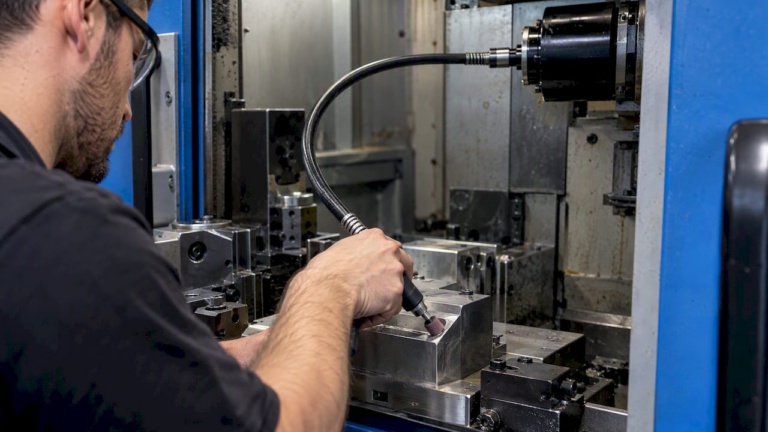
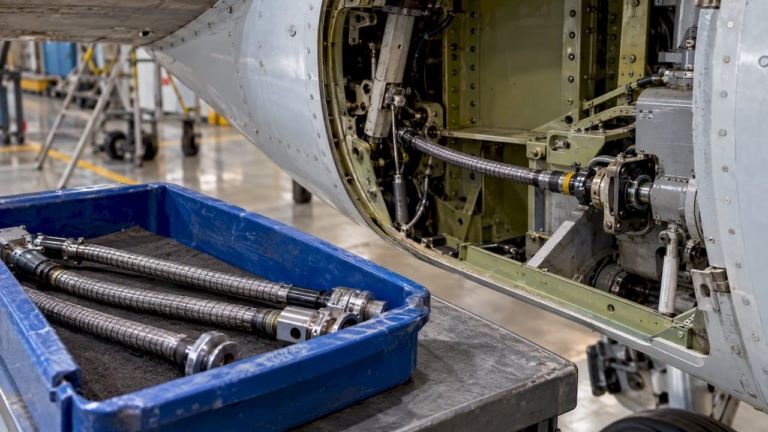
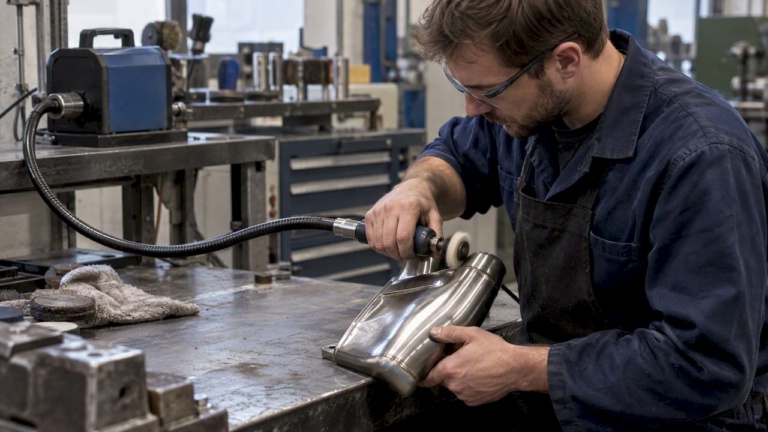
Biax-flexwellen designs and manufactures flexible shafts and drive components that complement compact drive architectures in manufacturing and finishing applications. Where integrated motor-drive units transmit torque to hard-to-reach or geometrically constrained work zones, flexible shafts provide the final mechanical link without requiring rigid alignment. This is particularly relevant in deburring, grinding, and polishing processes where the drive unit cannot be positioned directly at the tool. Biax-flexwellen supports machine builders with standard components and custom configurations matched to specific torque, RPM, and coupling interface requirements. Explore flexible shaft applications for industrial manufacturing, or review the shaft selection guide to identify the right configuration for your compact drive design.
FAQ
What is a compact drive system in manufacturing?
A compact drive system is an integrated assembly combining a motor, gearbox, and drive electronics in a single unit. It replaces the distributed architecture of separate components connected by external shafts, couplings, and cable harnesses.
How much cabling do integrated drive systems eliminate?
A traditional 4-axis machine requires eight continuous cables. Integrated servo systems reduce this to a single hybrid cable per axis through daisy-chained power and communication lines.
Do compact drive systems require active cooling?
Most integrated servo drives use the machine frame for thermal dissipation, eliminating the need for active cabinet cooling in standard operating conditions. The drive controller monitors thermal state and adjusts current limits in real time to prevent overheating.
Which industries use compact drive systems most?
AGV and AMR manufacturers, robotic arm builders, conveyor system designers, and packaging machine manufacturers are the primary adopters. Each application benefits from reduced wiring complexity and tighter spatial integration.
What maintenance changes come with compact integrated drives?
Fewer external shafts and lubricants simplify routine maintenance, but a failed unit requires full assembly replacement rather than individual component repair. Cleaning and lubrication protocols must be redesigned for enclosed integrated units to maintain reliability and hygiene.
Recommended
- Flexible Shaft Drive Solutions: Unlocking Compact Efficiency
- Benefits of flexible drive systems for manufacturing efficiency
- Flexible drive solutions for efficient industrial design
- Streamline your industrial drive solution workflow for precision
Related Topics
Send your spec inquiry
Custom flexible shafts for your application — we quote within 1 working day.