Shaft Design Considerations for Engineers: A Technical Guide
5 June 2026TL;DR:
- Effective shaft design requires analyzing strength, stiffness, fatigue resistance, and dynamic behavior from the outset to prevent failures.
- Doubling the shaft diameter exponentially reduces deflections and improves fatigue life, making size optimization crucial.
- In high-speed applications, full rotordynamic analysis surpasses simple critical speed estimates to prevent resonance-related failures.
Shaft design considerations for engineers are defined as the systematic evaluation of strength, stiffness, fatigue resistance, and dynamic behavior to achieve reliable rotational power transmission under combined loading conditions. A shaft that passes a static strength check can still fail in service if deflection misaligns bearings, torsional compliance introduces timing errors, or operating speed approaches a resonant frequency. The principal stresses acting on a shaft include torsional shear from transmitted torque, bending stress from radial loads, and axial stress from thrust. Each must be assessed individually and in combination, because shaft design requires balancing all three domains rather than sizing only by minimum diameter.
What mechanical stresses and loads must shaft design accommodate?
Shaft loading is rarely simple. Most industrial and aerospace shafts carry simultaneous torsion, bending, and axial loads, and the interaction between these stress states governs both static and fatigue performance.
Torsional shear stress arises from the torque transmitted between a driver and a driven component. It is distributed across the cross-section and reaches its maximum at the outer fiber. For solid circular shafts, the shear stress scales inversely with the cube of the diameter, so even modest diameter reductions produce significant stress increases.
Bending stress originates from radial loads applied by gears, pulleys, or belt drives. Unlike torsional stress, bending stress alternates in sign with each shaft revolution. This alternating character makes bending the primary driver of fatigue damage in most rotating shafts. Radial load magnitude and span between bearing supports both determine the peak bending moment.
Axial stress from thrust loads is present in helical gear drives, propeller shafts, and aerospace actuation systems such as thrust reverser mechanisms and flap drive shafts. Axial stress is typically smaller than bending or torsional stress but must be included in combined stress calculations.
When bending and torsion act simultaneously, the combined stress state is assessed using failure criteria appropriate to the material:
- Von Mises criterion applies to ductile steels and aluminum alloys under static combined loading. Von Mises stress is validated for ductile materials, and fatigue safety factors typically range from 1.5 to 3 depending on loading severity.
- Tresca criterion is more conservative and preferred when uncertainty in load definition is high.
- Goodman and Soderberg criteria extend fatigue assessment to combined mean and alternating stress states, accounting for the effect of mean torsional stress on fatigue life under alternating bending.
Fatigue is the dominant failure mode in rotating shafts. Cyclic bending stress, even at amplitudes well below the yield strength, initiates cracks at stress concentrations and propagates them to fracture. Fatigue analysis must therefore be integrated from the earliest design stage, not applied as a final check.
Pro Tip: When calculating combined stresses, always separate the mean and alternating components before applying Goodman or Soderberg. Applying these criteria to peak stress alone is a common error that produces unconservative safety factors.
How do deflection, stiffness, and critical speed affect shaft performance?
Many shaft failures stem more from deflection and vibration-induced misalignment than from material yielding. Stiffness and dynamic checks are therefore not secondary concerns. They are primary design constraints.
Bending deflection at gear or bearing locations causes misalignment that accelerates wear, increases noise, and reduces bearing life. Precision gear drives and synchronization shafts in aerospace flap actuation systems are particularly sensitive because angular misalignment at the mesh directly affects load distribution and fatigue life of gear teeth.
Torsional deflection introduces phase lag between the input and output ends of a shaft. In precision machinery and valve override systems where angular position must be controlled accurately, excessive torsional compliance produces timing errors that degrade functional performance.
Critical speed is the rotational frequency at which a shaft’s natural bending frequency coincides with the excitation frequency, producing resonance. At or near critical speed, deflection amplitudes grow rapidly and can cause catastrophic failure. The design rules for critical speed management follow a clear sequence:
- Calculate the first critical speed using the Rayleigh-Ritz method or finite element analysis, accounting for distributed mass and bearing stiffness.
- Target an operating speed below 75% of the first critical speed for subcritical operation. This margin accommodates manufacturing tolerances and load variability.
- For supercritical shafts, pass through the critical speed rapidly during run-up and verify that damping is sufficient to limit transient amplitudes.
- For high-speed or slender shafts, recognize that secondary critical speeds can fall within the operating range. Classical single-mode approximations are insufficient. Full rotordynamic analysis including multiple modes, damping, and bearing support stiffness is required.
- Verify bearing placement to minimize the unsupported span. Shorter spans raise the critical speed and reduce bending deflection simultaneously.
Design note: The length-to-diameter ratio is a primary lever for critical speed control. Reducing shaft length or increasing diameter both raise the first critical speed, but diameter increase has a disproportionately larger effect because bending stiffness scales with the fourth power of diameter.
Pro Tip: Never rely on a single critical speed estimate for shafts operating above 3,000 RPM. Commission a full rotordynamic analysis that includes gyroscopic effects and bearing cross-coupling terms. The cost of that analysis is negligible compared to the cost of a field failure.
What materials and geometric factors influence shaft design reliability?
Material selection and geometric detailing together determine whether a shaft meets its fatigue life and stiffness targets. Neither factor can be optimized in isolation.
Common shaft materials
| Material | Tensile Strength | Key Advantage | Primary Limitation |
|---|---|---|---|
| Medium carbon steel (e.g., AISI 1045) | 570-700 MPa | Low cost, good machinability | Moderate fatigue strength |
| Alloy steel (e.g., AISI 4340) | 900-1,100 MPa | High fatigue and torsional strength | Higher cost, heat treatment required |
| Stainless steel (e.g., 17-4 PH) | 930-1,170 MPa | Corrosion resistance | Lower fatigue limit than alloy steel |
| Aluminum alloy (e.g., 7075-T6) | 500-570 MPa | Low weight, good for high-speed shafts | No true fatigue limit |
| Titanium alloy (e.g., Ti-6Al-4V) | 900-1,100 MPa | High strength-to-weight ratio | High cost and manufacturing complexity |
Titanium alloys are specified in aerospace applications where weight is critical, such as actuation shafts in flight control systems. For most industrial machinery, alloy steels such as AISI 4340 provide the best balance of fatigue strength, machinability, and cost.
Geometric factors that govern fatigue and stiffness
Diameter is the single most influential geometric parameter. Doubling shaft diameter reduces bending deflection by a factor of 16 and torsional deflection by a factor of 32. This exponential relationship means that a modest diameter increase late in the design process can resolve deflection problems more effectively than repositioning bearings or shortening the shaft.
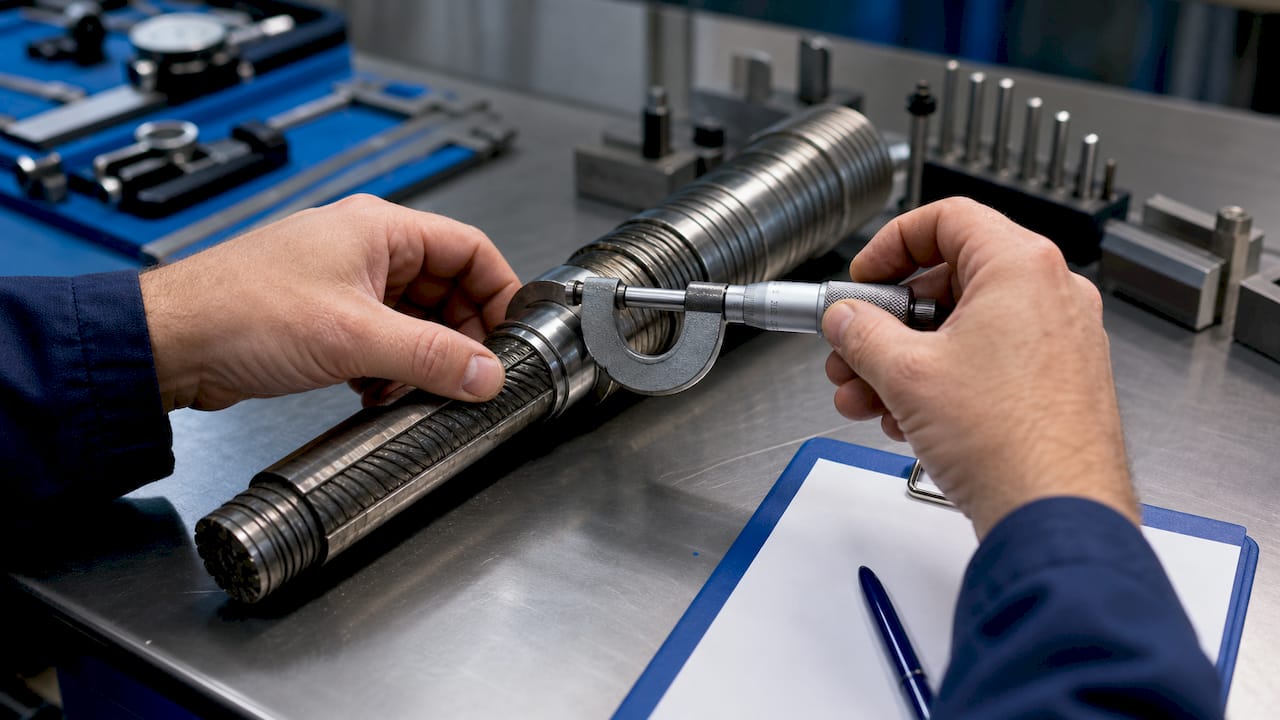
Stepped diameters are necessary to locate components axially and provide bearing seats, but each diameter transition creates a stress concentration. The severity of that concentration depends directly on the fillet radius at the step. Stress concentration factors at geometric discontinuities are empirically derived and incorporated into fatigue calculations to prevent crack initiation. The practical rule is to maximize fillet radii at every step while respecting the geometric constraints of adjacent components.
Key considerations for geometric detailing include:
- Fillet radii at diameter steps: Use the largest radius the component geometry permits. A radius-to-diameter ratio of 0.1 or greater reduces the stress concentration factor substantially.
- Keyway geometry: Keyways are among the most severe stress risers on a shaft. Keyway contact pressure and deformation can be modeled using DIN 6892 Method B to quantify critical volume thresholds and maintain minimum load capacity. End-milled keyways produce higher stress concentrations than sled-runner keyways and should be avoided in high-fatigue applications.
- Surface finish at bearing seats: A ground finish (Ra 0.4 to 0.8 µm) is standard for bearing seats. Rougher surfaces reduce the effective fatigue limit and can cause fretting under the bearing inner race.
- Fit tolerances: Interference fits at bearing seats introduce residual hoop stress that can reduce fatigue life if not accounted for in the stress analysis.
What best practices optimize shaft design for fatigue resistance and dynamic stability?
Effective shaft design integrates fatigue and dynamic considerations from the first iteration, not as corrections applied after geometry is fixed. The following practices define the standard of care for optimizing shaft design in industrial and aerospace applications.
- Size for deflection first, then verify strength. In most shafts, the stiffness requirement governs the minimum diameter. Sizing for deflection and then checking stress is more efficient than the reverse sequence and typically produces a more conservative result.
- Apply generous fillet radii at all stress concentration sites. This applies to diameter steps, keyway ends, and thread runouts. The fatigue strength reduction factor decreases significantly as fillet radius increases relative to shaft diameter.
- Specify shot peening on high-stress surfaces. Shot peening introduces compressive residual stress at the surface, where fatigue cracks initiate. Optimizing structural parameters through design changes and surface treatment has been shown to reduce axial displacement by 9.5%, overturning angle by 8.6%, and contact stress by 3.5% in turbine bearing systems. These are measurable improvements in fatigue reliability.
- Space bearings to minimize bending moments. Bearing placement determines the bending moment diagram. Supports positioned close to high radial loads reduce peak bending stress and shaft deflection simultaneously. Where misalignment is unavoidable, self-aligning spherical roller bearings accommodate angular error without transmitting bending moments into the shaft.
- Avoid keyways in high-bending zones. Place keyways in regions of low bending stress where possible. If a keyway must be located in a high-stress zone, use a sled-runner profile and specify a generous corner radius.
- Iterate diameter and length together. A shaft that is too long relative to its diameter will have a low critical speed and high deflection. Shortening the span between supports or increasing diameter are the two most direct corrective actions.
Pro Tip: Run a combined fatigue and deflection check at the end of each design iteration before committing to a diameter. Changing diameter by even 2 to 3 mm at the concept stage costs nothing. The same change after tooling is ordered costs significantly more.
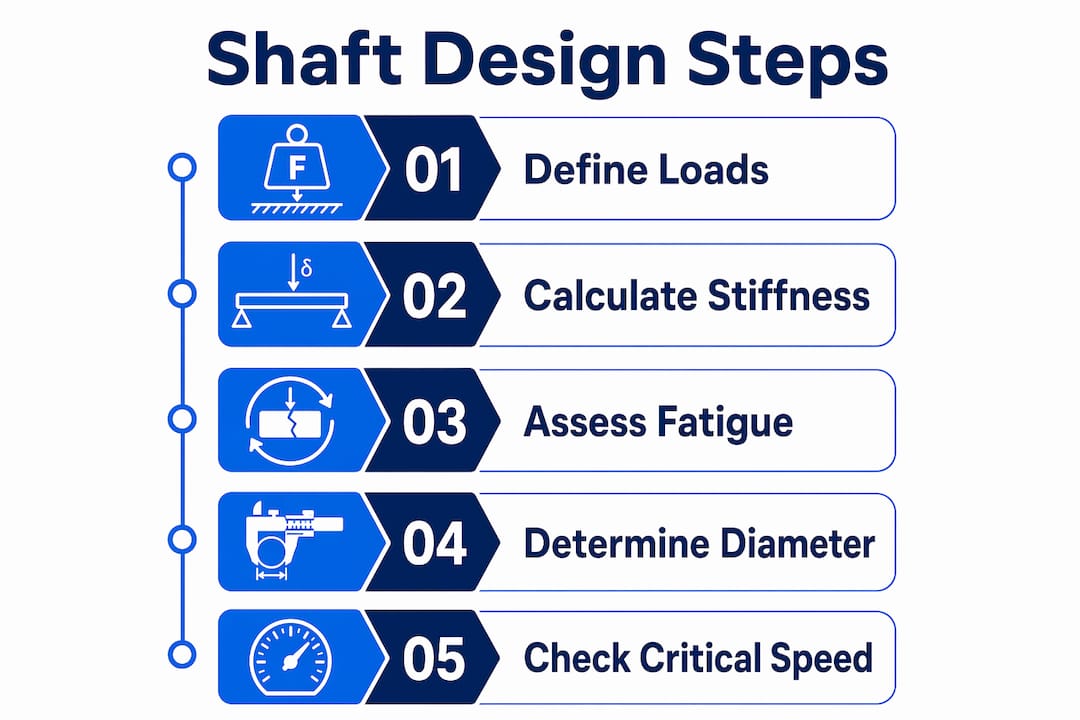
For precision applications where angular position accuracy matters, the step-by-step shaft design process for torsional stiffness verification should be completed before finalizing shaft length and coupling interface geometry.
Key takeaways
Shaft design reliability depends on integrating stiffness, fatigue, and dynamic analysis from the first design iteration rather than treating them as sequential checks.
| Point | Details |
|---|---|
| Size for stiffness first | Deflection governs minimum diameter in most shafts; strength checks follow geometry, not the reverse. |
| Diameter has exponential effect | Doubling diameter reduces bending deflection 16x and torsional deflection 32x, making it the most efficient design lever. |
| Operate below 75% of critical speed | Subcritical operation with a 25% margin protects against resonance from load variability and manufacturing tolerances. |
| Minimize stress concentrations | Generous fillet radii, sled-runner keyways, and ground surface finishes at bearing seats directly improve fatigue life. |
| Integrate fatigue from the start | Applying Goodman or Soderberg criteria at the concept stage prevents late-stage redesign driven by fatigue failures. |
Why small details in shaft design have outsized consequences
Working with shaft design across industrial and aerospace applications, the pattern that appears most consistently is this: engineers spend significant effort on torque and bending calculations, then treat geometric detailing as a drafting task. That sequence produces failures.
The fillet radius at a diameter step is not a drafting detail. It is a fatigue design parameter. A fillet radius that is 0.5 mm smaller than the optimum can increase the stress concentration factor by 20 to 30 percent, which translates directly into reduced fatigue life. The same logic applies to keyway profiles, surface finish specifications, and bearing fit tolerances. Each of these is a stress variable, not a manufacturing preference.
The second pattern worth noting is overconfidence in single-mode critical speed estimates. The Rayleigh-Ritz approximation is a useful first check, but rotordynamics for high-speed shafts requires accounting for multiple critical speeds, damping, and bearing support characteristics to avoid resonance phenomena that classical approximations do not capture. Shafts in aerospace actuation systems, high-speed spindles, and turbomachinery all fall into this category. A full rotordynamic model is not optional for these applications.
The third observation is that integrative design approaches combining fatigue, vibration, and stiffness optimization yield measurable improvements in shaft life and reliability. The engineers who achieve the best outcomes treat these three domains as a single coupled problem from the first sketch, not as three separate analyses performed in sequence.
— Uli
How Biax-flexwellen supports complex shaft design challenges
When rigid shaft geometry cannot satisfy space, alignment, or vibration constraints, flexible shaft solutions offer a direct alternative. Biax-flexwellen designs and manufactures industrial flexible shafts that transmit torque and rotation through confined or offset installation paths, including applications in deburring, grinding, polishing, and finishing equipment where rigid shaft runs are impractical.
Flexible shafts from Biax-flexwellen accommodate angular misalignment without transmitting bending moments into connected components, which reduces bearing load and extends service life. For machine builders and industrial manufacturers working through complex shafting configurations, flexible shafts improve machine design efficiency by decoupling the drive axis from the tool axis. Custom configurations covering torque and RPM requirements, coupling interfaces, and protective sheath specifications are available through direct engineering consultation.
Contact Biax-flexwellen to discuss your shaft configuration requirements.
FAQ
What are the primary shaft design considerations for engineers?
Shaft design considerations include torsional and bending stress under combined loading, deflection limits at bearing and gear locations, fatigue life under cyclic loading, critical speed margins, material selection, and geometric detailing at stress concentration sites such as keyways and diameter steps.
How does shaft diameter affect stiffness and fatigue life?
Doubling shaft diameter reduces bending deflection by 16 times and torsional deflection by 32 times. Larger diameters also reduce surface stress, which directly improves fatigue life by lowering the stress amplitude at crack initiation sites.
What is the recommended operating speed relative to critical speed?
Operating speed should remain below 75% of the first critical speed to maintain a safe margin against resonance. High-speed or slender shafts require full rotordynamic analysis because secondary critical speeds can fall within the operating range.
How do keyways affect shaft fatigue performance?
Keyways are significant stress risers. End-milled keyways produce higher stress concentration factors than sled-runner profiles. DIN 6892 Method B provides a framework for quantifying keyway contact pressure and critical volume thresholds to reduce fatigue failure risk.
Which failure criteria apply to shafts under combined loading?
Von Mises criterion applies to ductile materials under static combined bending and torsion. For fatigue assessment, Goodman and Soderberg criteria account for mean and alternating stress components, with safety factors typically ranging from 1.5 to 3 depending on load severity and application criticality.
Recommended
- Proven tips for optimizing shaft design for industrial efficiency
- Step by Step Shaft Design for Precision Applications
- Engineering standards for flexible shafts: a practical guide – BIAX Flexwellen
- Flexible shaft guide: Engineering compact drive solutions
Related Topics
Send your spec inquiry
Custom flexible shafts for your application — we quote within 1 working day.